Bioproducts and Biosystems Engineering, University of Minnesotagrid.17635.36, St. Paul, Minnesota, USA.
Environmental Molecular Science Laboratory, Pacific Northwest National Laboratorygrid.451303.0, Richland, Washington, USA.
Appl Environ Microbiol. 2022 Apr 26;88(8):e0018822. doi: 10.1128/aem.00188-22. Epub 2022 Mar 29.
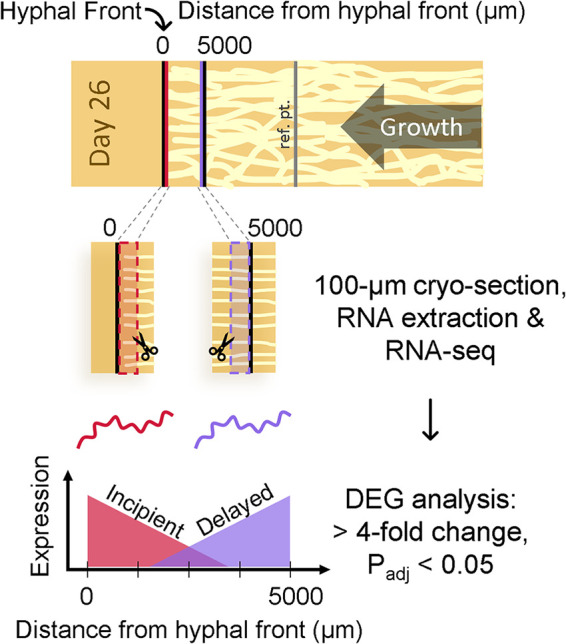
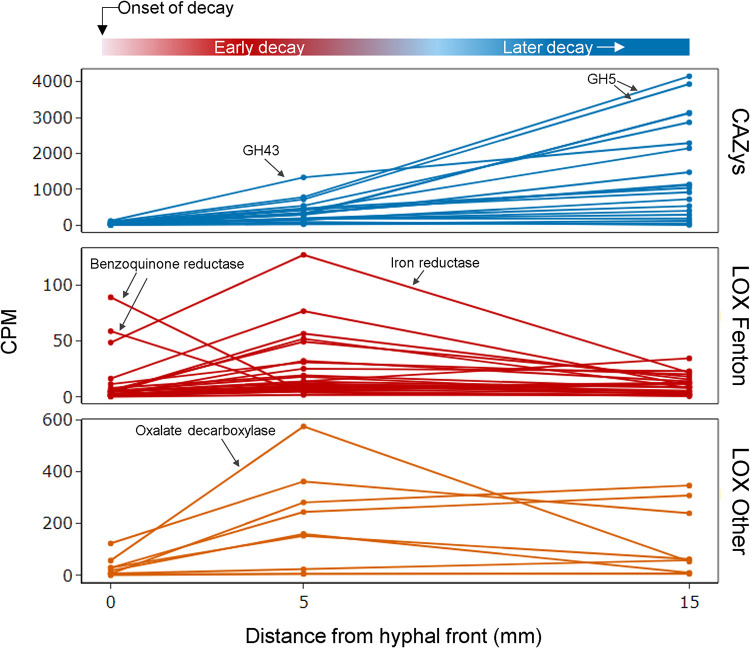
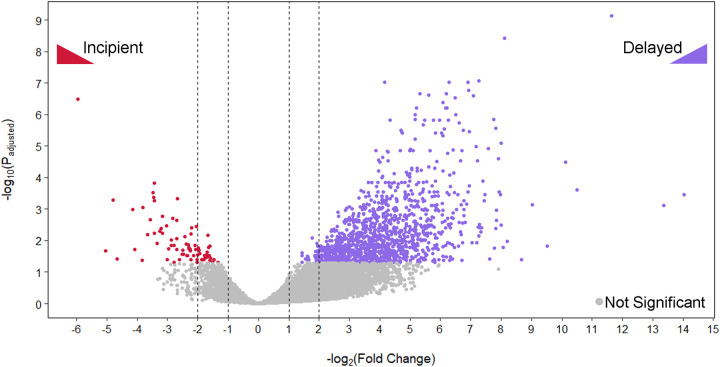
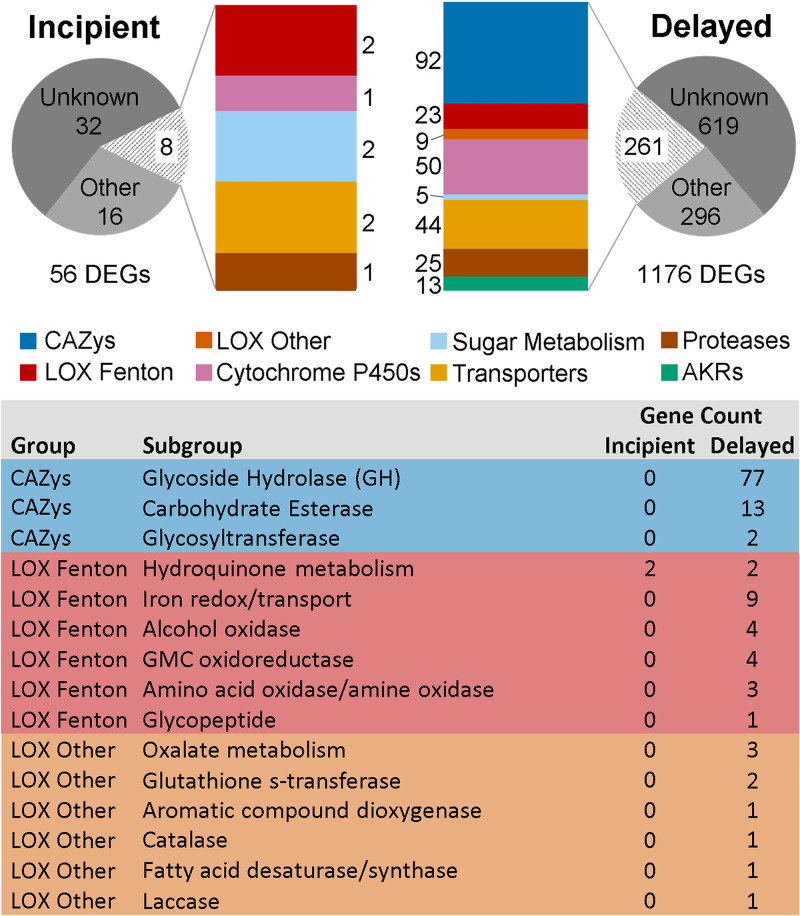
Brown rot fungi dominate wood decomposition in coniferous forests, and their carbohydrate-selective mechanisms are of commercial interest. Brown rot was recently described as a two-step, sequential mechanism orchestrated by fungi using differentially expressed genes (DEGs) and consisting of oxidation via reactive oxygen species (ROS) followed by enzymatic saccharification. There have been indications, however, that the initial oxidation step itself might require induction. To capture this early gene regulation event, here, we integrated fine-scale cryosectioning with whole-transcriptome sequencing to dissect gene expression at the single-hyphal-cell scale (tens of micrometers). This improved the spatial resolution 50-fold, relative to previous work, and we were able to capture the activity of the first 100 μm of hyphal front growth by Rhodonia placenta in aspen wood. This early decay period was dominated by delayed gene expression patterns as the fungus ramped up its mechanism. These delayed DEGs included many genes implicated in ROS pathways (lignocellulose oxidation [LOX]) that were previously and incorrectly assumed to be constitutively expressed. These delayed DEGs, which include those with and without predicted functions, also create a focused subset of target genes for functional genomics. However, this delayed pattern was not universal, with a few genes being upregulated immediately at the hyphal front. Most notably, this included a gene commonly implicated in hydroquinone and iron redox cycling: benzoquinone reductase. Earth's aboveground terrestrial biomass is primarily wood, and fungi dominate wood decomposition. Here, we studied these fungal pathways in a common "brown rot"-type fungus, , that selectively extracts sugars from carbohydrates embedded within wood lignin. Using a space-for-time design to map fungal gene expression at the extreme hyphal front in wood, we made two discoveries. First, we found that many genes long assumed to be "on" (constitutively expressed) from the very beginning of decay were instead "off" before being upregulated, when mapped (via transcriptome sequencing [RNA-seq]) at a high resolution. Second, we found that the gene encoding benzoquinone reductase was "on" in incipient decay and quickly downregulated, implying a key role in "kick-starting" brown rot.
棕腐真菌在针叶林中主导着木材的分解,其碳水化合物选择机制具有商业价值。最近,棕腐被描述为一个两步连续的机制,由真菌使用差异表达基因(DEGs)来协调,包括通过活性氧(ROS)进行氧化,然后进行酶促糖化。然而,有迹象表明,最初的氧化步骤本身可能需要诱导。为了捕捉这一早期基因调控事件,我们在这里将精细的冷冻切片与全转录组测序相结合,在单细胞水平(数十微米)剖析基因表达。这将空间分辨率提高了 50 倍,相对于之前的工作,我们能够捕捉到 Rhodonia placenta 在白杨木中菌丝前沿生长的前 100 μm 的活性。在这个早期的腐烂阶段,真菌启动其机制时,基因表达模式延迟,这占据主导地位。这些延迟的 DEGs 包括许多与 ROS 途径(木质纤维素氧化[LOX])相关的基因,这些基因之前被错误地认为是组成型表达的。这些延迟的 DEGs,包括那些具有和不具有预测功能的基因,也为功能基因组学创造了一个集中的目标基因子集。然而,这种延迟模式并非普遍存在,有几个基因在菌丝前沿立即上调。最值得注意的是,其中包括一个通常与对苯二酚和铁氧化还原循环有关的基因:苯醌还原酶。地球的地上陆地生物量主要是木材,真菌主导着木材的分解。在这里,我们研究了这种常见的“棕腐”型真菌中的这些真菌途径,它选择性地从嵌入木质素的碳水化合物中提取糖。我们使用时空设计在木材的极端菌丝前沿映射真菌基因表达,发现了两个发现。首先,我们发现许多长期以来被认为从腐烂一开始就“开启”(组成型表达)的基因,在被上调之前实际上是“关闭”的,这是通过高分辨率的转录组测序(RNA-seq)映射得到的。其次,我们发现编码苯醌还原酶的基因在初期腐烂时就“开启”,并迅速下调,这表明它在“启动”棕腐中起着关键作用。