Sanna Francesca, Locatelli Francesca, Sly Peter D, White Elisha, Blake David, Heyworth Jane, Hall Graham L, Foong Rachel E
Wal-yan Respiratory Centre, Children's Lung Health, Telethon Kids Institute, Nedlands, WA, Australia.
Unit of Epidemiology and Medical Statistics, Dept of Diagnostic and Public Health, University of Verona, Verona, Italy.
ERJ Open Res. 2022 Mar 21;8(1). doi: 10.1183/23120541.00072-2022. eCollection 2022 Jan.
There is growing evidence that lung function in early-life predicts later lung function. Adverse events over the lifespan might influence an individual's lung function trajectory, resulting in poor respiratory health. The aim of this study is to identify early-life risk factors and their impact on lung function trajectories to prevent long-term lung impairments.
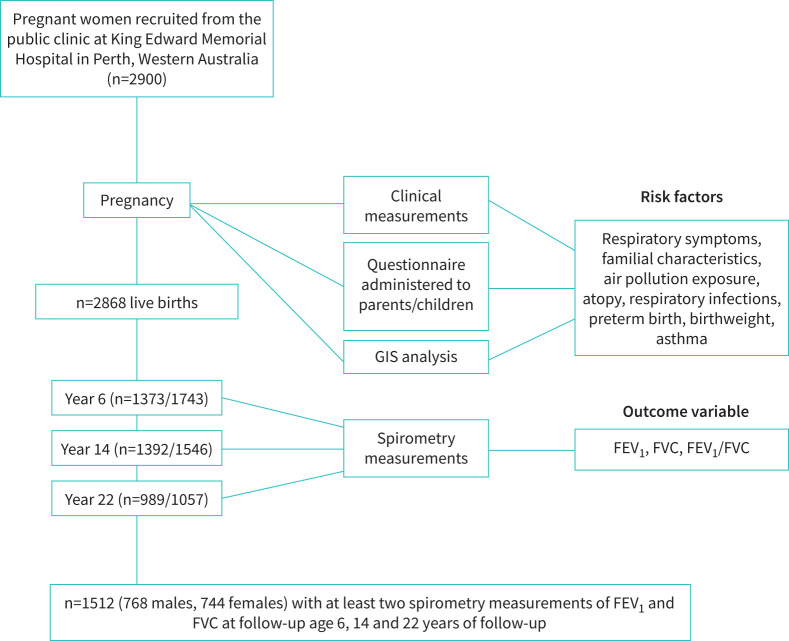
Our study included participants from the Raine Study, a prospective pregnancy cohort, with at least two spirometry measurements. Lung function trajectories from the 6- to 22-year follow-ups were characterised using finite mixture modelling. Multinomial logistic regression analyses were used to evaluate the association between early-life predictors and lung function trajectories.
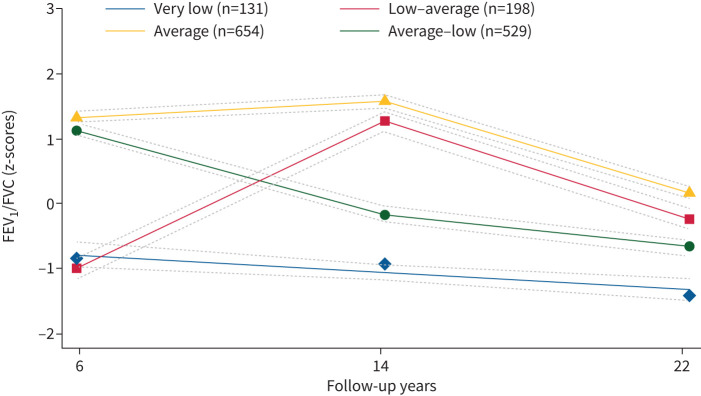
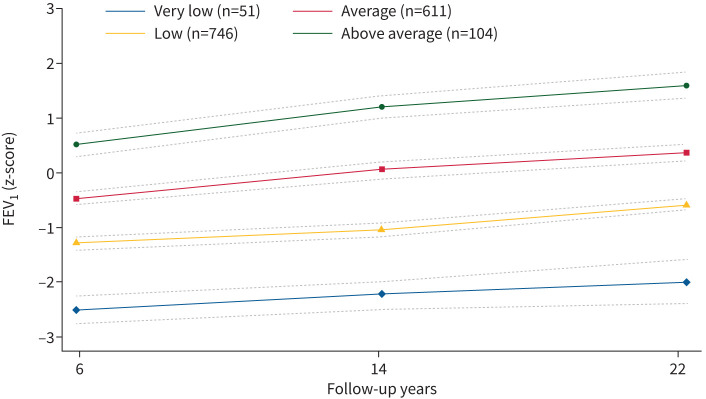
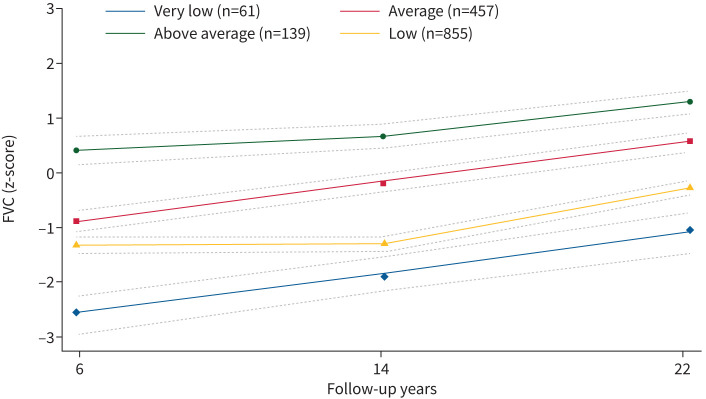
A total of 1512 participants (768 males, 744 females), representing 53% of the whole cohort, were included in this analysis. Four lung function trajectories of forced expiratory volume in 1 s (FEV), forced vital capacity (FVC) and FEV/FVC (z-scores) were identified. FEV and FVC trajectories were categorised as: "very low", "low", "average" and "above average", respectively. Based on their shape, lung function trajectories of FEV/FVC were categorised as "very low", "low-average", "average-low" and "average". Asthma and maternal smoking were identified as risk factors for low lung function trajectories in this cohort, as well as early-life exposure to PM.
Early-life risk factors may influence lung function trajectories over time. Nonetheless, identifying children with a high risk of having low lung function trajectories should be prioritised to prevent deficits in later life.
越来越多的证据表明,生命早期的肺功能可预测后期的肺功能。一生中的不良事件可能会影响个体的肺功能轨迹,导致呼吸健康状况不佳。本研究的目的是确定生命早期的风险因素及其对肺功能轨迹的影响,以预防长期的肺损伤。
我们的研究纳入了来自Raine研究(一项前瞻性妊娠队列研究)的参与者,这些参与者至少有两次肺活量测定。使用有限混合模型对6至22年随访期间的肺功能轨迹进行了特征描述。采用多项逻辑回归分析来评估生命早期预测因素与肺功能轨迹之间的关联。
本分析纳入了总共1512名参与者(768名男性,744名女性),占整个队列的53%。确定了1秒用力呼气量(FEV)、用力肺活量(FVC)和FEV/FVC(z分数)的四种肺功能轨迹。FEV和FVC轨迹分别被分类为:“非常低”、“低”、“平均”和“高于平均”。基于其形状,FEV/FVC的肺功能轨迹被分类为“非常低”、“低-平均”、“平均-低”和“平均”。哮喘和母亲吸烟被确定为该队列中肺功能轨迹低的风险因素,以及生命早期暴露于颗粒物。
生命早期的风险因素可能会随着时间的推移影响肺功能轨迹。尽管如此,应优先识别肺功能轨迹低风险高的儿童,以预防后期生活中的缺陷。