Zhu Ning, Lin Shanhong, Dai Luyan, Yu Hang, Xu Ning, Huang Weina, Yu Xiaopin
Department of Respiratory and Critical Care Medicine, Ningbo First Hospital, Ningbo, China.
Department of Ultrasound, Ningbo First Hospital, Ningbo, China.
Tob Induc Dis. 2022 Mar 14;20:29. doi: 10.18332/tid/145993. eCollection 2022.
This study aimed to explore the efficacy of abrupt and gradual smoking cessation with pre-cessation varenicline therapy.
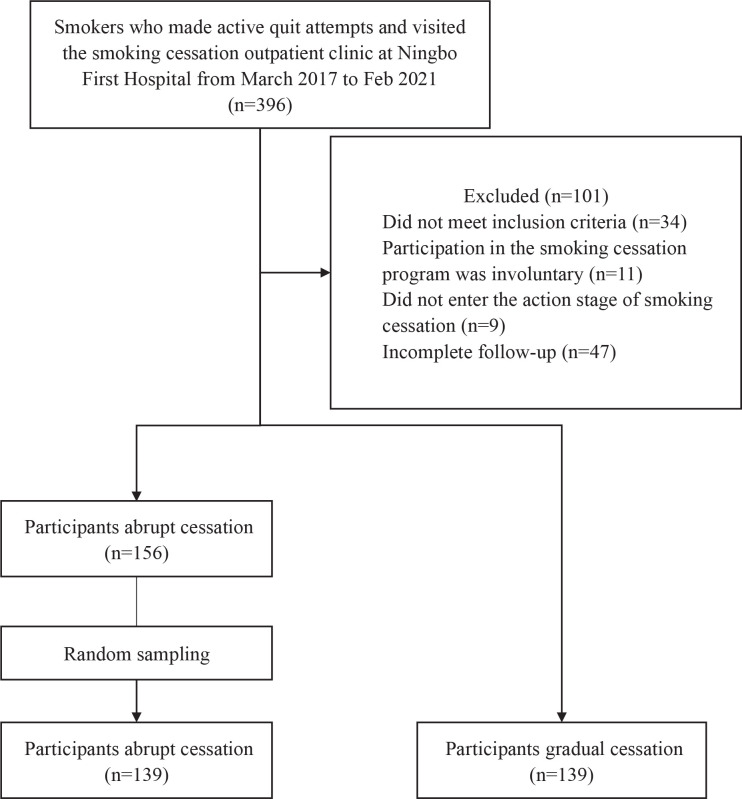
A total of 278 smokers who experienced moderate-to-severe nicotine dependence and visited a Chinese smoking cessation outpatient clinic from March 2017 to February 2021 were enrolled. This was a retrospective, observational, cohort study. Participants were divided into two groups by the cessation strategy they received: the abrupt cessation group (n=139, tobacco was not controlled during the first 3 weeks before the target cessation date and smoking was entirely discontinued on the 22nd day) and the gradual cessation group (n=139, tobacco was gradually reduced in the first 3 weeks before the target cessation date and smoking was discontinued on the 22nd day). The abstinence rates were compared between groups (7-day point prevalence abstinence rates at 1, 3 and 6 months post-treatment; and 1-month and 3-month continuous abstinence rates of 6-month follow-up). Possible factors that influence efficacy, reasons for smoking cessation failure, and associated adverse events were also analyzed.
No significant difference in the 7-day point prevalence abstinence rates at 1, 3 and 6 months post-treatment was observed between the groups (p>0.05). The 1-month continuous abstinence rate of the gradual cessation group was higher than that of the abrupt cessation group (51.1% vs 31.7%; χ=10.812, p=0.001). The 3-month continuous abstinence rate of the gradual cessation group was also higher than that of the abrupt cessation group (42.4% vs 27.3%; χ=6.983, p=0.008). Abrupt cessation was a risk factor for successful smoking cessation than gradual cessation (AOR=2.39; 95% CI: 1.15-3.85, p=0.013),the motivation of 'prevention and treatment of own diseases' reduced the risk of incomplete abstinence (AOR=0.87; 95% CI: 0.38-0.99, p=0.049). The incidence of adverse events was higher in the abrupt cessation group than in the gradual cessation group. The incidence rates of nausea and insomnia were statistically significant differences.
Compared with abrupt cessation, gradual smoking cessation with pre-cessation varenicline therapy produced higher abstinence rates and relatively milder withdrawal symptoms.
本研究旨在探讨在戒烟前使用伐尼克兰治疗时突然戒烟和逐渐戒烟的疗效。
纳入2017年3月至2021年2月期间在一家中国戒烟门诊就诊的278名中重度尼古丁依赖吸烟者。这是一项回顾性观察队列研究。根据参与者接受的戒烟策略将其分为两组:突然戒烟组(n = 139,在目标戒烟日期前的前3周不控制吸烟,并在第22天完全戒烟)和逐渐戒烟组(n = 139,在目标戒烟日期前的前3周逐渐减少吸烟量,并在第22天戒烟)。比较两组的戒烟率(治疗后1、3和6个月的7天时间点患病率戒烟率;以及6个月随访时的1个月和3个月持续戒烟率)。还分析了可能影响疗效的因素、戒烟失败的原因以及相关不良事件。
两组在治疗后1、3和6个月的7天时间点患病率戒烟率上未观察到显著差异(p>0.05)。逐渐戒烟组的1个月持续戒烟率高于突然戒烟组(51.1%对31.7%;χ=10.812,p = 0.001)。逐渐戒烟组的3个月持续戒烟率也高于突然戒烟组(42.4%对27.3%;χ=6.983,p = 0.008)。与逐渐戒烟相比,突然戒烟是戒烟成功的一个危险因素(比值比=2.39;95%置信区间:1.15 - 3.85,p = 0.013),“防治自身疾病”的动机降低了不完全戒烟的风险(比值比=0.87;95%置信区间:0.38 - 0.99,p = 0.049)。突然戒烟组的不良事件发生率高于逐渐戒烟组。恶心和失眠的发生率有统计学显著差异。
与突然戒烟相比,在戒烟前使用伐尼克兰治疗的逐渐戒烟产生了更高的戒烟率和相对较轻的戒断症状。