Department of Otolaryngology-Head and Neck Surgery, St. Vincent's Hospital, College of Medicine, The Catholic University of Korea, Suwon-si, Republic of Korea.
Department of Epidemiology, Fay W. Boozman College of Public Health, University of Arkansas for Medical Sciences, Little Rock, AR, USA.
BMC Cancer. 2022 Mar 29;22(1):345. doi: 10.1186/s12885-022-09403-9.
Although cigarette smoking is the most significant risk factor for laryngeal cancer, other risk factors might also be associated with the development of laryngeal cancer. We investigated whether underweight and type 2 diabetes are associated with laryngeal cancer in a Korean population.
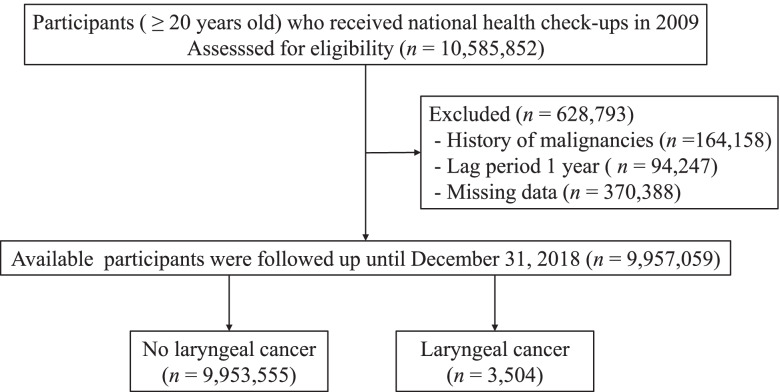
A total of 9,957,059 participants (≥20 years) without prior history of cancer who underwent a National Health Insurance Service health checkup in 2009 were followed up until December 31, 2018. Newly diagnosed laryngeal cancer was identified using claim data, and underweight was defined as body mass index (BMI) < 18.5 kg/m. A Cox proportional-hazards models with multivariable adjustment were used to estimate hazard ratios (HRs) and corresponding 95% confidence intervals (95% CIs).
During the median follow-up period of 8.3 years, 3504 cases of laryngeal cancer occurred. Underweight was associated with increased risk of laryngeal cancer after adjusting for potential confounders (HR: 1.43, 95% CI: 1.22-1.69) compared to those who were not underweight. Underweight and type 2 diabetes were synergistically associated with higher risk of laryngeal cancer (HR: 2.33, 95% CI: 1.54-3.51), compared to those without either condition. This relationship was stronger in those with an age < 65 years (HR: 3.33, 95% CI: 1.88-5.87) and alcohol consumption (HR: 2.72, 95% CI: 1.64-4.53).
These results suggest that underweight may be a significant risk factor for laryngeal cancer and that underweight and type 2 diabetes might synergistically increase the risk of laryngeal cancer.
尽管吸烟是喉癌的最重要危险因素,但其他危险因素也可能与喉癌的发生有关。我们研究了在韩国人群中,体重过轻和 2 型糖尿病是否与喉癌有关。
共有 9957059 名(≥20 岁)无癌症既往史的参与者于 2009 年接受了国家健康保险服务健康检查,并随访至 2018 年 12 月 31 日。通过索赔数据确定新诊断的喉癌,体重过轻定义为体重指数(BMI)<18.5kg/m。使用多变量调整的 Cox 比例风险模型来估计风险比(HR)和相应的 95%置信区间(95%CI)。
在中位随访 8.3 年期间,发生了 3504 例喉癌病例。与体重正常者相比,调整了潜在混杂因素后,体重过轻者患喉癌的风险增加(HR:1.43,95%CI:1.22-1.69)。与没有这两种情况的人相比,体重过轻和 2 型糖尿病与喉癌风险的增加呈协同作用(HR:2.33,95%CI:1.54-3.51)。这种关系在年龄<65 岁的人群(HR:3.33,95%CI:1.88-5.87)和饮酒者(HR:2.72,95%CI:1.64-4.53)中更强。
这些结果表明,体重过轻可能是喉癌的一个重要危险因素,而且体重过轻和 2 型糖尿病可能协同增加喉癌的风险。