Horobeanu Cosmin, Pullinger Samuel A, Paulus Julien, Savoia Cristian, Wong Fui Yen, Seurot Antoine, Croisier Jean L, Forthomme Benedicte
Aspetar, Qatar Orthopaedic and Sports Medicine Hospital, Doha, Qatar.
Département Des Sciences de La Motricité, Faculté de Médecine, Université de Liège, Liège, Belgium.
BMC Musculoskelet Disord. 2022 Mar 29;23(1):299. doi: 10.1186/s12891-022-05232-w.
Injury prevalence data, muscle strength, and fatiguability differ between males and females. In addition, arm spatial orientation affects muscle activation and strength of the shoulder muscles. Nevertheless, little research has been conducted in relation to the shoulder rotator muscles comparing men and women. Therefore, the main aim of of this study was to perform a comparative investigation between two arm spatial orientations (45° and 90° of abduction in the frontal plane) during a fatigue assessment of the internal rotator (IR) and external rotator (ER) shoulder muscles. Secondly, the interaction between sex and dominance with muscular performance was assessed.
Forty healthy sedentary participants, 20 males and 20 females took part in this study. Participants performed a fatigue resistance protocol consisting of 30 consecutive maximal concentric contractions of the IR and ER shoulder muscles in a supine position at a speed of 180°/s. The upper limb was abducted to an angle of 45° or 90° in the frontal plane and each participant was tested on the dominant and nom-dominant side, counterbalanced in order of administration. Performance measures of Induced Fatigue (IF; %), Cumulated Performance (C.Perf; J) and Best Repetition (BR; J) were calculated and used for analysis. IF represents the % difference between the amount of work done over the last 3 and first 3 repetitions, BR represents the largest amount of work done during a single contraction, and C.Perf represents the total amount of work done during all repetitions.
Muscle group was the only factor to display significant variation when not considering other factors, with higher values for C.Perf (mean difference = 353.59 J, P < 0.0005), BR (mean difference = 14.21 J, P < 0.0005) and IF (mean difference = 3.65%, P = 0.0046). There was a significant difference between both angles, with higher values observed at 90° compared to 45° of abduction for C.Perf by ~ 7.5% (mean difference = 75 to 152 J) and ~ 10.8% (mean difference = 5.1 to 9.4 J) for BR in the ER, in males and females respectively (P < 0.0005). The dominant arm was significantly stronger than the non-dominant arm for C.Perf by 11.7% (mean difference = 111.58 J) for males and by 18% (mean difference = 82.77 J) for females in the ER at 45° abduction. At 90° abduction, only females were stronger in the dominant arm by 18.8% (mean difference = 88.17 J). Values for BR ranged from 9.2 to 21.8% depending on the abduction angle and sex of the athlete (mean difference = 2.44 - 4.85 J). Males were significantly stronger than females by 48.8 to 50.7% for values of C.Perf and BR in both the IR and ER (P < 0.0005). There was a significant difference between the ER and IR muscles, with significantly higher values observed for the IR in C.Perf (mean difference = 331.74 J) by 30.0% and in BR (mean difference = 13.31 J) by 26.64%.
Differences in shoulder performance fatiguability between sexes are affected by arm position, arm dominance and muscle groups. In agreement with the literature, performance values in males were approximately 50% higher than in females. However, the amount of IF was no different between both sexes. Based on findings in literature, it could be suggested that this is due to differences between males and females in motor control and/or coordination strategies during repetitive tasks. In addition, we also observed the IR muscles to be significantly stronger than the ER muscles. It has long been established in literature that these observations are due to the muscle-size differences between both muscle groups, where the IR muscles can produce a larger amount of force due to the larger cross-sectional area. Results of our study found similar ER:IR ratios compared to previous reports.
Therefore, these findings are useful for clinicians when monitoring rehabilitation programs in sedentary individuals following shoulder injuries.
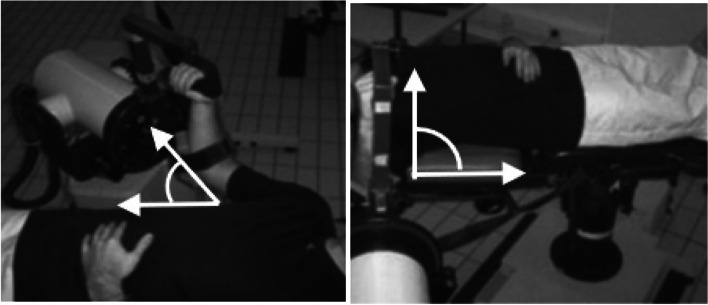
男性和女性的损伤患病率数据、肌肉力量和疲劳程度存在差异。此外,手臂空间方位会影响肩部肌肉的激活和力量。然而,关于比较男性和女性肩部旋转肌的研究较少。因此,本研究的主要目的是在对内旋(IR)和外旋(ER)肩部肌肉进行疲劳评估期间,对两种手臂空间方位(额面外展45°和90°)进行比较研究。其次,评估性别和优势手与肌肉表现之间的相互作用。
40名健康的久坐参与者,20名男性和20名女性参与了本研究。参与者在仰卧位以180°/秒的速度进行了一项抗疲劳方案,包括IR和ER肩部肌肉连续30次最大向心收缩。上肢在额面外展至45°或90°,并对每位参与者的优势侧和非优势侧进行测试,测试顺序进行了平衡。计算并使用诱导疲劳(IF;%)、累积表现(C.Perf;焦耳)和最佳重复次数(BR;焦耳)的表现指标进行分析。IF表示最后3次和前3次重复所做工作量之间的%差异,BR表示单次收缩期间所做的最大工作量,C.Perf表示所有重复期间所做的总工作量。
在不考虑其他因素时,肌肉群是唯一显示出显著差异的因素,C.Perf(平均差异=353.59焦耳,P<0.0005)、BR(平均差异=14.21焦耳,P<0.0005)和IF(平均差异=3.65%,P=0.0046)的值更高。两个角度之间存在显著差异,外展90°时的C.Perf值比45°时高约7.5%(平均差异=75至152焦耳),男性和女性外展90°时ER的BR值分别比45°时高约10.8%(平均差异=5.1至9.4焦耳)(P<0.0005)。在45°外展时,优势手臂的C.Perf在男性中比非优势手臂显著强11.7%(平均差异=111.58焦耳),在女性中显著强18%(平均差异=82.77焦耳)。在90°外展时,只有女性优势手臂更强,强18.8%(平均差异=88.17焦耳)。BR值根据运动员的外展角度和性别在9.2%至21.
