Liao Chin-Te, Bahrani Sima, da Silva Francisco Ferreira, Kashefi Elham
VeriQloud, Paris, France.
School of Informatics, University of Edinburgh, Edinburgh, UK.
Sci Rep. 2022 Mar 28;12(1):5298. doi: 10.1038/s41598-022-08901-x.
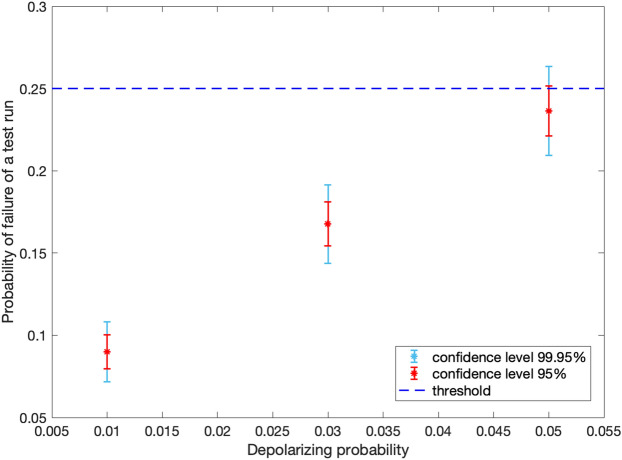
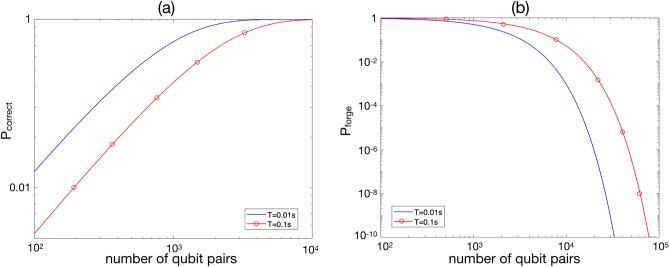
Quantum network protocols offer new functionalities such as enhanced security to communication and computational systems. Despite the rapid progress in quantum hardware, it has not yet reached a level of maturity that enables execution of many quantum protocols in practical settings. To develop quantum protocols in real world, it is necessary to examine their performance considering the imperfections in their practical implementation using simulation platforms. In this paper, we consider several quantum protocols that enable promising functionalities and services in near-future quantum networks. The protocols are chosen from both areas of quantum communication and quantum computation as follows: quantum money, W-state based anonymous transmission, verifiable blind quantum computation, and quantum digital signature. We use NetSquid simulation platform to evaluate the effect of various sources of noise on the performance of these protocols, considering different figures of merit. We find that to enable quantum money protocol, the decoherence time constant of the quantum memory must be at least three times the storage time of qubits. Furthermore, our simulation results for the w-state based anonymous transmission protocol show that to achieve an average fidelity above 0.8 in this protocol, the storage time of sender's and receiver's particles in the quantum memory must be less than half of the decoherence time constant of the quantum memory. We have also investigated the effect of gate imperfections on the performance of verifiable blind quantum computation. We find that with our chosen parameters, if the depolarizing probability of quantum gates is equal to or greater than 0.05, the security of the protocol cannot be guaranteed. Lastly, our simulation results for quantum digital signature protocol show that channel loss has a significant effect on the probability of repudiation.
量子网络协议为通信和计算系统提供了诸如增强安全性等新功能。尽管量子硬件取得了快速进展,但尚未达到能够在实际环境中执行许多量子协议的成熟水平。为了在现实世界中开发量子协议,有必要使用模拟平台来考虑其实际实现中的缺陷,从而研究它们的性能。在本文中,我们考虑了几种能在不久的将来的量子网络中实现有前景的功能和服务的量子协议。这些协议从量子通信和量子计算两个领域中选取,如下所示:量子货币、基于W态的匿名传输、可验证的盲量子计算以及量子数字签名。我们使用NetSquid模拟平台,考虑不同的品质因数,来评估各种噪声源对这些协议性能的影响。我们发现,要实现量子货币协议,量子存储器的退相干时间常数必须至少是量子比特存储时间的三倍。此外,我们基于W态的匿名传输协议的模拟结果表明,要在该协议中实现平均保真度高于0.8,发送方和接收方粒子在量子存储器中的存储时间必须小于量子存储器退相干时间常数的一半。我们还研究了门缺陷对可验证盲量子计算性能的影响。我们发现,对于我们选择的参数,如果量子门的去极化概率等于或大于0.05,该协议的安全性就无法得到保证。最后,我们的量子数字签名协议模拟结果表明,信道损耗对拒认概率有显著影响。