Gelhorn Heather L, Cutts Katelyn, Edson-Heredia Emily, Wright Peter, Delozier Amy, Shapiro Jerry, Senna Maryanne, Tosti Antonella
Evidera, Bethesda, MD, USA.
Eli Lilly and Company, Indianapolis, IN, USA.
Dermatol Ther (Heidelb). 2022 Apr;12(4):989-997. doi: 10.1007/s13555-022-00702-4. Epub 2022 Mar 29.
Alopecia areata (AA) is an autoimmune disease characterized by hair loss. Patients with AA experience a range of social and emotional impacts, and the lack of effective treatments and multiple affected locations can deepen the burden of illness. The objective of the current study was to assess health-related quality of life (HRQL) among patients with AA, and to evaluate the relationship between patient-reported AA severity, HRQL and treatment patterns.
A web survey was completed by participants recruited through the National Alopecia Areata Foundation. The survey included questions on disease characteristics, burden and impact (evaluated by the Skindex-16 for AA and items on work/school and sexual relationships), healthcare utilization and treatment experience. Analyses were conducted for the overall sample and by key subgroups, including AA severity and disease duration.
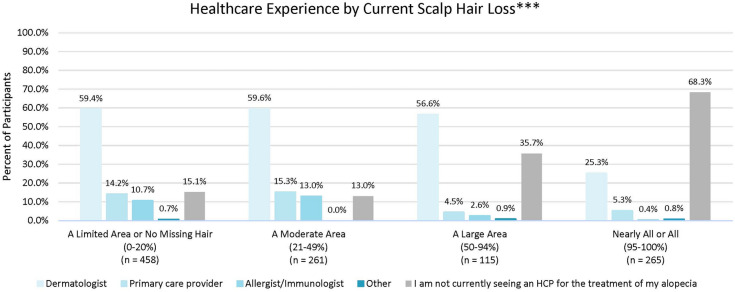
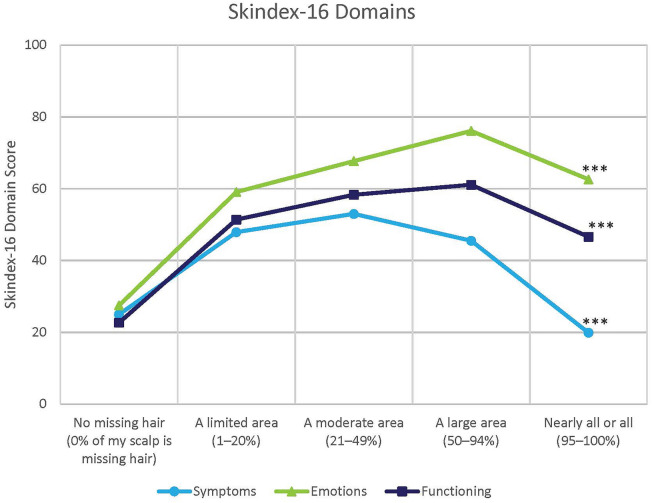
A total of 1327 participants with AA completed the survey. The mean age was 39.7 [standard deviation (SD) 12.3] years and 58.4% were female. On average, participants had experienced signs and symptoms of AA for 11.5 years (SD 12.5) and were diagnosed by a healthcare provider (HCP) 10.5 (SD 12.2) years ago. Participants reported a range of severity of current scalp hair loss, including 0% (2.6%), 1-20% (39.8%), 21-49% (26.2%), 50-94% (10.2%) and 95-100% (21.3%). Participants reporting 95-100% of scalp hair missing were less likely to be currently seeing an HCP and to currently be on treatments for AA. There was a non-linear relationship between HRQL and current AA severity. Participants with 1-20% to 50-94% of current scalp hair missing reported higher symptom, functioning and emotional impacts due to AA than participants with 0% missing scalp hair and/or 95-100% missing scalp hair. Similar findings were observed for current eyebrow and eyelash severity, except for emotional impacts.
Severity of AA plays an important role in understanding the burden of illness and healthcare patterns of people living with AA.
斑秃(AA)是一种以脱发为特征的自身免疫性疾病。斑秃患者会受到一系列社会和情感方面的影响,而且缺乏有效的治疗方法以及多个部位受累会加重疾病负担。本研究的目的是评估斑秃患者的健康相关生活质量(HRQL),并评估患者报告的斑秃严重程度、健康相关生活质量和治疗模式之间的关系。
通过美国国家斑秃基金会招募的参与者完成了一项网络调查。该调查包括有关疾病特征、负担和影响(通过用于斑秃的Skindex-16以及关于工作/学校和性关系的项目进行评估)、医疗保健利用情况和治疗经历的问题。对总体样本以及包括斑秃严重程度和疾病持续时间在内的关键亚组进行了分析。
共有1327名斑秃患者完成了调查。平均年龄为39.7岁[标准差(SD)12.3],女性占58.4%。平均而言,参与者出现斑秃的体征和症状已有11.5年(SD 12.5),10.5年(SD 12.2)前被医疗服务提供者(HCP)诊断出患有斑秃。参与者报告了当前头皮脱发的一系列严重程度,包括0%(2.6%)、1 - 20%(39.8%)、21 - 49%(26.2%)、50 - 94%(10.2%)和95 - 100%(21.3%)。报告头皮脱发95 - 100%的参与者目前看医疗服务提供者以及目前接受斑秃治疗的可能性较小。健康相关生活质量与当前斑秃严重程度之间存在非线性关系。当前头皮脱发1 - 20%至50 - 94%的参与者报告因斑秃导致的症状、功能和情感影响高于头皮脱发0%和/或95 - 100%的参与者。除情感影响外,当前眉毛和睫毛严重程度也观察到类似结果。
斑秃的严重程度在理解斑秃患者的疾病负担和医疗模式方面起着重要作用。