University Grenoble Alpes, CEA, INSERM, IRIG, Biomics, 38054, Grenoble, France.
University Grenoble Alpes, CEA, LETI, 38054, Grenoble, France.
J Exp Clin Cancer Res. 2022 Mar 30;41(1):115. doi: 10.1186/s13046-022-02328-y.
The inhibition of neddylation by the preclinical drug MLN4924 represents a new strategy to combat cancer. However, despite being effective against hematologic malignancies, its success in solid tumors, where cell-cell and cell-ECM interactions play essential roles, remains elusive.
Here, we studied the effects of MLN4924 on cell growth, migration and invasion in cultured prostate cancer cells and in disease-relevant prostate tumoroids. Using focused protein profiling, drug and RNAi screening, we analyzed cellular pathways activated by neddylation inhibition.
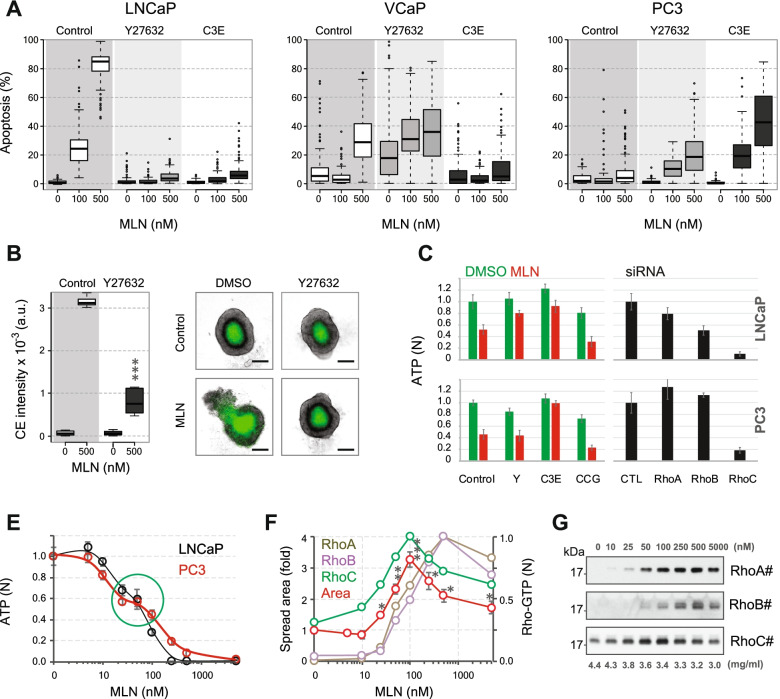
We show that mechanical stress induced by MLN4924 in prostate cancer cells significantly affects the therapeutic outcome. The latter depends on the cell type and involves distinct Rho isoforms. In LNCaP and VCaP cells, the stimulation of RhoA and RhoB by MLN4924 markedly upregulates the level of tight junction proteins at cell-cell contacts, which augments the mechanical strain induced by Rho signaling. This "tight junction stress response" (TJSR) causes the collapse of cell monolayers and a characteristic rupture of cancer spheroids. Notably, TJSR is a major cause of drug-induced apoptosis in these cells. On the other hand, in PC3 cells that underwent partial epithelial-to-mesenchymal transition (EMT), the stimulation of RhoC induces an adverse effect by promoting amoeboid cell scattering and invasion. We identified complementary targets and drugs that allow for the induction of TJSR without stimulating RhoC.
Our finding that MLN4924 acts as a mechanotherapeutic opens new ways to improve the efficacy of neddylation inhibition as an anticancer approach.
临床前药物 MLN4924 通过抑制 neddylation 代表了一种对抗癌症的新策略。然而,尽管它在血液恶性肿瘤中非常有效,但在实体肿瘤中,其作用仍然难以捉摸,因为在实体肿瘤中,细胞-细胞和细胞-细胞外基质的相互作用起着至关重要的作用。
在这里,我们研究了 MLN4924 对培养的前列腺癌细胞和相关前列腺肿瘤球体中细胞生长、迁移和侵袭的影响。通过聚焦蛋白质谱分析、药物和 RNAi 筛选,我们分析了 neddylation 抑制激活的细胞通路。
我们表明,MLN4924 在前列腺癌细胞中诱导的机械应激显著影响治疗效果。后者取决于细胞类型,并涉及不同的 Rho 同工型。在 LNCaP 和 VCaP 细胞中,MLN4924 刺激 RhoA 和 RhoB 显著上调细胞-细胞连接处紧密连接蛋白的水平,从而增加 Rho 信号诱导的机械应变。这种“紧密连接应激反应”(TJSR)导致细胞单层的崩溃和癌症球体的特征性破裂。值得注意的是,TJSR 是这些细胞中药物诱导凋亡的主要原因。另一方面,在经历部分上皮-间充质转化(EMT)的 PC3 细胞中,RhoC 的刺激通过促进阿米巴样细胞散射和侵袭产生不利影响。我们确定了互补的靶点和药物,这些靶点和药物可以在不刺激 RhoC 的情况下诱导 TJSR。
我们的发现表明,MLN4924 作为一种机械治疗剂,为改善 neddylation 抑制作为一种抗癌方法的疗效开辟了新途径。