Division of Psychiatry, University of Edinburgh, Royal Edinburgh Hospital, Morningside Park, Edinburgh, EH10 5HF, UK.
College of Life and Environmental Sciences, Psychology, University of Exeter, Exeter, UK.
Genome Med. 2022 Mar 31;14(1):36. doi: 10.1186/s13073-022-01039-5.
Depression is a disabling and highly prevalent condition where genetic and epigenetic, such as DNA methylation (DNAm), differences contribute to disease risk. DNA methylation is influenced by genetic variation but the association between polygenic risk of depression and DNA methylation is unknown.
We investigated the association between polygenic risk scores (PRS) for depression and DNAm by conducting a methylome-wide association study (MWAS) in Generation Scotland (N = 8898, mean age = 49.8 years) with replication in the Lothian Birth Cohorts of 1921 and 1936 and adults in the Avon Longitudinal Study of Parents and Children (ALSPAC) (N = 2049, mean age = 79.1, 69.6 and 47.2 years, respectively). We also conducted a replication MWAS in the ALSPAC children (N = 423, mean age = 17.1 years). Gene ontology analysis was conducted for the cytosine-guanine dinucleotide (CpG) probes significantly associated with depression PRS, followed by Mendelian randomisation (MR) analysis to infer the causal relationship between depression and DNAm.
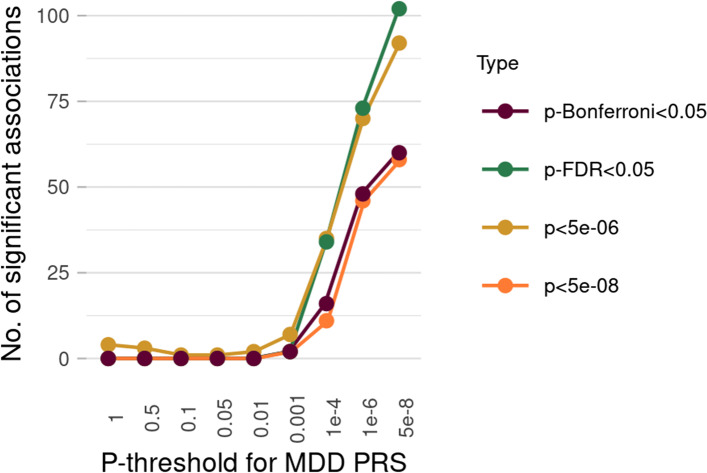
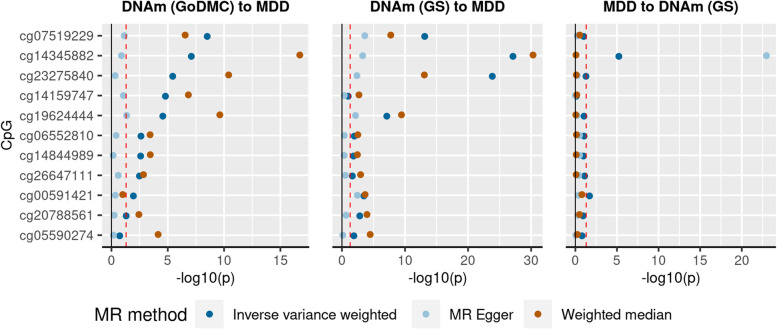
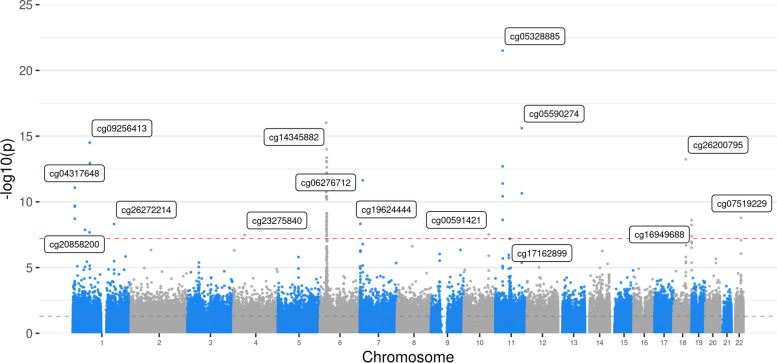
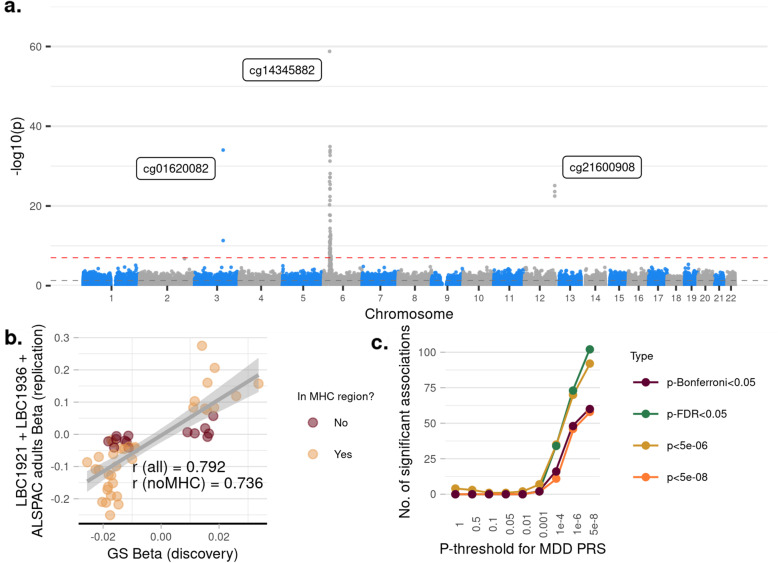
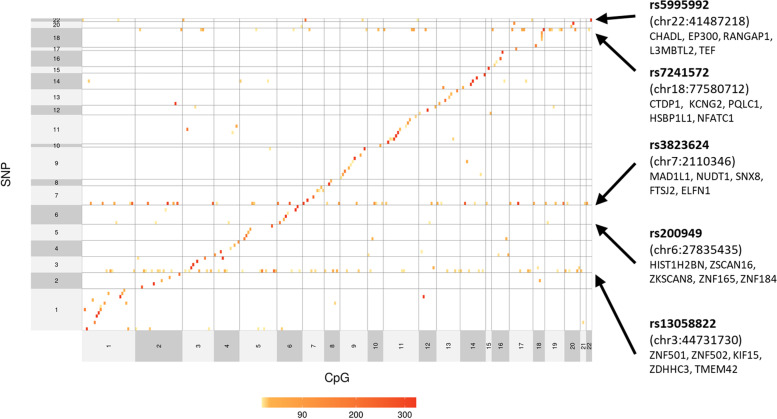
Widespread associations (N = 71, p < 0.05, p < 6.3 × 10) were found between PRS constructed using genetic risk variants for depression and DNAm in CpG probes that localised to genes involved in immune responses and neural development. The effect sizes for the significant associations were highly correlated between the discovery and replication samples in adults (r = 0.79) and in adolescents (r = 0.82). Gene Ontology analysis showed that significant CpG probes are enriched in immunological processes in the human leukocyte antigen system. Additional MWAS was conducted for each lead genetic risk variant. Over 47.9% of the independent genetic risk variants included in the PRS showed associations with DNAm in CpG probes located in both the same (cis) and distal (trans) locations to the genetic loci (p < 0.045). Subsequent MR analysis showed that there are a greater number of causal effects found from DNAm to depression than vice versa (DNAm to depression: p ranged from 0.024 to 7.45 × 10; depression to DNAm: p ranged from 0.028 to 0.003).
PRS for depression, especially those constructed from genome-wide significant genetic risk variants, showed methylome-wide differences associated with immune responses. Findings from MR analysis provided evidence for causal effect of DNAm to depression.
抑郁症是一种致残性且普遍存在的疾病,其遗传和表观遗传因素(如 DNA 甲基化(DNAm))差异导致了疾病风险。DNA 甲基化受遗传变异的影响,但抑郁症的多基因风险与 DNA 甲基化之间的关联尚不清楚。
我们通过在苏格兰世代(Generation Scotland)中进行全基因组关联研究(MWAS)来研究抑郁症的多基因风险评分(PRS)与 DNAm 之间的关联(N=8898,平均年龄=49.8 岁),并在 1921 年和 1936 年的洛锡安出生队列以及阿冯纵向父母与子女研究(Avon Longitudinal Study of Parents and Children,ALSPAC)中的成年人中进行了复制(N=2049,平均年龄分别为 79.1、69.6 和 47.2 岁)。我们还在阿冯纵向父母与子女研究的儿童中进行了复制 MWAS(N=423,平均年龄为 17.1 岁)。对与抑郁症 PRS 显著相关的胞嘧啶-鸟嘌呤二核苷酸(CpG)探针进行了基因本体论分析,然后进行了孟德尔随机化(MR)分析,以推断抑郁症和 DNAm 之间的因果关系。
在 CpG 探针中发现了广泛的关联(N=71,p<0.05,p<6.3×10),这些探针位于与免疫反应和神经发育相关的基因上,其构建使用了抑郁症遗传风险变异的 PRS。在成人(r=0.79)和青少年(r=0.82)的发现和复制样本中,显著关联的效应大小高度相关。基因本体论分析表明,显著的 CpG 探针在人类白细胞抗原系统的免疫过程中富集。对每个主要遗传风险变异进行了额外的 MWAS。包含在 PRS 中的 47.9%以上的独立遗传风险变异与位于遗传位点相同(顺式)和远端(反式)位置的 CpG 探针中的 DNAm 相关(p<0.045)。随后的 MR 分析表明,从 DNAm 到抑郁症的因果效应数量多于反之(DNAm 到抑郁症:p 范围从 0.024 到 7.45×10;抑郁症到 DNAm:p 范围从 0.028 到 0.003)。
抑郁症的 PRS,尤其是那些由全基因组显著遗传风险变异构建的 PRS,显示出与免疫反应相关的全甲基组差异。MR 分析的结果为 DNAm 对抑郁症的因果效应提供了证据。