Cabrera Anatael, Han Yang, Obolensky Michel, Cavalier Fabien, Coelho João, Navas-Nicolás Diana, Nunokawa Hiroshi, Simard Laurent, Bian Jianming, Nayak Nitish, Ochoa-Ricoux Juan Pedro, Roskovec Bedřich, Chimenti Pietro, Dusini Stefano, Bongrand Mathieu, Karaparambil Rebin, Lebrin Victor, Viaud Benoit, Yermia Frederic, Asquith Lily, Bezerra Thiago J C, Hartnell Jeff, Lasorak Pierre, Ling Jiajie, Liao Jiajun, Yu Hongzhao
APC, CNRS/IN2P3, CEA/IRFU, Observatoire de Paris, Sorbonne Paris Cité University, 75205, Paris Cedex 13, France.
IJCLab, Université Paris-Saclay, CNRS/IN2P3, 91405, Orsay, France.
Sci Rep. 2022 Mar 30;12(1):5393. doi: 10.1038/s41598-022-09111-1.
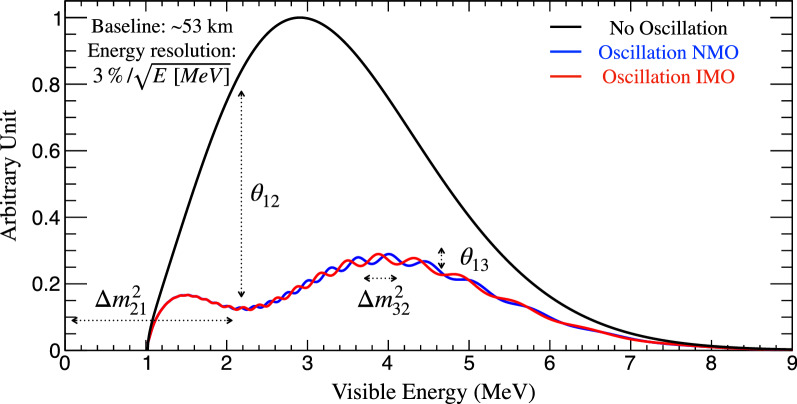
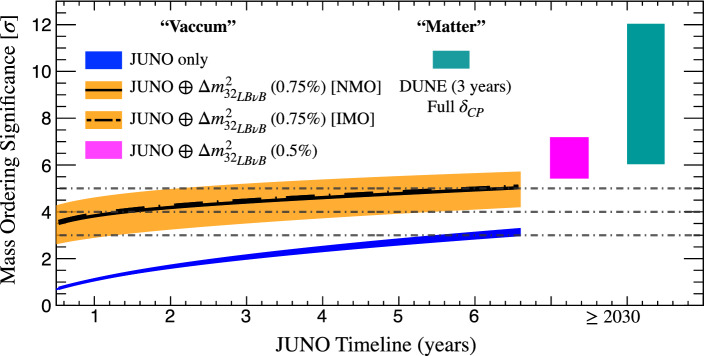
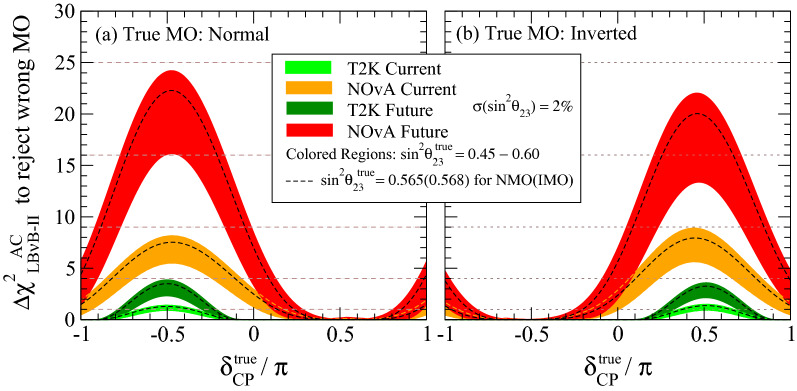
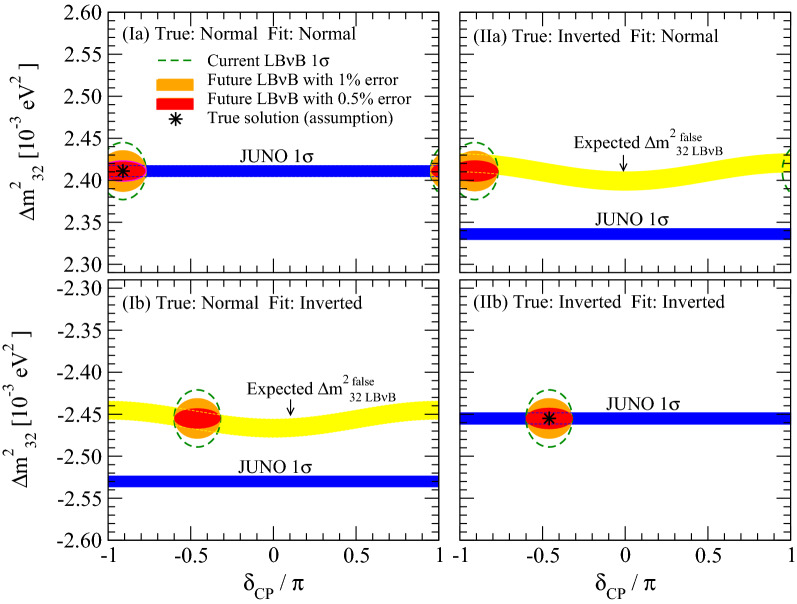
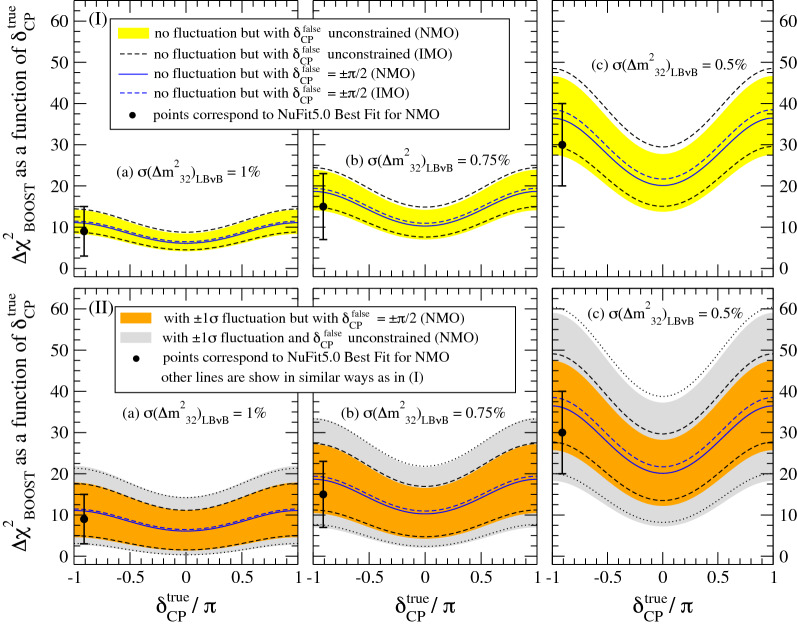
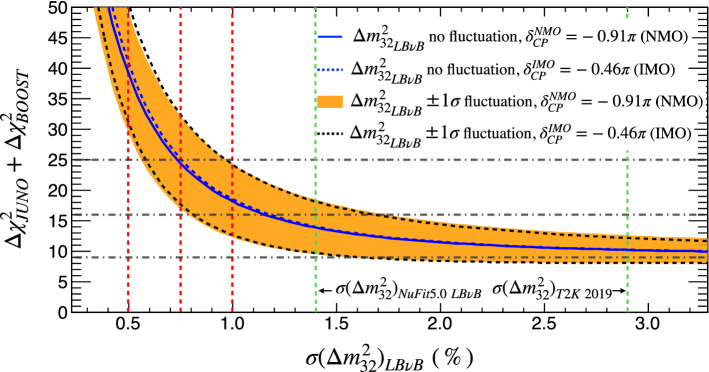
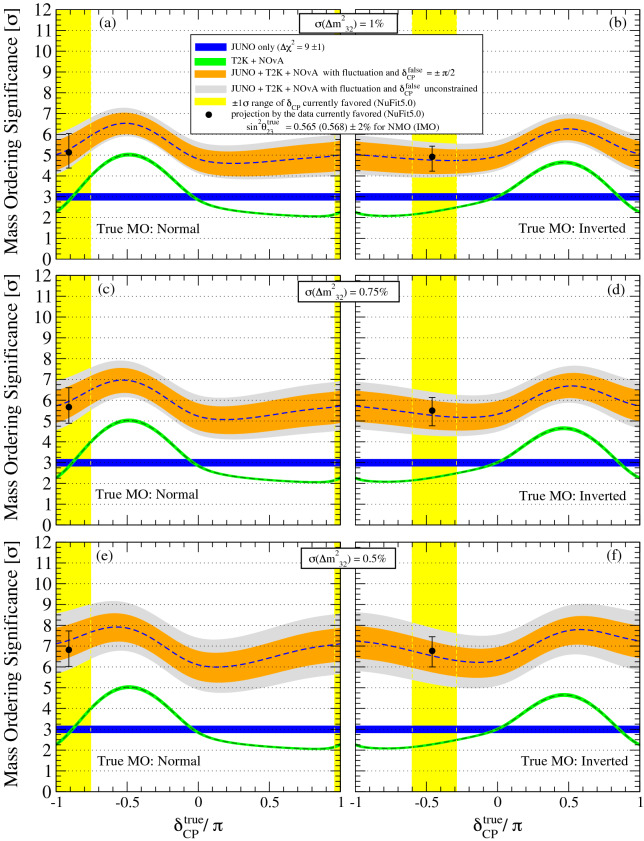
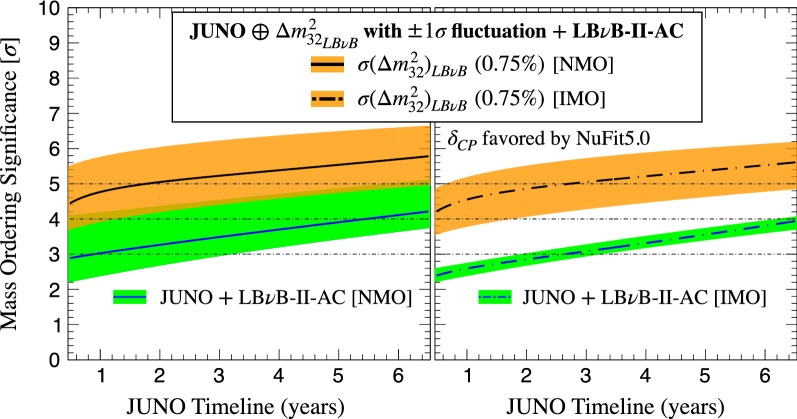
The measurement of neutrino mass ordering (MO) is a fundamental element for the understanding of leptonic flavour sector of the Standard Model of Particle Physics. Its determination relies on the precise measurement of [Formula: see text] and [Formula: see text] using either neutrino vacuum oscillations, such as the ones studied by medium baseline reactor experiments, or matter effect modified oscillations such as those manifesting in long-baseline neutrino beams (LB[Formula: see text]B) or atmospheric neutrino experiments. Despite existing MO indication today, a fully resolved MO measurement ([Formula: see text]) is most likely to await for the next generation of neutrino experiments: JUNO, whose stand-alone sensitivity is [Formula: see text], or LB[Formula: see text]B experiments (DUNE and Hyper-Kamiokande). Upcoming atmospheric neutrino experiments are also expected to provide precious information. In this work, we study the possible context for the earliest full MO resolution. A firm resolution is possible even before 2028, exploiting mainly vacuum oscillation, upon the combination of JUNO and the current generation of LB[Formula: see text]B experiments (NOvA and T2K). This opportunity is possible thanks to a powerful synergy boosting the overall sensitivity where the sub-percent precision of [Formula: see text] by LB[Formula: see text]B experiments is found to be the leading order term for the MO earliest discovery. We also found that the comparison between matter and vacuum driven oscillation results enables unique discovery potential for physics beyond the Standard Model.
中微子质量顺序(MO)的测量是理解粒子物理标准模型轻子味区的一个基本要素。其确定依赖于通过中微子真空振荡(如中基线反应堆实验所研究的振荡)或物质效应修正振荡(如长基线中微子束(LBνB)或大气中微子实验中表现出的振荡)来精确测量[公式:见正文]和[公式:见正文]。尽管目前已有MO的迹象,但要完全确定MO的测量结果([公式:见正文])很可能要等待下一代中微子实验:JUNO,其独立灵敏度为[公式:见正文],或LBνB实验(DUNE和超级神冈探测器)。即将进行的大气中微子实验也有望提供宝贵信息。在这项工作中,我们研究了最早完全解决MO问题的可能情况。即使在2028年之前,主要利用真空振荡,通过结合JUNO和当前一代的LBνB实验(NOvA和T2K),也有可能得到确定的结果。由于强大的协同作用提高了整体灵敏度,这种机会是可能的,其中LBνB实验对[公式:见正文]的亚百分比精度被发现是最早发现MO的主导项。我们还发现,物质驱动振荡结果与真空驱动振荡结果之间的比较为超出标准模型的物理提供了独特的发现潜力。