Department of Cognitive Science, University of California, Irvine, California, USA.
Department of Psychology, Princeton Neuroscience Institute, Princeton University, Princeton, New Jersey, USA.
J Sleep Res. 2022 Oct;31(5):e13574. doi: 10.1111/jsr.13574. Epub 2022 Mar 30.
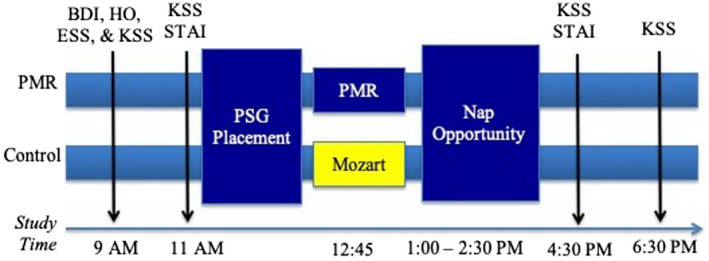
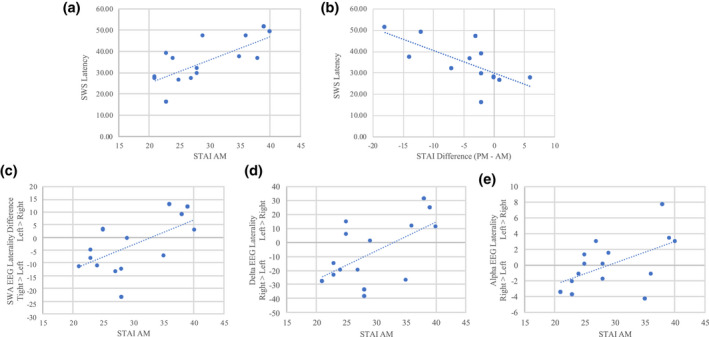
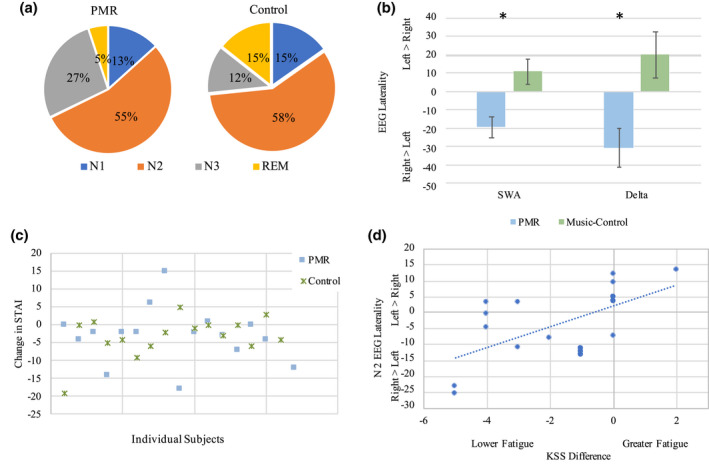
Sleep is critical for health, cognition, and restorative processes, and yet, many experience chronic sleep restriction. Sleep interventions have been designed to enhance overnight sleep quality and physiology. Components of these interventions, like relaxation-based progressive muscle relaxation (PMR), have been studied in isolation and have shown direct effects on sleep architecture, including increasing time in restorative, slow-wave sleep (SWS). These relaxation methods have been understudied in naps, which are effective fatigue countermeasures that reduce deleterious effects of chronic sleep restriction. We hypothesised that PMR should boost SWS in a nap, as compared to an active control. We used a between-subject design in which healthy young adults underwent PMR training or listened to Mozart music (control) prior to a 90-min nap opportunity. We assessed changes in the amount and lateralisation of SWS, as evidence suggests left hemispheric lateralisation may be a proxy for recuperative sleep needs, and changes to state-dependent anxiety and fatigue before and after the nap to assess intervention success. We found PMR participants spent ~10 min more in SWS, equivalent to 125% more time, than the control group, and concomitantly, significantly less time in rapid eye movement sleep. PMR participants also had greater right lateralised slow-wave activity and delta activity compared to the control suggesting a more well-rested brain profile during sleep. Further, pre-sleep anxiety levels predicted nap architecture in the intervention group, suggesting benefits may be impacted by anxiety. The feasibility and accessibility of PMR prior to a nap make this an interesting research avenue to pursue with strong translational application.
睡眠对于健康、认知和恢复过程至关重要,但许多人经历慢性睡眠限制。睡眠干预旨在提高夜间睡眠质量和生理机能。这些干预措施的组成部分,如基于放松的渐进性肌肉松弛(PMR),已经在单独研究中进行了研究,并直接影响了睡眠结构,包括增加恢复性慢波睡眠(SWS)的时间。这些放松方法在小睡中研究较少,小睡是有效的疲劳对抗措施,可以减轻慢性睡眠限制的有害影响。我们假设 PMR 应该比主动对照更能促进小睡中的 SWS。我们采用了一种被试间设计,其中健康的年轻成年人在 90 分钟的小睡机会之前接受 PMR 训练或听莫扎特音乐(对照)。我们评估了 SWS 的量和侧化的变化,因为有证据表明左侧偏侧化可能是恢复性睡眠需求的代理,以及小睡前后状态相关的焦虑和疲劳的变化,以评估干预的成功。我们发现 PMR 参与者在 SWS 中多睡了~10 分钟,相当于多睡了 125%,而对照组则相应地在快速眼动睡眠中少睡了 10 分钟。PMR 参与者的右侧慢波活动和 delta 活动也比对照组更大,这表明睡眠期间大脑的休息状态更好。此外,睡前焦虑水平预测了干预组的小睡结构,这表明焦虑可能会影响干预的效果。PMR 在小睡前的可行性和可及性使其成为一个有趣的研究途径,具有很强的转化应用前景。