Department of Pediatric Cardiology, University Hospital Erlangen, Friedrich-Alexander-University Erlangen-Nuremberg, Erlangen, Germany.
Division of Pediatric Pulmonology, Allergology and Neonatology, Hannover Medical School, Hannover, Germany.
Pediatr Pulmonol. 2022 Sep;57(9):1998-2002. doi: 10.1002/ppul.25906. Epub 2022 Jun 20.
Invasive mechanical ventilation poses a strong risk factor for the development of chronic lung disease in preterm infants. A reduction of the dead space as part of the total breathing volume would reduce the ventilation effort and thereby lower the risk of ventilator-induced lung injuries. In this experimental study, we compared the efficacy of mechanical dead space washout via uncontrolled and controlled leakage flow in their ability to eliminate CO during conventional ventilation in preterm infants.
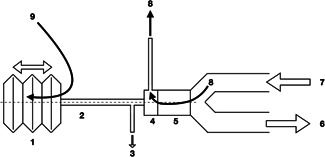
Three frequently used neonatal ventilators, operating under standard conventional ventilating parameters, were individually connected to a test lung. To maintain a constant physiological end-expiratory pCO level during ventilation, the test lung was continuously flooded with CO . A side port in the area of the connector between the endotracheal tube and the flow sensor allowed breathing gas to escape passively or in a second experimental setup, regulated by a pump. Measurements of end-expiratory pCO were taken in both experiments and compared to end-expiratory pCO levels of ventilation without active dead space leakage.
Following dead space washout, a significant reduction of end-expiratory pCO was attained. Under conditions of uncontrolled leakage, the mean decrease was 14.1% while controlled leakage saw a mean reduction of 16.1%.
Washout of dead space by way of leakage flow is an effective method to reduce end-expiratory pCO . Both controlled and uncontrolled leakage provide comparable results, but precise regulation of leakage allows for a more stable ventilation by preventing uncontrolled loss of tidal volume during inspiration.
机械通气会增加早产儿发生慢性肺病的风险。作为总呼吸量的一部分,减少死腔可以降低通气做功,从而降低呼吸机相关性肺损伤的风险。在这项实验研究中,我们比较了在常规通气中,通过不可控和可控泄漏流量进行机械死腔冲洗,以消除 CO 的效果。
三个常用的新生儿呼吸机,在标准常规通气参数下单独连接到测试肺。为了在通气过程中保持恒定的生理呼气末 pCO 水平,测试肺持续被 CO 淹没。在气管导管和流量传感器之间的连接器区域的一个侧端口允许呼吸气体被动逸出,或者在第二个实验设置中,由泵调节。在两个实验中都测量了呼气末 pCO 并与无主动死腔泄漏通气的呼气末 pCO 水平进行比较。
死腔冲洗后,呼气末 pCO 显著降低。在不可控泄漏的情况下,平均降低了 14.1%,而可控泄漏则降低了 16.1%。
通过泄漏流进行死腔冲洗是降低呼气末 pCO 的有效方法。可控和不可控泄漏都提供了类似的结果,但泄漏的精确调节可以通过防止吸气时潮气量的不可控损失来提供更稳定的通气。