College of Veterinary Medicine, China Agricultural University, Haidian, Beijing 100193, China.
Department of Nutrition and Health, China Agricultural University, Haidian, Beijing 100193, China.
Oxid Med Cell Longev. 2022 Mar 20;2022:8133310. doi: 10.1155/2022/8133310. eCollection 2022.
Our previous studies demonstrated that melatonin could effectively ameliorate sleep deprivation- (SD-) caused oxidative stress-mediated gut microbiota disorder and colitis. The research further clarified the mechanism of melatonin in improving colitis from the perspective of the interaction between and goblet cells.
A seventy-two hours SD mouse model with or without melatonin intervention and fecal microbiota transplantation (FMT) to explore the vital position of -goblet cell interactions in melatonin improving SD-induced colitis. Moreover, or LPS-supplied mice were assessed, and the influence of melatonin on -goblet cell interactions-mediated oxidative stress caused colitis. Furthermore, in vitro experiment investigated the regulation mechanism of melatonin.
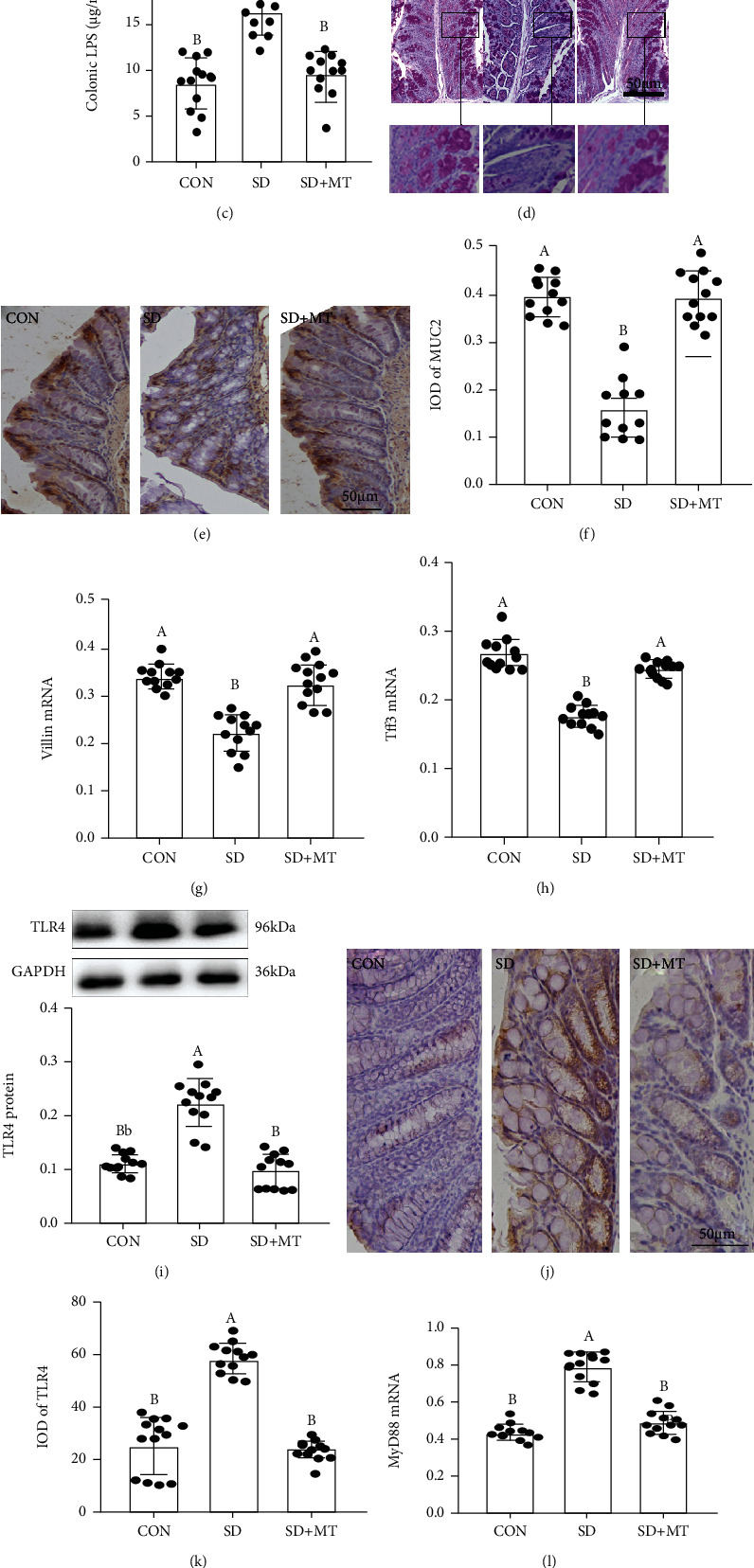
Our study showed that SD induced colitis, with upregulation of and LPS levels and reductions in goblet cells number and MUC2 protein. Similarly, FMT from SD mice, veronii colonization, and LPS treatment restored the SD-like goblet cells number and MUC2 protein decrease and colitis. Moreover, LPS treatment downregulated the colonic antioxidant capacity. Yet, melatonin intervention reversed all consequence in SD, veronii colonization, and LPS-treated mice. In vitro, melatonin reversed veronii- or LPS-induced MUC2 depletion in mucus-secreting human HT-29 cells via increasing the expression level of Villin, Tff3, p-GSK-3, -catenin, and melatonin receptor 2 (MT2) and decreasing the level of p-IB, p-P65, ROS, TLR4, and MyD88 proteins, while the improvement effect was blocked with pretreatment with a MT2 antagonist but were mimicked by TLR4 and GSK-3 antagonists and ROS scavengers.
Our results demonstrated that melatonin-mediated MT2 inhibits -goblet cell interactions to restore the level of MUC2 production via LPS/TLR4/MyD88/GSK-3/ROS/NF-B loop, further improving colitis in SD mice.
我们之前的研究表明,褪黑素可以有效改善睡眠剥夺(SD)引起的氧化应激介导的肠道微生物失调和结肠炎。该研究进一步从 和杯状细胞的相互作用的角度阐明了褪黑素改善结肠炎的机制。
采用 72 小时 SD 小鼠模型,进行褪黑素干预和粪便微生物移植(FMT)实验,以探讨 -杯状细胞相互作用在褪黑素改善 SD 诱导的结肠炎中的重要地位。此外,评估 或 LPS 供应的小鼠,以及褪黑素对 -杯状细胞相互作用介导的氧化应激引起的结肠炎的影响。此外,在体外实验中研究了褪黑素的调节机制。
我们的研究表明,SD 诱导的结肠炎,伴有 和 LPS 水平上调,杯状细胞数量和 MUC2 蛋白减少。同样,来自 SD 小鼠的 FMT、V. veronii 定植和 LPS 处理恢复了 SD 样杯状细胞数量和 MUC2 蛋白减少和结肠炎。此外,LPS 处理下调了结肠的抗氧化能力。然而,褪黑素干预逆转了 SD、V. veronii 定植和 LPS 处理小鼠的所有后果。在体外,褪黑素通过增加 Villin、Tff3、p-GSK-3、β-catenin 和褪黑素受体 2(MT2)的表达水平,降低 p-IB、p-P65、ROS、TLR4 和 MyD88 蛋白水平,逆转了 veronii 或 LPS 诱导的 HT-29 黏液分泌细胞中 MUC2 的耗竭,而用 MT2 拮抗剂预处理则阻断了这种改善作用,但被 TLR4 和 GSK-3 拮抗剂和 ROS 清除剂模拟。
我们的结果表明,褪黑素介导的 MT2 通过 LPS/TLR4/MyD88/GSK-3/ROS/NF-κB 环抑制 -杯状细胞相互作用,恢复 MUC2 产生水平,进一步改善 SD 小鼠的结肠炎。