Department of Biology, MSc.in Biomedical Sciences, College of Natural and Computational Sciences, Mizan-Tepi University, Tepi, Ethiopia.
Department of Statistics, MSc. in Biostatistics, College of Natural and Computational Sciences, Mizan-Tepi University, Tepi, Ethiopia.
ScientificWorldJournal. 2022 Mar 20;2022:2312407. doi: 10.1155/2022/2312407. eCollection 2022.
Youth-friendly reproductive health services are designed to meet the unique needs of young individuals. Nevertheless, in developing countries such as Ethiopia, knowledge, attitude, and utilization of these services are very limited. This study was designed to assess the knowledge, attitude, and utilization of youth-friendly health services and associated factors among students.
A public university-based cross-sectional study was conducted between October and January 2019. Participants were chosen from the target group using a simple random selection procedure. To find the factors linked to youth-friendly health services, researchers used descriptive analysis, the chi-square test, and a logistic regression model.
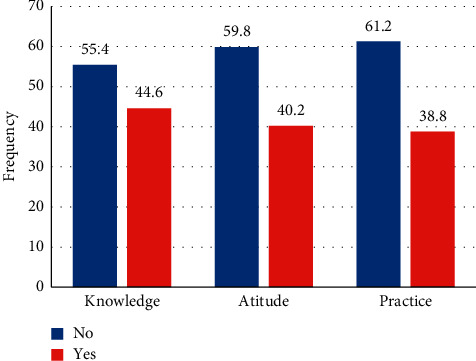
This study revealed that 237 (55.4%), 256 (59.8%), and 262 (61.2%) students had no knowledge, negative attitude, and not practiced youth-friendly reproductive health services, respectively. The binary logistic regression results revealed that male students were more likely to have knowledge and practice (AOR = 1.847; 95% CI: 1.124, 3.034; =0.015) and (AOR = 1.821; 95% CI: 1.114, 2.975; =0.017) respectively; however, they had less likely positive attitudes (AOR = 0.519; 95% CI: 0.315, 0.856; value = 0.010) compared to female students. Students from primary and above educated families were more likely to have knowledge, attitude, and practice compared to students from uneducated families.
Overall, students' knowledge, attitudes, and utilization of youth-friendly reproductive health services were poor. As a result, additional efforts, such as the availability of service providers and the improvement of facilities, as well as education linked to the service for young people and the allocation of appropriate service time, are required.
青年友好型生殖健康服务旨在满足年轻人的独特需求。然而,在埃塞俄比亚等发展中国家,这些服务的知识、态度和利用率非常有限。本研究旨在评估学生对青年友好型健康服务的知识、态度和利用情况及其相关因素。
这是一项 2019 年 10 月至 1 月期间在一所公立大学进行的横断面研究。采用简单随机抽样程序从目标人群中选择参与者。为了发现与青年友好型卫生服务相关的因素,研究人员使用了描述性分析、卡方检验和逻辑回归模型。
本研究显示,分别有 237(55.4%)、256(59.8%)和 262(61.2%)名学生对青年友好型生殖健康服务缺乏了解、持有消极态度且并未实际践行。二元逻辑回归结果显示,男生更有可能具备相关知识和实践能力(AOR=1.847;95%CI:1.124,3.034;=0.015)(AOR=1.821;95%CI:1.114,2.975;=0.017),而他们对该服务的积极态度则更不倾向(AOR=0.519;95%CI:0.315,0.856;=0.010),与女生相比。来自小学及以上教育家庭的学生比来自未受教育家庭的学生更有可能具备相关知识、态度和实践能力。
总体而言,学生对青年友好型生殖健康服务的知识、态度和利用率都较差。因此,需要进一步努力,如提供服务提供者并改善设施,以及为年轻人提供与服务相关的教育和分配适当的服务时间。