Hao Can, Ma Bingjie, Gao Nan, Jin Tian, Liu Xiaoming
Pain Management Center, Shanghai Xinhua Hospital, School of Medicine, Shanghai Jiaotong University, Shanghai, 210092, People's Republic of China.
J Pain Res. 2022 Mar 24;15:767-778. doi: 10.2147/JPR.S359397. eCollection 2022.
Recent studies showed promotion of astrocyte autophagy in the spinal cord would provide analgesic effects. Silent information regulator T1 (SIRT1) and α subunit of peroxisome proliferator-activated receptor-γ coactivator-1 (PGC-1α) are two master regulators of endogenous antioxidant defense and mitochondrial biogenesis. They play vital roles in both autophagy and neuropathic pain (NP). Our previous study showed that TSPO agonist Ro5-4864 elicited potent analgesic effects against NP, but the mechanisms remain unclear. This study aims to investigate the effects of TSPO agonist Ro5-4864 on autophagy and nuclear SIRT1/PGC-1α signaling in spinal dorsal horn.
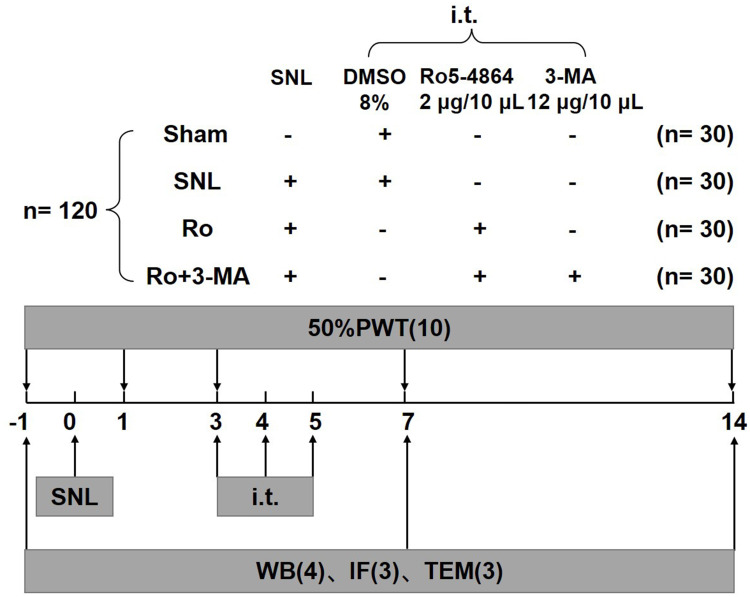
A rat model of L5 spinal nerve ligation (SNL) was adopted. Rats were randomly assigned to the Sham group, the SNL group, the Ro (TSPO agonist Ro5-4864) group and the Ro+3-MA group. The behavior assessments were conducted at baseline, on Day 1, 3, 7 and 14 after SNL. The autophagy-related proteins (ATG7, Beclin1, LC3, and P62) in spinal dorsal horn were assayed and the nuclear SIRT1/PGC-1α and downstream factors were analyzed.
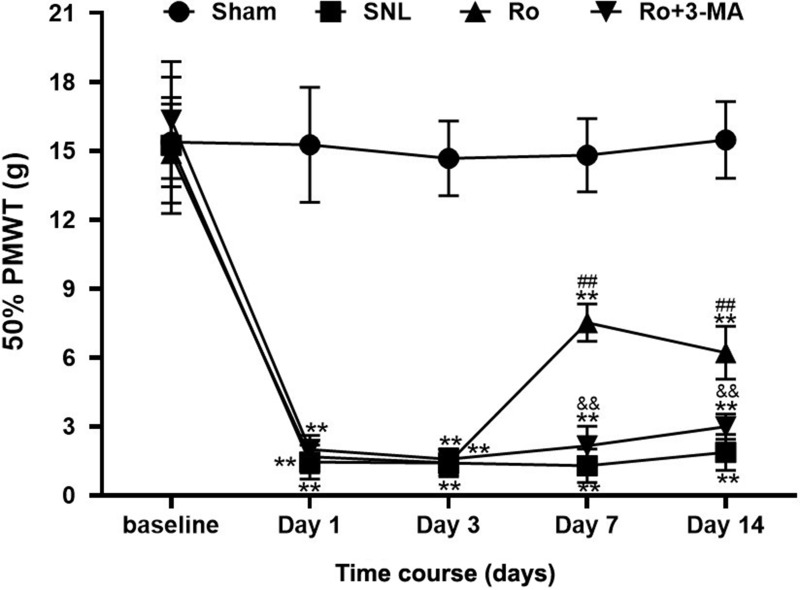
Ro5-4864 alleviated the mechanical allodynia induced by SNL (P < 0.01 vs the SNL group), which could be totally abrogated by autophagy inhibitor 3-MA (P < 0.01 vs the Ro group). SNL induced elevated ATG7 (P < 0.01), Beclin1 (P < 0.01) and LC3-II/LC3-I (P < 0.01) contents and P62 accumulation (P < 0.01) on Day 7 and Day 14, which suggested an autophagy flux impairment. Ro5-4864 augmented ATG7 (P < 0.01), Beclin1 (P < 0.01) and LC3-II/LC3-I (P < 0.05) with decreased P62 (P < 0.01), which indicated a more fluent autophagic process. These effects were also totally abrogated by 3-MA (P < 0.01). Furthermore, Ro5-4864 activated the spinal nuclear SIRT1/PGC-1α signaling pathway.
TSPO improved both autophagy impairment and mitochondrial biogenesis, which may provide a new strategy for the treatment of NP.
近期研究表明,促进脊髓星形胶质细胞自噬可产生镇痛作用。沉默信息调节因子T1(SIRT1)和过氧化物酶体增殖物激活受体γ共激活因子1α亚基(PGC-1α)是内源性抗氧化防御和线粒体生物发生的两个主要调节因子。它们在自噬和神经性疼痛(NP)中均发挥着至关重要的作用。我们之前的研究表明,TSPO激动剂Ro5-4864对NP具有显著的镇痛作用,但其机制尚不清楚。本研究旨在探讨TSPO激动剂Ro5-4864对脊髓背角自噬及核SIRT1/PGC-1α信号通路的影响。
采用L5脊髓神经结扎(SNL)大鼠模型。将大鼠随机分为假手术组、SNL组、Ro(TSPO激动剂Ro5-4864)组和Ro+3-MA组。在SNL术后第1、3、7和14天进行行为学评估。检测脊髓背角自噬相关蛋白(ATG7、Beclin1、LC3和P62),并分析核SIRT1/PGC-1α及其下游因子。
Ro5-4864减轻了SNL诱导的机械性异常疼痛(与SNL组相比,P<0.01),自噬抑制剂3-MA可完全消除该作用(与Ro组相比,P<0.01)。SNL导致第7天和第14天ATG7(P<0.01)、Beclin1(P<0.01)和LC3-II/LC3-I(P<0.01)含量升高以及P62蓄积(P<0.01),提示自噬流受损。Ro5-4864增加了ATG7(P<0.01)、Beclin1(P<0.01)和LC3-II/LC3-I(P<0.05),同时降低了P62(P<0.01),表明自噬过程更顺畅。3-MA也完全消除了这些作用(P<0.01)。此外,Ro5-4864激活了脊髓核SIRT1/PGC-1α信号通路。
TSPO改善了自噬损伤和线粒体生物发生,这可能为NP的治疗提供一种新策略。