García-Oliva Ovidio, Hantzsche Florian M, Boersma Maarten, Wirtz Kai W
Institute of Coastal Systems - Analysis and Modeling, Helmholtz-Zentrum Hereon, Max-Planck-straße 1, Geesthacht 21502, Germany.
Alfred-Wegener-Institute Helmholtz-Zentrum für Polar- und Meeresforschung, Biologischen Anstalt Helgoland, Helgoland 27483, Germany.
J Plankton Res. 2022 Mar 14;44(2):224-240. doi: 10.1093/plankt/fbac013. eCollection 2022 Mar-Apr.
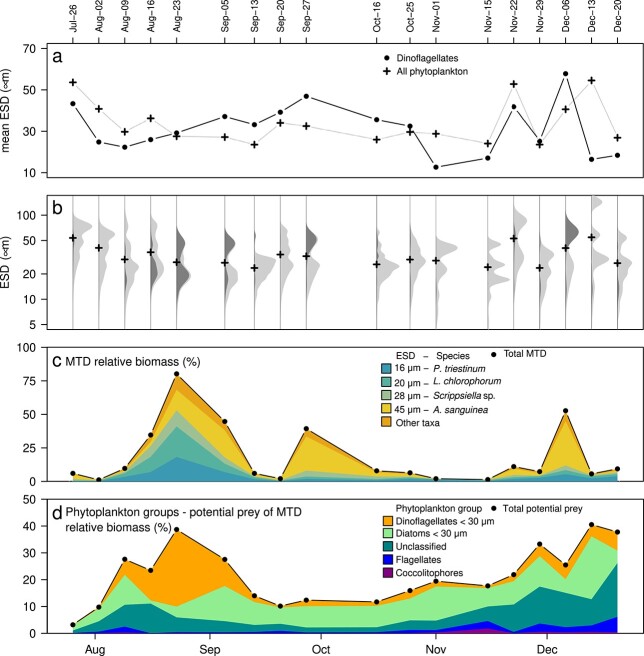
Mixotrophic dinoflagellates (MTD) are a diverse group of organisms often responsible for the formation of harmful algal blooms. However, the development of dinoflagellate blooms and their effects on the plankton community are still not well explored. Here we relate the species succession of MTD with parallel changes of phytoplankton size spectra during periods of MTD dominance. We used FlowCAM analysis to acquire size spectra in the range 2-200 μm every one or two weeks from July to December 2007 at Helgoland Roads (Southern North Sea). Most size spectra of dinoflagellates were bimodal, whereas for other groups, e.g. diatoms and autotrophic flagellates, the spectra were unimodal, which indicates different resource use strategies of autotrophs and mixotrophs. The biomass lost in the size spectrum correlates with the potential grazing pressure of MTD. Based on size-based analysis of trophic linkages, we suggest that mixotrophy, including detritivory, drives species succession and facilitates the formation of bimodal size spectra. Bimodality in particular indicates niche differentiation through grazing of large MTD on smaller MTD. Phagotrophy of larger MTD may exceed one of the smaller MTD since larger prey was more abundant than smaller prey. Under strong light limitation, a usually overlooked refuge strategy may derive from detritivory. The critical role of trophic links of MTD as a central component of the plankton community may guide future observational and theoretical research.
混合营养型甲藻(MTD)是一类多样的生物群体,常引发有害藻华。然而,甲藻藻华的发展及其对浮游生物群落的影响仍未得到充分研究。在此,我们将MTD的物种演替与MTD占主导时期浮游植物大小谱的平行变化联系起来。我们利用FlowCAM分析,于2007年7月至12月期间每隔一到两周在黑尔戈兰湾(北海南部)获取2 - 200微米范围内的大小谱。甲藻的大多数大小谱是双峰的,而对于其他类群,如硅藻和自养鞭毛虫,谱是单峰的,这表明自养生物和混合营养生物有不同的资源利用策略。大小谱中损失的生物量与MTD的潜在捕食压力相关。基于对营养联系的基于大小的分析,我们认为包括碎屑摄食在内的混合营养驱动了物种演替,并促进了双峰大小谱的形成。双峰尤其表明通过大型MTD对小型MTD的捕食实现了生态位分化。大型MTD的吞噬作用可能超过小型MTD之一,因为较大的猎物比较小的猎物更丰富。在强光限制下,一种通常被忽视的避难策略可能源于碎屑摄食。MTD的营养联系作为浮游生物群落核心组成部分的关键作用可能会指导未来的观测和理论研究。