The Johns Hopkins Kimmel Cancer Center, Baltimore, Maryland, USA.
University of Minnesota Masonic Cancer Center, Minneapolis, Minnesota, USA.
Prostate. 2022 May;82(7):753-762. doi: 10.1002/pros.24328. Epub 2022 Mar 31.
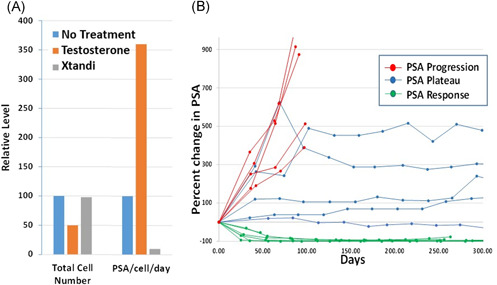
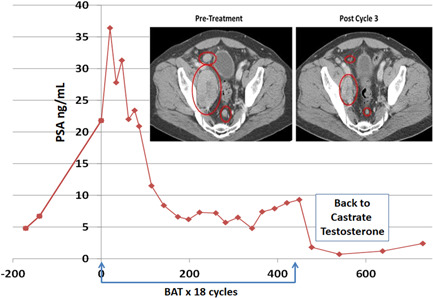
Bipolar androgen therapy (BAT) is a new treatment concept for men whose prostate cancer has become resistant to standard hormone-blocking therapy. Over the past decade, we have performed a series of clinical studies testing BAT in asymptomatic men with castration-resistant prostate cancer. The key findings from these clinical studies are that BAT (a) can be safely administered to asymptomatic patients with metastatic castrate-resistant prostate cancer; (b) does not produce symptomatic disease progression; (c) produces sustained prostate-specific antigen and objective responses in 30%-40% of patients; and (d) can resensitize and prolong response to subsequent antiandrogen therapy. The concept of BAT has generated significant interest from men with prostate cancer, their families, and their physicians. Here we provide a "Patient's Guide" that answers questions about BAT in a form that is accessible to patients, their families, and physicians. Our goal is to provide information to help patients make the most informed decisions they can regarding their prostate cancer treatment.
双氢睾酮治疗(BAT)是一种新的治疗方法,适用于那些对标准激素阻断治疗产生抗药性的前列腺癌男性患者。在过去的十年中,我们进行了一系列临床试验,以测试 BAT 在无症状去势抵抗性前列腺癌男性患者中的应用。这些临床研究的主要发现是,BAT(a)可安全地用于治疗有转移性去势抵抗性前列腺癌的无症状患者;(b)不会导致有症状的疾病进展;(c)在 30%-40%的患者中产生持续的前列腺特异性抗原和客观反应;以及 (d)可以重新敏感化并延长对后续抗雄激素治疗的反应。BAT 的概念引起了前列腺癌患者、他们的家人和医生的极大兴趣。在这里,我们提供了一份“患者指南”,以患者、其家人和医生易于理解的形式回答有关 BAT 的问题。我们的目标是提供信息,帮助患者在其前列腺癌治疗方面做出最明智的决策。