Department of Orthopaedics, Institute of Clinical Sciences, Sahlgrenska Academy, University of Gothenburg, Gothenburg, Sweden.
Department of Internal Medicine and Clinical Nutrition, Institute of Medicine, Sahlgrenska Academy, University of Gothenburg, Gothenburg, Sweden.
Knee Surg Sports Traumatol Arthrosc. 2022 Oct;30(10):3451-3460. doi: 10.1007/s00167-022-06948-x. Epub 2022 Mar 31.
To compare demographic characteristics and concomitant injury patterns in patients undergoing primary isolated posterior cruciate ligament reconstruction (PCL-R) and combined posterior cruciate ligament (PCL) and anterior cruciate ligament (ACL) reconstruction (PCL-R/ACL-R) with isolated ACL reconstruction (ACL-R) as a reference using data from the Swedish National Knee Ligament Registry (SNKLR).
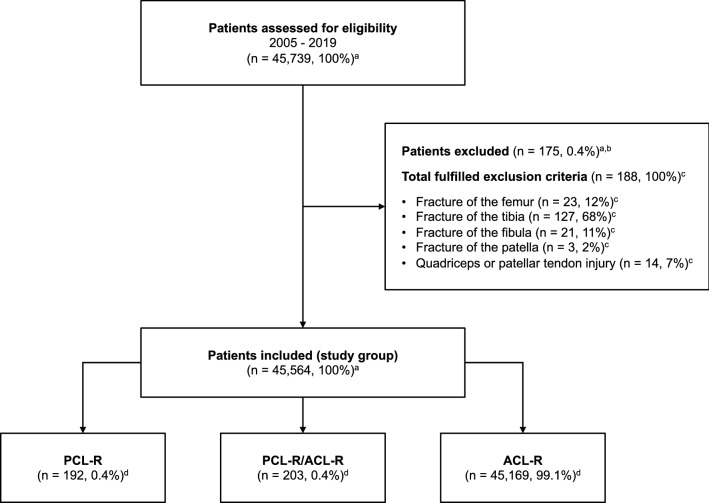
This cohort study based on the SNKLR comprised patients undergoing either PCL-R, ACL-R, or combined PCL-R/ACL-R between January 1, 2005 and December 31, 2019 in Sweden. Demographic and surgery-related data with regards to injury mechanism, concomitant intraarticular lesions and their treatment, neurovascular damage, and concomitant ligamentous injuries were extracted. Exclusion criteria included concomitant fractures of the femur, fibula, patella or tibia, and quadriceps or patellar tendon injury.
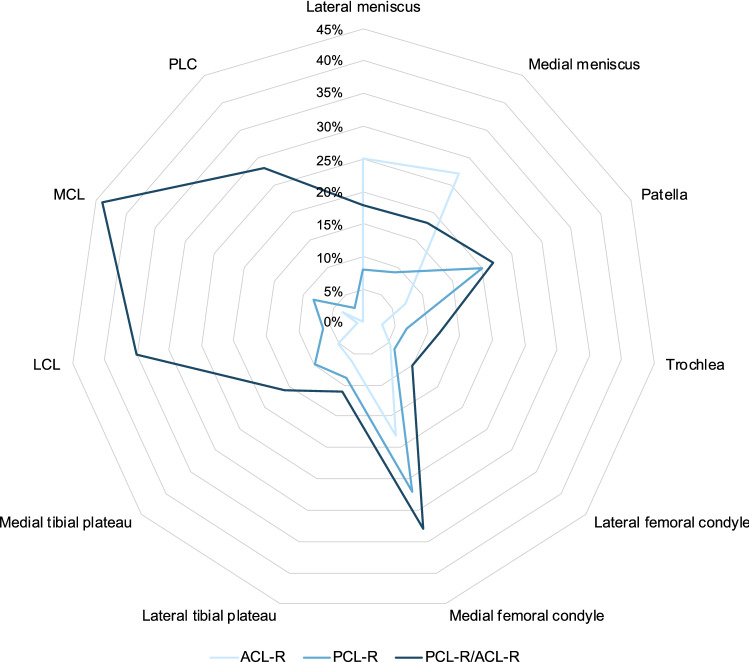
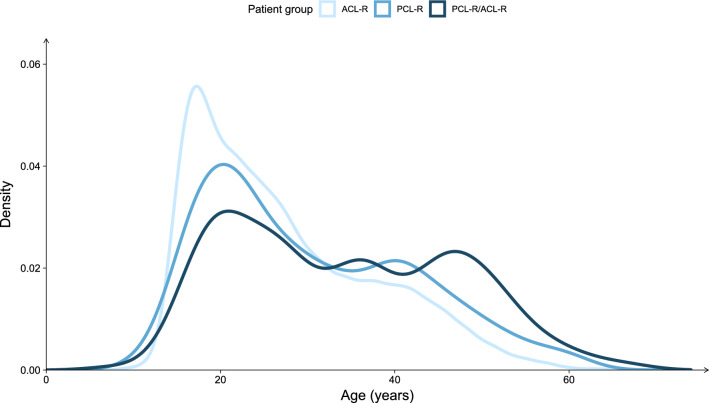
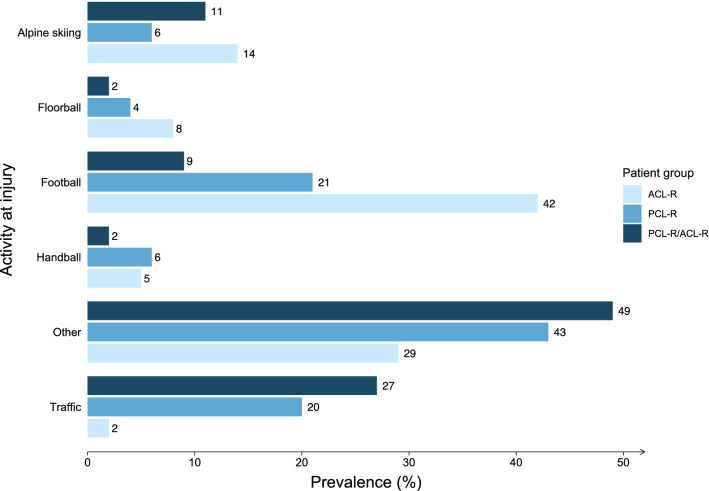
A total of 45,564 patients were included in this study. Isolated PCL-R, combined PCL-R/ACL-R, and isolated ACL-R were performed in 192 (0.4%), 203 (0.5%) and 45,169 (99.1%) patients, respectively. Sports were identified as the cause of 64% of PCL-Rs, 54% of PCL-R/ACL-Rs, and 89% of ACL-Rs, while a traffic-related mechanism was identified in 20% of PCL-Rs, 27% of PCL-R/ACL-Rs and 2% of ACL-Rs. Meniscus injury prevalence was 45% in ACL-Rs, 31% in PCL-R/ACL-Rs and 16% in isolated PCL-Rs (p < 0.001). Cartilage injuries were more common in PCL-R (37%) and PCL-R/ACL-R patients (40%) compared to ACL-R patients (26%, p < 0.001). Concomitant knee ligament injury was identified in 28-44% of PCL-R/ACL-R patients. Neurovascular injuries were present in 9% of PCL-R/ACL-Rs, 1% of PCL-Rs, and 0.3% of ACL-Rs (p < 0.001).
Differences in injury mechanisms among patient groups confirm that operatively treated PCL tears are frequently caused by both traffic and sports. Cartilage and ligament injuries were more frequent in patients with PCL-R compared to ACL-R. Consequently, combined PCL and ACL tears should raise suspicion for concomitant knee lesions with clinical relevance during the operative treatment of these complex injuries.
III.
利用瑞典膝关节韧带国家登记处(SNKLR)的数据,比较初次单纯后交叉韧带重建(PCL-R)与合并后交叉韧带(PCL)和前交叉韧带(ACL)重建(PCL-R/ACL-R)与单纯 ACL 重建(ACL-R)患者的人口统计学特征和伴随损伤模式。
本基于 SNKLR 的队列研究纳入了 2005 年 1 月 1 日至 2019 年 12 月 31 日期间在瑞典接受 PCL-R、ACL-R 或合并 PCL-R/ACL-R 的患者。提取了有关损伤机制、伴发关节内病变及其治疗、神经血管损伤和伴发韧带损伤的人口统计学和手术相关数据。排除标准包括股骨、腓骨、髌骨或胫骨骨折以及股四头肌或髌腱损伤。
本研究共纳入 45564 例患者。单纯 PCL-R、合并 PCL-R/ACL-R 和单纯 ACL-R 分别在 192(0.4%)、203(0.5%)和 45169(99.1%)例患者中进行。运动被确定为 64%的 PCL-R、54%的 PCL-R/ACL-R 和 89%的 ACL-R 的病因,而交通相关机制分别在 20%的 PCL-R、27%的 PCL-R/ACL-R 和 2%的 ACL-R 中被确定。半月板损伤的发生率在 ACL-R 中为 45%,在 PCL-R/ACL-R 中为 31%,在单纯 PCL-R 中为 16%(p<0.001)。与 ACL-R 患者(26%,p<0.001)相比,PCL-R(37%)和 PCL-R/ACL-R 患者(40%)的软骨损伤更为常见。在 PCL-R/ACL-R 患者中,28-44%的患者存在膝关节韧带合并损伤。神经血管损伤在 PCL-R/ACL-R 患者中占 9%,在 PCL-R 患者中占 1%,在 ACL-R 患者中占 0.3%(p<0.001)。
不同患者群体的损伤机制差异证实,手术治疗的 PCL 撕裂常由交通和运动引起。与 ACL-R 相比,PCL-R 患者的软骨和韧带损伤更为常见。因此,PCL 和 ACL 合并撕裂时,在治疗这些复杂损伤时,应在手术治疗中高度怀疑伴有关节内病变,且具有临床意义。
III 级。