King Brett A, Senna Maryanne M, Ohyama Manabu, Tosti Antonella, Sinclair Rodney D, Ball Susan, Ko Justin M, Glashofer Marc, Pirmez Rodrigo, Shapiro Jerry
Department of Dermatology, Yale School of Medicine, PO Box 208059, New Haven, CT, 06520, USA.
Department of Dermatology, Massachusetts General Hospital and Harvard Medical School, Boston, MA, USA.
Dermatol Ther (Heidelb). 2022 Apr;12(4):825-834. doi: 10.1007/s13555-022-00711-3. Epub 2022 Mar 31.
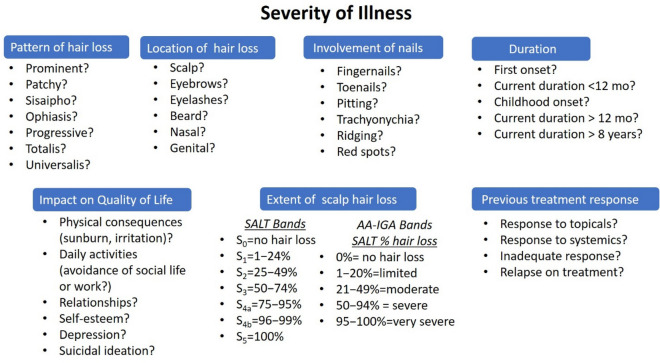
Alopecia areata (AA) is an autoimmune disease characterized by nonscarring hair loss. As a clinically heterogeneous disease, various classification systems have evolved for defining its severity. In this high-level review of the literature, we discuss the traditional classification systems for AA severity and their strengths and weaknesses. Most recent classifications have focused on the extent of scalp hair loss as a defining feature, but additional clinical aspects of the disease, including location, pattern, and duration of hair loss as well as impact on the patient's quality of life, are also relevant. These various components have typically been used unidimensionally to classify patients. We propose a multidimensional framework to define AA severity that incorporates multiple patient- and illness-related domains. Using such a framework, dermatologists may better assess the severity of the disease for the individual patient beyond the extent of hair loss.
斑秃(AA)是一种以非瘢痕性脱发为特征的自身免疫性疾病。作为一种临床异质性疾病,已经形成了各种分类系统来定义其严重程度。在本次对文献的高级综述中,我们讨论了斑秃严重程度的传统分类系统及其优缺点。最近的分类主要集中在头皮脱发的范围作为一个决定性特征,但该疾病的其他临床方面,包括脱发的部位、模式和持续时间以及对患者生活质量的影响,也具有相关性。这些不同的组成部分通常被单维度地用于对患者进行分类。我们提出了一个多维框架来定义斑秃的严重程度,该框架纳入了多个与患者和疾病相关的领域。使用这样一个框架,皮肤科医生可以超越脱发范围,更好地评估个体患者的疾病严重程度。