Department of Infection, Guy's and St Thomas' NHS Foundation Trust, London, UK.
Gilead Sciences Ltd UK & Ireland, Medical Department, London, UK.
J Viral Hepat. 2022 Jul;29(7):559-568. doi: 10.1111/jvh.13676. Epub 2022 Apr 9.
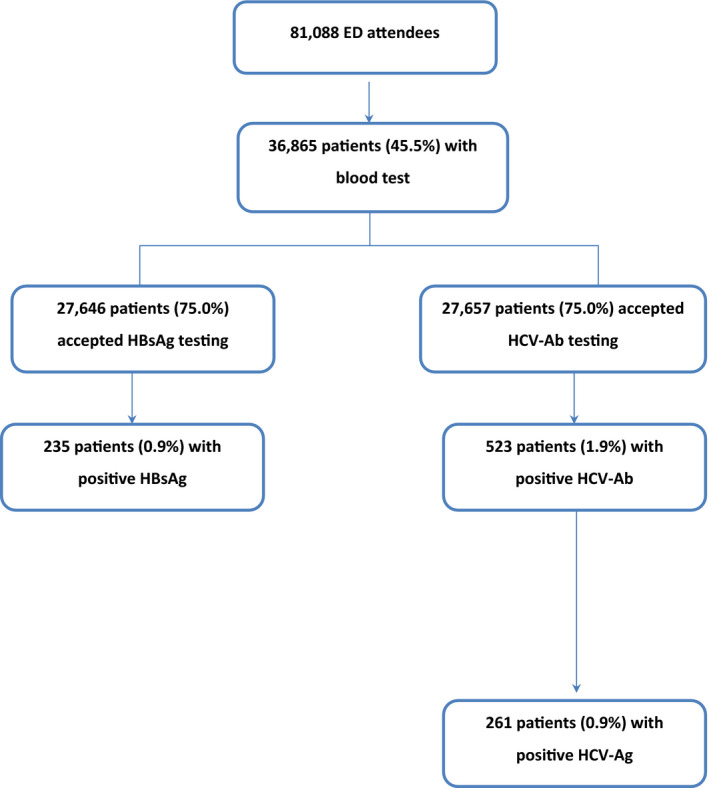
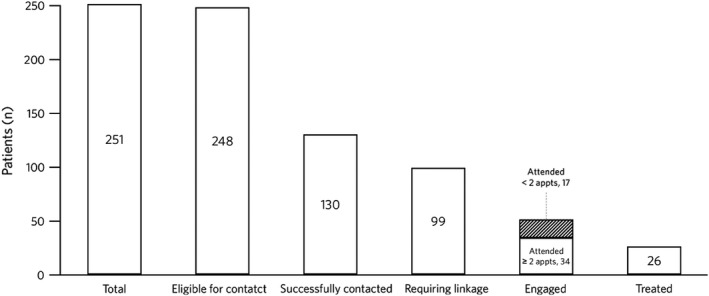
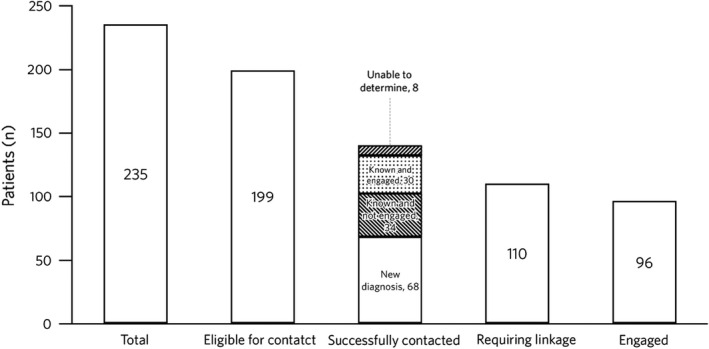
Innovative testing approaches and care pathways are required to meet global hepatitis B virus (HBV) and hepatitis C virus (HCV) elimination goals. Routine blood-borne virus (BBV) testing in emergency departments (EDs) in high-prevalence areas is suggested by the European Centre for Disease Prevention and Control (ECDC) but there is limited evidence for this. Universal HIV testing in our ED according to UK guidance has been operational since 2015. We conducted a real-world service evaluation of a modified electronic patient record (EPR) system to include opportunistic opt-out HBV/reflex-HCV tests for any routine blood test orders for ED attendees aged ≥16 years. Reactive laboratory results were communicated directly to specialist clinical teams. Our model for contacting patients requiring linkage to care (new diagnoses/known but disengaged) evolved from initially primarily hospital-led to collaborating with regional health and community service networks. Over 11 months, 81,088 patients attended the ED; 36,865 (45.5%) had a blood test. Overall uptake for both HBV and HCV testing was 75%. Seroprevalence was 0.9% for hepatitis B surface antigen (HBsAg) and 0.9% for HCV antigen (HCV-Ag). 79% of 140 successfully contacted HBsAg+patients required linkage to care, of which 87% engaged. 76% of 130 contactable HCV-Ag+patients required linkage, 52% engaged. Our results demonstrate effectiveness and sustainability of universal ED EPR opt-out HBV/HCV testing combined with comprehensive linkage to care pathways, allowing care provision particularly for marginalized at-risk groups with limited healthcare access. The findings support the ECDC BBV testing guidance and may inform future UK hepatitis testing guidance.
需要创新的检测方法和护理途径来实现全球乙型肝炎病毒 (HBV) 和丙型肝炎病毒 (HCV) 的消除目标。欧洲疾病预防控制中心 (ECDC) 建议在高流行地区的急诊科 (ED) 进行常规血液传播病毒 (BBV) 检测,但这方面的证据有限。根据英国的指导意见,我们的 ED 自 2015 年以来一直在进行普遍的艾滋病毒检测。我们对修改后的电子病历 (EPR) 系统进行了真实世界的服务评估,该系统将包括对任何年龄≥16 岁的 ED 就诊者的常规血液检查订单进行机会性乙型肝炎病毒/反射丙型肝炎病毒检测。反应性实验室结果直接传达给专科临床团队。我们联系需要联系护理的患者(新诊断/已知但未参与)的模式最初主要是医院主导,后来发展为与区域卫生和社区服务网络合作。在 11 个月的时间里,有 81088 名患者到 ED 就诊;36865 人(45.5%)进行了血液检查。乙型肝炎和丙型肝炎检测的总体接受率为 75%。乙型肝炎表面抗原 (HBsAg) 的血清阳性率为 0.9%,丙型肝炎抗原 (HCV-Ag) 的血清阳性率为 0.9%。140 名成功联系到的 HBsAg+患者中有 79%需要联系护理,其中 87%参与。130 名可联系到的 HCV-Ag+患者中有 76%需要联系,其中 52%参与。我们的结果表明,结合综合联系护理途径,对所有 ED EPR 选择退出 HBV/HCV 检测具有有效性和可持续性,这使得护理能够提供给那些获得医疗保健机会有限的边缘化高危人群。这些发现支持 ECDC 的 BBV 检测指南,并可能为未来英国的肝炎检测指南提供信息。