Department of Pathology and Laboratory Medicine.
UNC Blood Research Center.
Blood. 2022 May 26;139(21):3194-3203. doi: 10.1182/blood.2022015787.
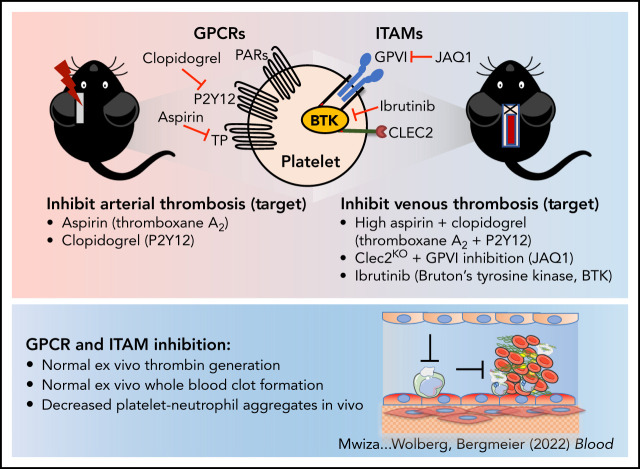
Platelets are critical in hemostasis and a major contributor to arterial thrombosis (AT). (Pre)clinical studies suggest platelets also contribute to venous thrombosis (VT), but the mechanisms are largely unknown. We hypothesized that in VT, platelets use signaling machinery distinct from AT. Here we aimed to characterize the contributions of platelet G protein-coupled (GPCR) and immunoreceptor tyrosine-based activation motif (ITAM) receptor signaling to VT. Wild-type (WT) and transgenic mice were treated with inhibitors to selectively inhibit platelet-signaling pathways: ITAM-CLEC2 (Clec2mKO), glycoprotein VI (JAQ1 antibody), and Bruton's tyrosine kinase (ibrutinib); GPCR-cyclooxygenase 1 (aspirin); and P2Y12 (clopidogrel). VT was induced by inferior vena cava stenosis. Thrombin generation in platelet-rich plasma and whole-blood clot formation were studied ex vivo. Intravital microscopy was used to study platelet-leukocyte interactions after flow restriction. Thrombus weights were reduced in WT mice treated with high-dose aspirin + clopidogrel (dual antiplatelet therapy [DAPT]) but not in mice treated with either inhibitor alone or low-dose DAPT. Similarly, thrombus weights were reduced in mice with impaired ITAM signaling (Clec2mKO + JAQ1; WT + ibrutinib) but not in Clec2mKO or WT + JAQ1 mice. Both aspirin and clopidogrel, but not ibrutinib, protected mice from FeCl3-induced AT. Thrombin generation and clot formation were normal in blood from high-dose DAPT- or ibrutinib-treated mice; however, platelet adhesion and platelet-neutrophil aggregate formation at the vein wall were reduced in mice treated with high-dose DAPT or ibrutinib. In summary, VT initiation requires platelet activation via GPCRs and ITAM receptors. Strong inhibition of either signaling pathway reduces VT in mice.
血小板在止血和动脉血栓形成 (AT) 中起着关键作用。(临床前)研究表明,血小板也有助于静脉血栓形成 (VT),但机制在很大程度上尚不清楚。我们假设在 VT 中,血小板使用与 AT 不同的信号机制。在这里,我们旨在表征血小板 G 蛋白偶联 (GPCR) 和免疫受体酪氨酸基激活基序 (ITAM) 受体信号对 VT 的贡献。使用选择性抑制血小板信号通路的抑制剂处理野生型 (WT) 和转基因小鼠:ITAM-CLEC2(Clec2mKO)、糖蛋白 VI(JAQ1 抗体)和布鲁顿酪氨酸激酶(ibrutinib);GPCR-环氧化酶 1(阿司匹林);和 P2Y12(氯吡格雷)。通过下腔静脉狭窄诱导 VT。研究富含血小板的血浆和全血凝块形成的体外血栓生成。使用活体显微镜研究血流限制后血小板-白细胞相互作用。WT 小鼠用高剂量阿司匹林+氯吡格雷(双重抗血小板治疗 [DAPT])治疗,但用单独一种抑制剂或低剂量 DAPT 治疗的小鼠血栓重量减轻。同样,ITAM 信号受损(Clec2mKO+JAQ1;WT+ibrutinib)的小鼠血栓重量减轻,但 Clec2mKO 或 WT+JAQ1 小鼠则不然。阿司匹林和氯吡格雷均能保护小鼠免受 FeCl3 诱导的 AT,但 ibrutinib 则不能。高剂量 DAPT 或 ibrutinib 治疗的小鼠血液中的凝血酶生成和凝块形成正常;然而,在高剂量 DAPT 或 ibrutinib 治疗的小鼠中,血小板黏附性和血小板-中性粒细胞在静脉壁上的聚集减少。总之,VT 的启动需要 GPCR 和 ITAM 受体介导的血小板激活。两种信号通路的强烈抑制均可减少小鼠的 VT。