Electrotechnical Engineering and Energy Technology, MOBI Research Group, Vrije Universiteit Brussel, Pleinlaan 2, Brussels 1050, Belgium.
Electrotechnical Engineering and Energy Technology, MOBI Research Group, Vrije Universiteit Brussel, Pleinlaan 2, Brussels 1050, Belgium.
Sci Total Environ. 2022 Jul 20;831:154859. doi: 10.1016/j.scitotenv.2022.154859. Epub 2022 Mar 28.
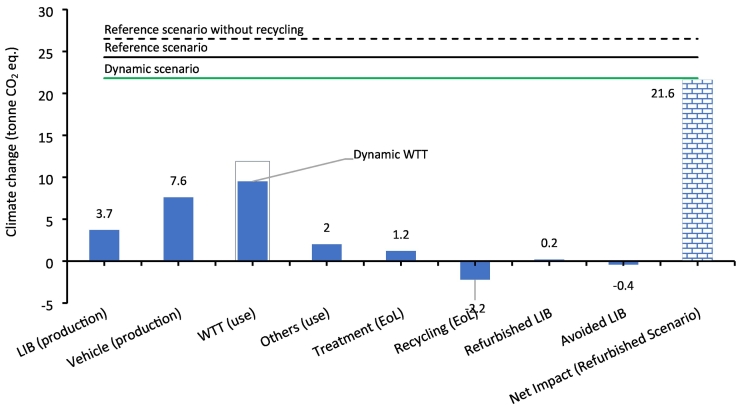
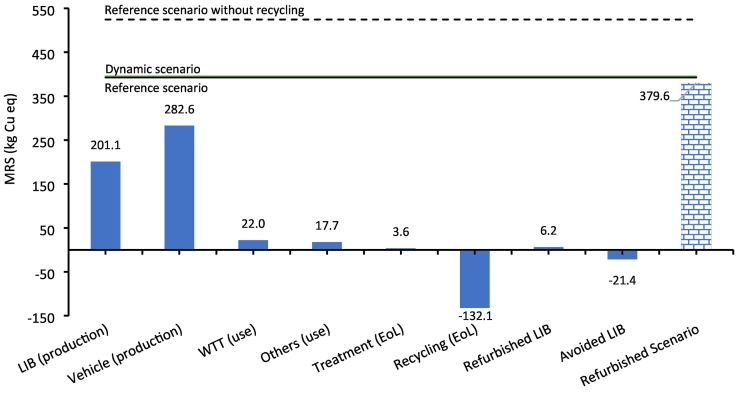
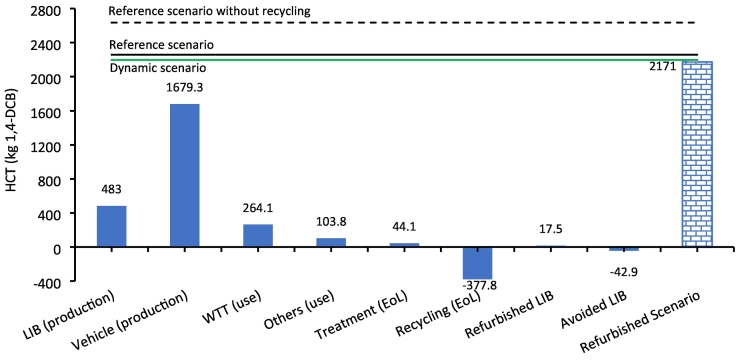
The environmental performance of battery electric vehicles (BEVs) is influenced by their battery size and charging electricity source. Therefore, assessing their environmental performance should consider changes in the electricity sector and refurbishment of their batteries. This study conducts a scenario-based Life Cycle Assessment (LCA) of three different scenarios combining four key parameters: future changes in the charging electricity mix, battery efficiency fade, battery refurbishment, and recycling for their collective importance on the life-cycle environmental performance of a BEV. The system boundary covers all the life-cycle stages of the BEV and includes battery refurbishment, except for its second use stage. The refurbished battery was modelled considering refurbished components and a 50% cell conversation rate for the second life of 5 years. The results found a 9.4% reduction in climate impacts when future changes (i.e., increase in the share of renewable energy) in the charging electricity are considered. Recycling reduced the BEV climate impacts by approximately 8.3%, and a reduction smaller than 1% was observed for battery refurbishment. However, the battery efficiency fade increases the BEV energy consumption, which results in a 7.4 to 8.1% rise in use-stage climate impacts. Therefore, it is vital to include battery efficiency fade and changes to the electricity sector when estimating the use-stage impacts of BEVs; without this, LCA results could be unreliable. The sensitivity analysis showed the possibility of a higher reduction in the BEV climate impacts for longer second lifespans (>5 years) and higher cell conversation rates (>50%). BEV and battery production are the most critical stages for all the other impact categories assessed, specifically contributing more than 90% to mineral resource scarcity. However, recycling and battery refurbishment can reduce the burden of the different impact categories considered. Therefore, manufacturers should design BEV battery packs while considering recycling and refurbishment.
电池电动汽车 (BEV) 的环境性能受其电池尺寸和充电电源的影响。因此,评估其环境性能应考虑电力部门的变化和电池的翻新。本研究通过基于情景的生命周期评估 (LCA) 对四个关键参数相结合的三种不同情景进行了评估:未来充电电力组合的变化、电池效率衰减、电池翻新以及它们对 BEV 生命周期环境性能的集体重要性的回收。系统边界涵盖了 BEV 的所有生命周期阶段,包括电池翻新,但其第二使用阶段除外。翻新电池考虑了翻新组件和 50%的电池转化率,其第二使用寿命为 5 年。结果发现,当考虑未来充电电力的变化(即可再生能源份额增加)时,气候影响降低了 9.4%。回收减少了 BEV 的气候影响,约为 8.3%,而电池翻新的减少小于 1%。然而,电池效率衰减会增加 BEV 的能源消耗,从而导致使用阶段气候影响增加 7.4%至 8.1%。因此,在估计 BEV 的使用阶段影响时,必须包括电池效率衰减和电力部门的变化;否则,LCA 结果可能不可靠。敏感性分析表明,对于更长的第二寿命(>5 年)和更高的电池转化率(>50%),BEV 气候影响的降低幅度可能更大。对于评估的所有其他影响类别,BEV 和电池生产是最关键的阶段,特别是对矿产资源稀缺性的贡献超过 90%。然而,回收和电池翻新可以减轻不同考虑的影响类别。因此,制造商在设计 BEV 电池组时应考虑回收和翻新。