Sato Akemi, Tominaga Koji, Iwatani Yoshiko, Kato Yoko, Wataya-Kaneda Mari, Makita Kai, Nemoto Kiyotaka, Taniike Masako, Kagitani-Shimono Kuriko
United Graduate School of Child Development, Osaka University, Osaka, Japan.
Molecular Research Center for Children's Mental Development, Osaka University Graduate School of Medicine, Osaka, Japan.
Front Neurol. 2022 Mar 14;13:782479. doi: 10.3389/fneur.2022.782479. eCollection 2022.
Tuberous sclerosis complex (TSC) is a genetic disease that arises from or abnormalities and induces the overactivation of the mammalian/mechanistic target of rapamycin pathways. The neurological symptoms of TSC include epilepsy and tuberous sclerosis complex-associated neuropsychiatric disorders (TAND). Although TAND affects TSC patients' quality of life, the specific region in the brain associated with TAND remains unknown. We examined the association between white matter microstructural abnormalities and TAND, using diffusion tensor imaging (DTI).
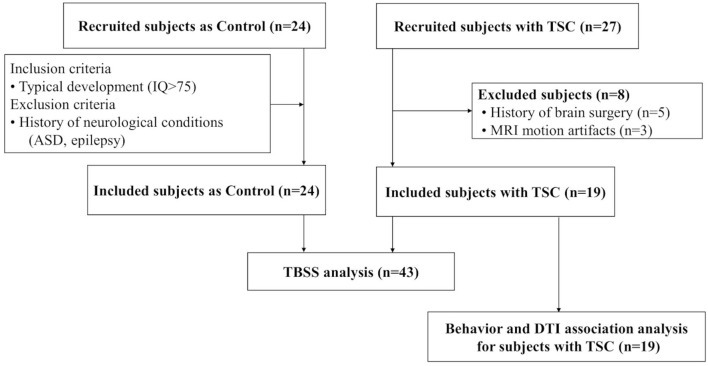
A total of 19 subjects with TSC and 24 age-matched control subjects were enrolled. Tract-based spatial statistics (TBSS) were performed to assess group differences in fractional anisotropy (FA) between the TSC and control groups. Atlas-based association analysis was performed to reveal TAND-related white matter in subjects with TSC. Multiple linear regression was performed to evaluate the association between TAND and the DTI parameters; FA and mean diffusivity in seven target regions and projection fibers.
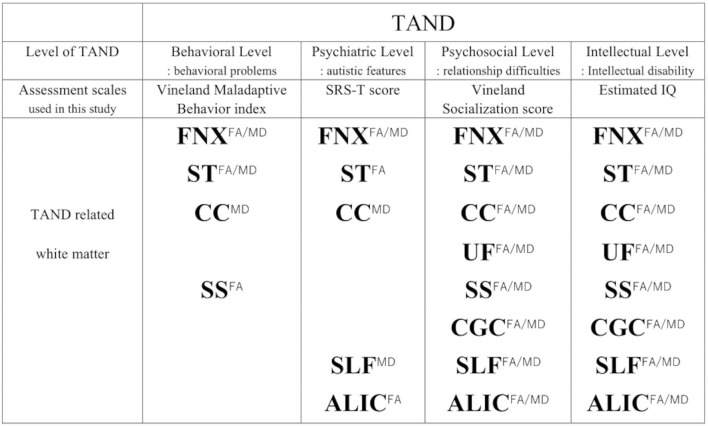
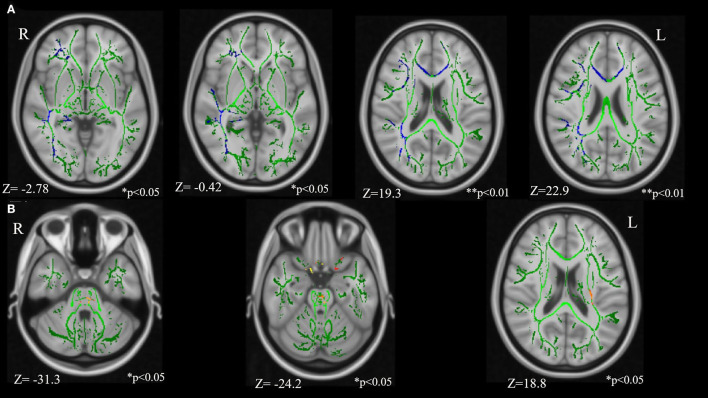
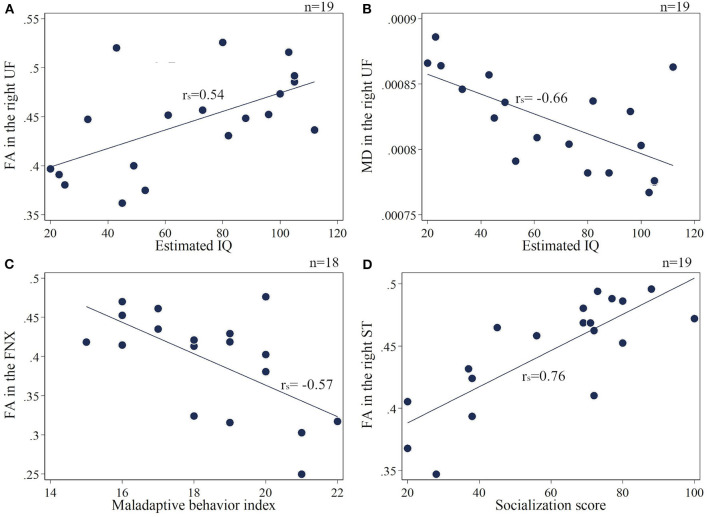
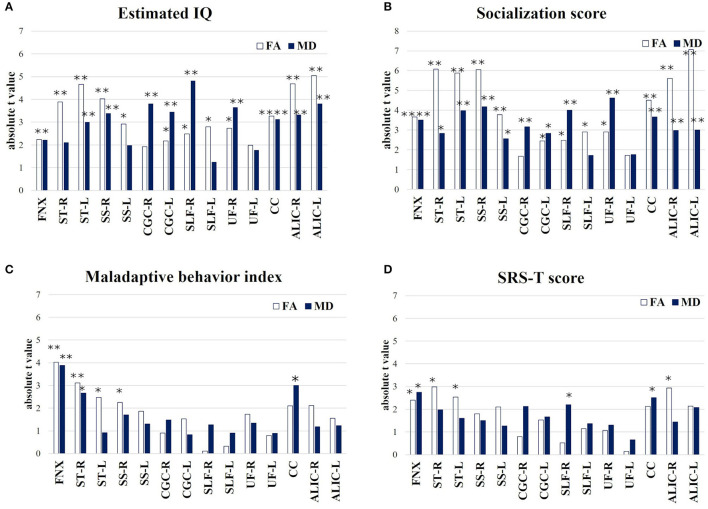
The TBSS showed significantly reduced FA in the right hemisphere and particularly in the inferior frontal occipital fasciculus (IFOF), inferior longitudinal fasciculus (ILF), superior longitudinal fasciculus (SLF), uncinate fasciculus (UF), and genu of corpus callosum (CC) in the TSC group relative to the control group. In the association analysis, intellectual disability was widely associated with all target regions. In contrast, behavioral problems and autistic features were associated with the limbic system white matter and anterior limb of the internal capsule (ALIC) and CC.
The disruption of white matter integrity may induce underconnectivity between cortical and subcortical regions. These findings suggest that TANDs are not the result of an abnormality in a specific brain region, but rather caused by connectivity dysfunction as a network disorder. This study indicates that abnormal white matter connectivity including the limbic system is relevant to TAND. The analysis of brain and behavior relationship is a feasible approach to reveal TAND related white matter and neural networks. TAND should be carefully assessed and treated at an early stage.
结节性硬化症(TSC)是一种由 异常引起的遗传性疾病,并诱导雷帕霉素哺乳动物/机制靶点通路的过度激活。TSC的神经症状包括癫痫和结节性硬化症相关神经精神障碍(TAND)。尽管TAND会影响TSC患者的生活质量,但与TAND相关的大脑特定区域仍不清楚。我们使用扩散张量成像(DTI)研究了白质微结构异常与TAND之间的关联。
共纳入19名TSC受试者和24名年龄匹配的对照受试者。采用基于纤维束的空间统计学(TBSS)评估TSC组和对照组之间的各向异性分数(FA)的组间差异。进行基于图谱的关联分析,以揭示TSC受试者中与TAND相关的白质。进行多元线性回归以评估TAND与DTI参数之间的关联;七个目标区域和投射纤维中的FA和平均扩散率。
TBSS显示,与对照组相比,TSC组右半球,特别是额枕下束(IFOF)、下纵束(ILF)、上纵束(SLF)、钩束(UF)和胼胝体膝部(CC)的FA显著降低。在关联分析中,智力残疾与所有目标区域广泛相关。相比之下,行为问题和自闭症特征与边缘系统白质、内囊前肢(ALIC)和CC相关。
白质完整性的破坏可能导致皮质和皮质下区域之间的连接不足。这些发现表明,TAND不是特定脑区异常的结果,而是由作为网络障碍的连接功能障碍引起的。这项研究表明,包括边缘系统在内的异常白质连接与TAND相关。脑与行为关系的分析是揭示TAND相关白质和神经网络的可行方法。应在早期对TAND进行仔细评估和治疗。