Neuhaus Edmund C, Slavich George M
Department of Psychiatry, McLean Hospital/Harvard Medical School, Belmont, MA, United States.
atai Life Sciences, San Diego, CA, United States.
Front Psychiatry. 2022 Mar 14;13:821208. doi: 10.3389/fpsyt.2022.821208. eCollection 2022.
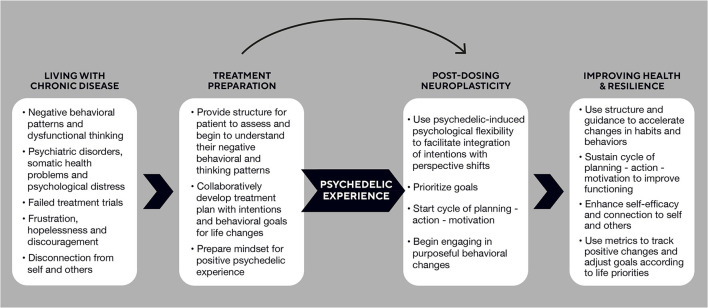
One of the most recent and potentially promising advancements in the health sciences has involved the attempted use of psychedelics for treating mental and behavioral health problems, such as anxiety, depression, posttraumatic stress disorder, and addiction. Despite surging scientific and public interest in this work, however, we presently have no standard of care or consensus regarding how best to combine psychotherapy and psychedelics or to assess effectiveness. We discuss these timely issues here through the lens of , which we define as the study of psychedelics to foster intentional changes in habits and behaviors to improve health and resilience. Psychedelics may have the potential to reduce chronic disease risk caused by mental and behavioral rigidity. To fully realize this potential, though, we believe the field must establish best practices and guidelines that include how to induce lasting changes in behavior.
健康科学领域最近最具潜力且有前景的进展之一,涉及尝试使用迷幻剂来治疗精神和行为健康问题,如焦虑、抑郁、创伤后应激障碍和成瘾。然而,尽管科学界和公众对这项工作的兴趣激增,但目前我们对于如何最好地将心理治疗与迷幻剂相结合或评估其有效性,尚无护理标准或共识。我们在此通过“行为迷幻学”的视角来讨论这些适时出现的问题,我们将“行为迷幻学”定义为对迷幻剂的研究,以促进习惯和行为的有意改变,从而改善健康状况和恢复力。迷幻剂可能有潜力降低由精神和行为僵化导致的慢性病风险。不过,为了充分实现这一潜力,我们认为该领域必须建立包括如何诱导行为产生持久变化在内的最佳实践和指导方针。