Morrison Catriona A, Butler Simon J, Clark Jacquie A, Arizaga Juan, Baltà Oriol, Cepák Jaroslav, Nebot Arantza Leal, Piha Markus, Thorup Kasper, Wenninger Thomas, Robinson Robert A, Gill Jennifer A
School of Biological Sciences, University of East Anglia, Norwich Research Park, Norwich NR4 7TJ, UK.
British Trust for Ornithology, The Nunnery, Thetford IP24 2PU, UK.
R Soc Open Sci. 2022 Mar 30;9(3):211671. doi: 10.1098/rsos.211671. eCollection 2022 Mar.
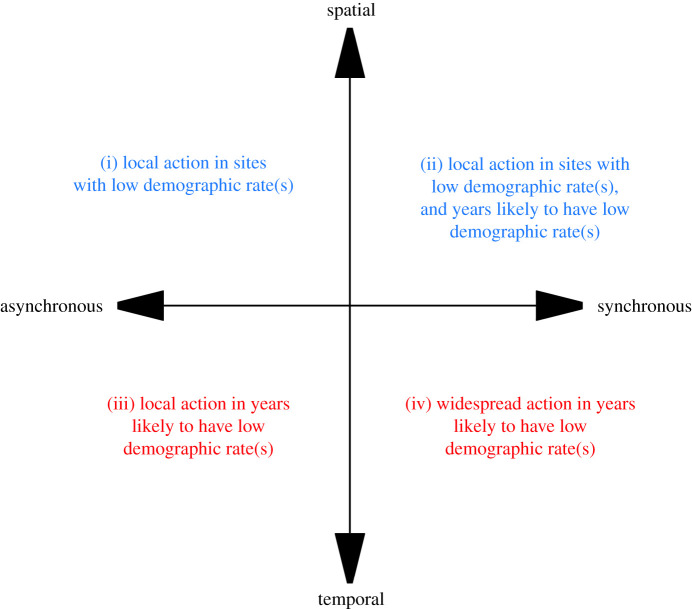
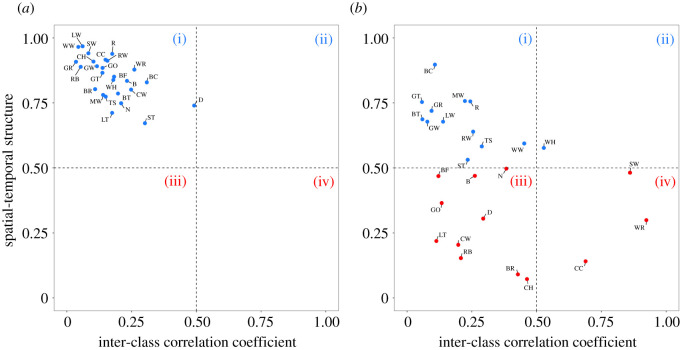
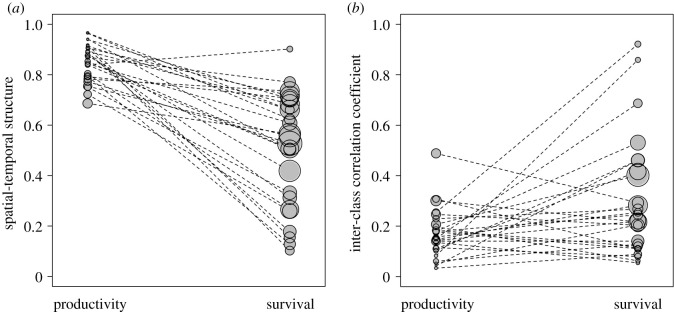
The dynamics of wild populations are governed by demographic rates which vary spatially and/or temporally in response to environmental conditions. Conservation actions for widespread but declining populations could potentially exploit this variation to target locations (or years) in which rates are low, but only if consistent spatial or temporal variation in demographic rates occurs. Using long-term demographic data for wild birds across Europe, we show that productivity tends to vary between sites (consistently across years), while survival rates tend to vary between years (consistently across sites), and that spatial synchrony is more common in survival than productivity. Identifying the conditions associated with low demographic rates could therefore facilitate spatially targeted actions to improve productivity or (less feasibly) forecasting and temporally targeting actions to boost survival. Decomposing spatio-temporal variation in demography can thus be a powerful tool for informing conservation policy and for revealing appropriate scales for actions to influence demographic rates.
野生种群的动态受人口统计学比率的支配,这些比率会随着环境条件在空间和/或时间上发生变化。对于分布广泛但数量正在减少的种群,保护行动有可能利用这种变化,针对比率较低的地点(或年份)采取措施,但前提是人口统计学比率存在一致的空间或时间变化。利用欧洲野生鸟类的长期人口统计学数据,我们发现繁殖率往往在不同地点之间存在差异(多年来保持一致),而存活率往往在不同年份之间存在差异(多年来保持一致),并且空间同步性在存活率方面比繁殖率更为常见。因此,确定与低人口统计学比率相关的条件有助于采取空间针对性行动来提高繁殖率,或者(可行性较低)进行预测并采取时间针对性行动来提高存活率。分解人口统计学中的时空变化因此可以成为一个强有力的工具,为保护政策提供依据,并揭示影响人口统计学比率的行动的适当尺度。