
基于人工智能中人机交互的提高文本阅读能力的策略
Strategies for Improving Text Reading Ability Based on Human-Computer Interaction in Artificial Intelligence.
作者信息
Shen Guorong
机构信息
School of Foreign Languages, Henan University of Technology, Zhengzhou, China.
出版信息
Front Psychol. 2022 Mar 11;13:853066. doi: 10.3389/fpsyg.2022.853066. eCollection 2022.
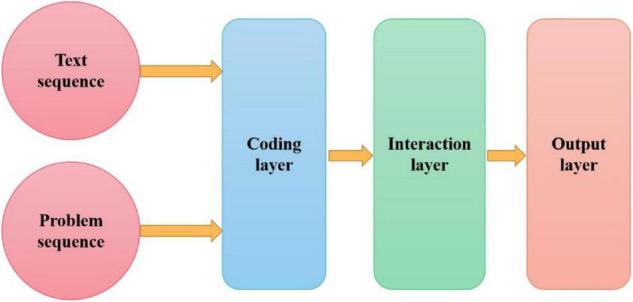
In order to improve text reading ability, a human-computer interaction method based on artificial intelligence (AI) human-computer interaction is proposed. Firstly, the design of the AI human-computer interaction model is constructed, which includes the Stanford Question Answering Dataset (SQuAD) and the designed baseline model. There are three components: the coding layer is based on a cyclic neural network (recurrent neural network [RNN] encoder layer), which aims to encode the problem and text into a hidden state; the interaction layer is used to integrate problems and text representation; the output layer connects two independent soft Max layers after a fully connected layer, one is used to obtain the starting position of the answer in the text and the other is used to obtain the ending position. In the interaction layer of the model, this manuscript uses hierarchical attention and aggregation mechanism to improve text coding. The traditional model interaction layer has a simple structure, which leads to weak relevance between text and problems, and poor understanding ability of the model. Finally, the self-attention model is used to further enhance the feature representation of text. The experimental results show that the improved model in this manuscript is compared with the public AI human-computer interaction reading comprehension model. According to the data in the table, the accuracy of the model in this manuscript is better than that of the baseline model, in which the exact match (EM) value is increased by 1.4% and the F1 value is increased by 2.7%. However, compared with improvement point 2, the EM and F1 values of the model have decreased by 0.7%. It shows that the output layer has a certain impact on the effect of the model, and the improvement and optimization of the output layer can also improve the performance of the model. It is proved that AI human-computer interaction can effectively improve text reading ability.
为了提高文本阅读能力,提出了一种基于人工智能(AI)人机交互的人机交互方法。首先,构建了AI人机交互模型的设计,其中包括斯坦福问答数据集(SQuAD)和设计的基线模型。它有三个组件:编码层基于循环神经网络(递归神经网络[RNN]编码器层),旨在将问题和文本编码为隐藏状态;交互层用于整合问题和文本表示;输出层在全连接层之后连接两个独立的soft Max层,一个用于获取文本中答案的起始位置,另一个用于获取结束位置。在模型的交互层中,本文使用分层注意力和聚合机制来改进文本编码。传统模型交互层结构简单,导致文本与问题之间的相关性较弱,模型的理解能力较差。最后,使用自注意力模型进一步增强文本的特征表示。实验结果表明,本文改进后的模型与公共AI人机交互阅读理解模型进行了比较。根据表中的数据,本文模型的准确率优于基线模型,其中精确匹配(EM)值提高了1.4%,F1值提高了2.7%。然而,与改进点2相比,模型的EM和F1值下降了0.7%。这表明输出层对模型的效果有一定影响,对输出层的改进和优化也可以提高模型的性能。证明了AI人机交互可以有效提高文本阅读能力。




 Zotero 插件