Katsanis Sara H, Claes Peter, Doerr Megan, Cook-Deegan Robert, Tenenbaum Jessica D, Evans Barbara J, Lee Myoung Keun, Anderton Joel, Weinberg Seth M, Wagner Jennifer K
Mary Ann and J. Milburn Smith Child Health Outcomes, Research, and Evaluation Center, Ann and Robert H. Lurie Children's Hospital of Chicago, Chicago, IL 60611 USA; Department of Pediatrics, Feinberg School of Medicine, Northwestern University, Evanston, IL 60208 USA.
Department of Electrical Engineering, ESAT/PSI, Medical Imaging Research Center, and Department of Human Genetics, KU Leuven, 3000 Leuven, Belgium.
IEEE Trans Technol Soc. 2022 Mar;3(1):9-15. doi: 10.1109/tts.2021.3120317. Epub 2021 Oct 18.
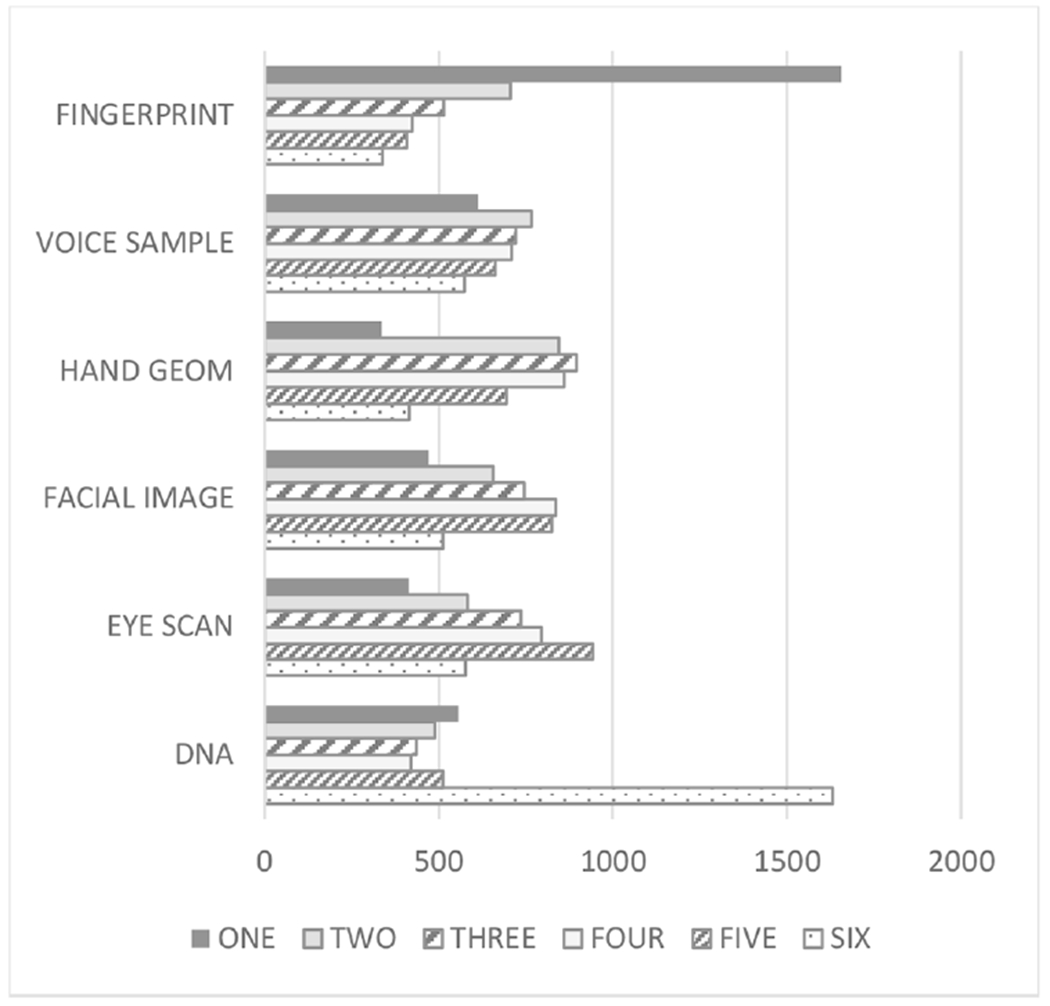
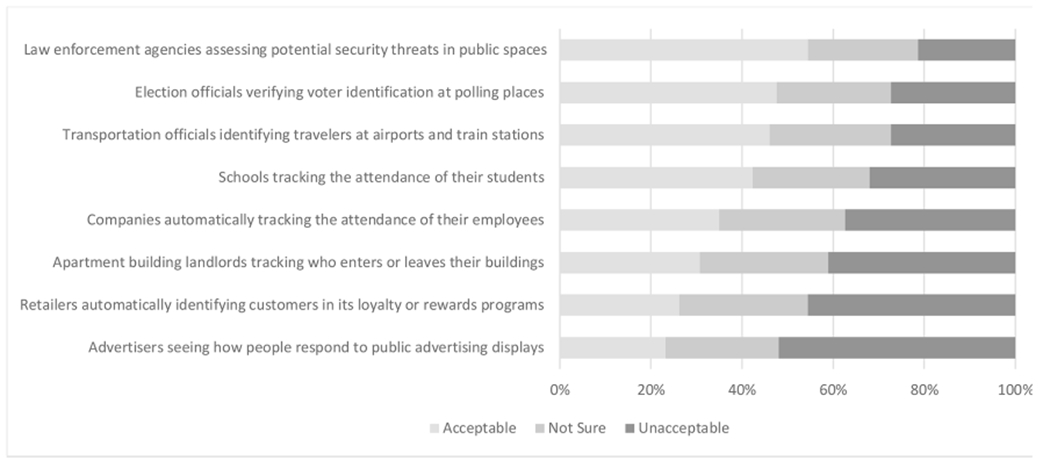
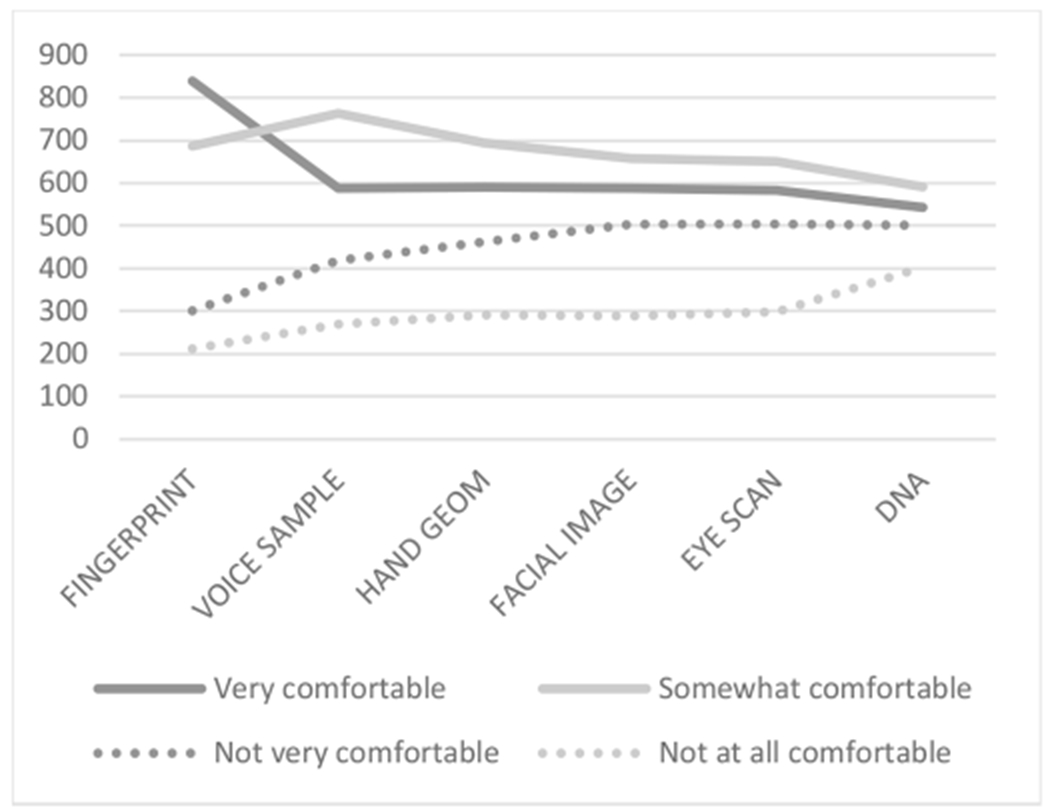
Applications of biometrics in various societal contexts have been increasing in the United States, and policy debates about potential restrictions and expansions for specific biometrics (such as facial recognition and DNA identification) have been intensifying. Empirical data about public perspectives on different types of biometrics can inform these debates. We surveyed 4048 adults to explore perspectives regarding experience and comfort with six types of biometrics; comfort providing biometrics in distinct scenarios; trust in social actors to use two types of biometrics (facial images and DNA) responsibly; acceptability of facial images in eight scenarios; and perceived effectiveness of facial images for five tasks. Respondents were generally comfortable with biometrics. Trust in social actors to use biometrics responsibly appeared to be context specific rather than dependent on biometric type. Contrary to expectations given mounting attention to dataveillance concerns, we did not find sociodemographic factors to influence perspectives on biometrics in obvious ways. These findings underscore a need for qualitative approaches to understand the contextual factors that trigger strong opinions of comfort with and acceptability of biometrics in different settings, by different actors, and for different purposes and to identify the informational needs relevant to the development of appropriate policies and oversight.
在美国,生物识别技术在各种社会背景下的应用不断增加,关于特定生物识别技术(如面部识别和DNA识别)潜在限制和扩展的政策辩论也日益激烈。有关公众对不同类型生物识别技术看法的实证数据可为这些辩论提供参考。我们对4048名成年人进行了调查,以探讨他们对六种生物识别技术的体验和舒适度的看法;在不同场景中提供生物识别技术的舒适度;对社会行为者负责任地使用两种生物识别技术(面部图像和DNA)的信任度;面部图像在八种场景中的可接受性;以及面部图像在五项任务中的感知有效性。受访者总体上对生物识别技术感到满意。对社会行为者负责任地使用生物识别技术的信任似乎因具体情况而异,而非取决于生物识别技术的类型。与人们对数据监控问题日益关注的预期相反,我们没有发现社会人口统计学因素以明显方式影响对生物识别技术的看法。这些发现强调需要采用定性方法,以了解在不同环境中、由不同行为者出于不同目的触发对生物识别技术舒适度和可接受性强烈意见的背景因素,并确定与制定适当政策和监督相关的信息需求。