Priority Research Centre for Healthy Lungs, College of Health, Medicine and Wellbeing, University of Newcastle, Hunter Medical Research Institute, Newcastle, Australia.
Dept of Respiratory and Sleep Medicine, John Hunter Hospital, Newcastle, Australia.
Eur Respir J. 2022 Nov 3;60(5). doi: 10.1183/13993003.02583-2021. Print 2022 Nov.
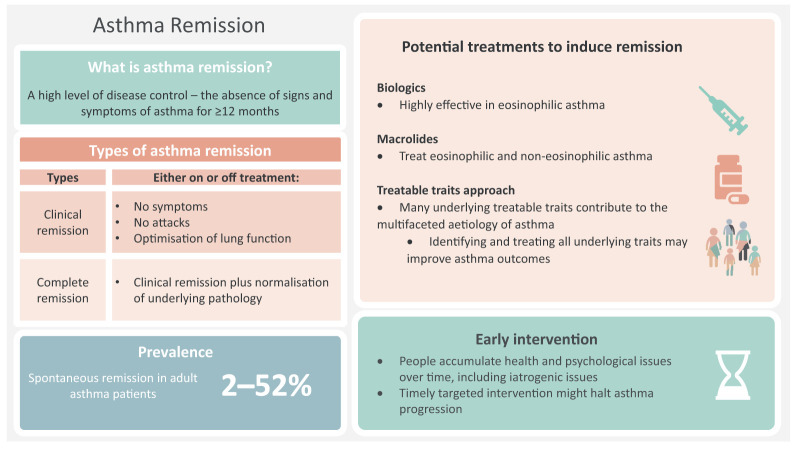
Asthma treatment goals currently focus on symptom and exacerbation control rather than remission. Remission is not identical to cure, but is a step closer. This review considers the current definitions of remission in asthma, the prevalence and predictors, the pathophysiology of remission, the possibility of achieving it using the available treatment options, and the future research directions. Asthma remission is characterised by a high level of disease control, including the absence of symptoms and exacerbations, and normalisation or optimisation of lung function with or without ongoing treatment. Even in those who develop a symptomatic remission of asthma, persistent pathological abnormalities are common, leading to a risk of subsequent relapse at any time. Complete remission requires normalisation or stabilisation of any underlying pathology in addition to symptomatic remission. Remission is possible as part of the natural history of asthma, and the prevalence of remission in the adult asthma population varies between 2% and 52%. The factors associated with remission include mild asthma, better lung function, better asthma control, younger age, early-onset asthma, shorter duration of asthma, milder bronchial hyperresponsiveness, fewer comorbidities and smoking cessation or never smoking. Although previous studies have not targeted treatment-induced remission, there is some evidence to show that the current long-term add-on therapies such as biologics and azithromycin can achieve some criteria for asthma remission on treatment, at least in a subgroup of patients. However, more research is required. Long-term remission could be included as a therapeutic goal in studies of asthma treatments.
哮喘治疗目标目前侧重于症状和加重控制,而不是缓解。缓解并不等同于治愈,但更接近治愈。本综述考虑了哮喘缓解的当前定义、缓解的流行率和预测因素、缓解的病理生理学、使用现有治疗选择实现缓解的可能性以及未来的研究方向。哮喘缓解的特征是高水平的疾病控制,包括无症状和加重,以及肺功能正常化或优化,无论是否持续治疗。即使在那些出现哮喘症状缓解的人中,持续的病理异常也很常见,导致随时可能复发的风险。完全缓解除了症状缓解外,还需要正常化或稳定任何潜在的病理。缓解是哮喘自然史的一部分,成人哮喘人群中缓解的流行率在 2%至 52%之间。与缓解相关的因素包括轻度哮喘、更好的肺功能、更好的哮喘控制、更年轻的年龄、早发哮喘、哮喘持续时间较短、较轻的支气管高反应性、较少的合并症以及戒烟或从不吸烟。尽管以前的研究并未针对治疗诱导的缓解进行,但有一些证据表明,目前的长期附加疗法,如生物制剂和阿奇霉素,可以在治疗中至少在一部分患者中达到哮喘缓解的某些标准。然而,还需要更多的研究。长期缓解可以作为哮喘治疗研究的治疗目标之一。