
基于依恋的家庭治疗:性少数和性别少数青年及其难以接受他们的父母。
Attachment-based family therapy for sexual and gender minority young adults and their nonaccepting parents.
机构信息
Department of Psychology, Ben-Gurion University, Beer-Sheva, Israel.
出版信息
Fam Process. 2022 Jun;61(2):530-548. doi: 10.1111/famp.12770. Epub 2022 Apr 1.
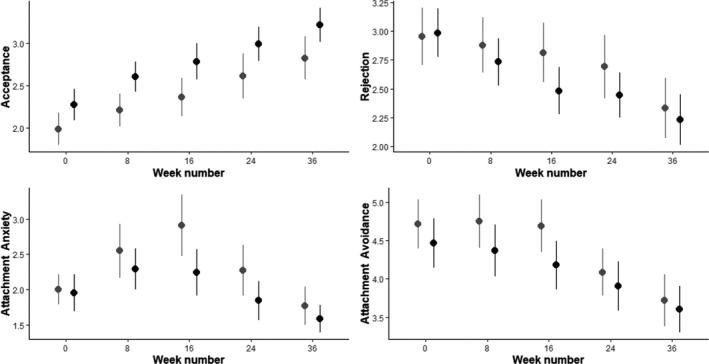
This pilot open trial examined the efficacy of attachment-based family therapy (ABFT) for Israeli sexual and gender minority (SGM) young adults and their persistently nonaccepting parents. Thirty families received up to 26 weeks of treatment, with parental rejection, parental acceptance, and young adults' attachment avoidance and attachment anxiety assessed at baseline, 8, 16, 24, and 36 weeks (three months post-treatment). Analyses using multilevel growth models revealed that both young adults and their mothers independently reported increases in mothers' acceptance of their young adult's same-sex orientation or noncisgender identity. In addition, young adults reported decreases in both parents' levels of rejection. Also, mothers, but not fathers, reported decreases in their own level of rejection. Finally, young adults reported a decrease in attachment avoidance in their relationships with both mothers and fathers, but not a decrease in attachment anxiety. Importantly, these treatment gains were maintained three months after the end of treatment. Together, these results suggest that ABFT-SGM, a manualized, affirmative, experiential, family-based treatment, may be effective in reducing long-standing parental rejection, promoting parental acceptance, and improving the quality of LGBTQ+ young adults' relationships with their parents. These findings are encouraging in light of the urgent need for efficacious interventions to reduce family generated minority stress and promote safer, more supportive environments for sexual and gender minority people.
本试点开放试验研究了依恋家庭治疗(ABFT)对以色列性少数群体和跨性别青年及其持续不接受的父母的疗效。30 个家庭接受了长达 26 周的治疗,在基线、8、16、24 和 36 周(治疗后三个月)评估了父母的拒绝、父母的接受以及年轻人的依恋回避和依恋焦虑。使用多层次增长模型进行的分析显示,年轻人及其母亲都独立报告了母亲对其同性取向或非顺性别认同的接受程度增加。此外,年轻人报告称父母的拒绝程度都有所降低。此外,母亲(而不是父亲)报告说自己的拒绝程度有所降低。最后,年轻人报告说他们与母亲和父亲的关系中的依恋回避程度有所降低,但依恋焦虑程度没有降低。重要的是,这些治疗效果在治疗结束三个月后仍然存在。总之,这些结果表明,ABFT-SGM 是一种规范化、肯定、经验性、以家庭为基础的治疗方法,可能有助于减少长期存在的父母拒绝、促进父母接受,并改善 LGBTQ+年轻人与父母关系的质量。鉴于迫切需要有效的干预措施来减少家庭产生的少数群体压力并为性少数群体和跨性别群体创造更安全、更支持的环境,这些发现令人鼓舞。

 Zotero 插件