Department of Occupational and Environmental Medicine, Telemark Hospital, Skien, Norway
Institute of Clinical Medicine, Faculty of Medicine, University of Oslo, Oslo, Norway.
BMJ Open Respir Res. 2022 Mar;9(1). doi: 10.1136/bmjresp-2021-001186.
Occupational exposure and increased body mass index (BMI) are associated with respiratory symptoms. This study investigated whether the association of a respiratory burden score with changes in BMI as well as changes in occupational exposure to vapours, gas, dust and fumes (VGDF) varied in subjects with and without asthma and in both sexes over a 5-year period.
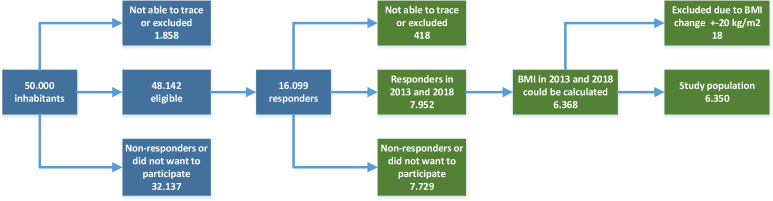
In a 5-year follow-up of a population-based study, 6350 subjects completed a postal questionnaire in 2013 and 2018. A respiratory burden score based on self-reported respiratory symptoms, BMI and frequency of occupational exposure to VGDF were calculated at both times. The association between change in respiratory burden score and change in BMI or VGDF exposure was assessed using stratified regression models.
Changes in respiratory burden score and BMI were associated with a β-coefficient of 0.05 (95% CI 0.04 to 0.07). This association did not vary significantly by sex, with 0.05 (0.03 to 0.07) for women and 0.06 (0.04 to 0.09) for men. The association was stronger among those with asthma (0.12; 0.06 to 0.18) compared with those without asthma (0.05; 0.03 to 0.06) (p=0.011). The association of change in respiratory burden score with change in VGDF exposure gave a β-coefficient of 0.15 (0.05 to 0.19). This association was somewhat greater for men versus women, with coefficients of 0.18 (0.12 to 0.24) and 0.13 (0.07 to 0.19), respectively (p=0.064). The estimate was similar among subjects with asthma (0.18; -0.02 to 0.38) and those without asthma (0.15; 0.11 to 0.19).
Increased BMI and exposure to VGDF were associated with increased respiratory burden scores. The change due to increased BMI was not affected by sex, but subjects with asthma had a significantly larger change than those without. Increased frequency of VGDF exposure was associated with increased respiratory burden score but without statistically significant differences with respect to sex or asthma status.
职业暴露和体重指数(BMI)增加与呼吸症状有关。本研究旨在探讨在 5 年内,对于有和没有哮喘的男性和女性,呼吸负担评分与 BMI 变化以及与 vapours、gas、dust 和 fumes(VGDF)职业暴露变化的关联是否存在差异。
在一项基于人群的 5 年随访研究中,6350 名受试者于 2013 年和 2018 年完成了一份邮寄问卷。在这两个时间点,根据自我报告的呼吸症状、BMI 和 VGDF 职业暴露频率,计算了呼吸负担评分。使用分层回归模型评估呼吸负担评分变化与 BMI 或 VGDF 暴露变化之间的关系。
呼吸负担评分和 BMI 的变化与β系数为 0.05(95%CI 0.04 至 0.07)相关。这种关联在性别之间没有显著差异,女性为 0.05(0.03 至 0.07),男性为 0.06(0.04 至 0.09)。与没有哮喘的受试者相比,哮喘患者的关联更强(0.12;0.06 至 0.18)(p=0.011)。呼吸负担评分变化与 VGDF 暴露变化之间的关联给出了β系数为 0.15(0.05 至 0.19)。对于男性与女性而言,这种关联稍大,系数分别为 0.18(0.12 至 0.24)和 0.13(0.07 至 0.19)(p=0.064)。在有哮喘和没有哮喘的受试者中,估计值分别为 0.18(-0.02 至 0.38)和 0.15(0.11 至 0.19)。
BMI 增加和 VGDF 暴露与呼吸负担评分增加有关。BMI 增加导致的变化不受性别影响,但哮喘患者的变化明显大于非哮喘患者。VGDF 暴露频率的增加与呼吸负担评分的增加有关,但与性别或哮喘状况无关。