An Xuedong, Peng Bo, Huang Xiaodong, Jiang Hongmei, Xiong Zhang'e, Zhang Hong, Lian Fengmei, Ba Yuanming, Tong Xiaolin
Guang'an Men Hospital of China Academy of Chinese Medical Sciences, Beijing, 100053, China.
Wuhan Third Hospital, Wuhan, 430060, China.
Chin Med. 2022 Apr 2;17(1):42. doi: 10.1186/s13020-022-00602-x.
To explore the effect of Ludangshen oral liquid for treatment of convalescent patients with coronavirus disease 2019 (COVID-19) with randomized, double-blind, placebo-controlled multicenter method.
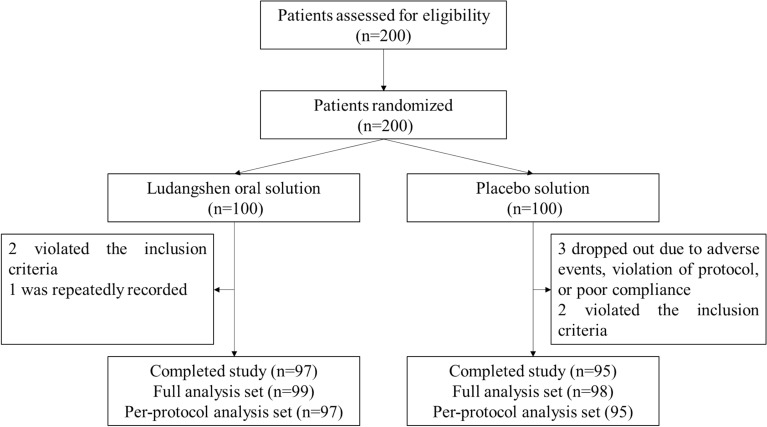
200 convalescent COVID-19 patients who had symptoms related to decreased digestive and respiratory function were randomly divided to either receive Ludangshen oral liquid or placebo for 2 weeks. The severity of clinical symptoms including fatigue, anorexia, abdominal distension, loose stools, and shortness of breath were assessed by visual analogue scale and observed at before and after treatment. The improvement and resolution rates of clinical symptoms were evaluated. Full analysis set (FAS) and per-protocol set (PPS) were used for statistical analyses. Adverse events were recorded during the study.
8 patients did not complete the study. After 2 weeks of treatment, both FAS and PPS results showed that patients in Ludangshen group had significantly lower score of fatigue, anorexia, loose stools, and shortness of breath than placebo group (P < 0.05), while there was no significant difference in distention (P > 0.05). The improvement rate of fatigue, anorexia, distension, loose stools and shortness of breath were significantly higher in Ludangshen group (P < 0.05), as well as the resolution rates (P < 0.05) except for shortness of breath (P > 0.05). There were two cases of adverse events, with one nose bleeding in Ludangshen group and one headache in placebo group.
The study suggested that two weeks of Ludangshen oral liquid treatment may have certain effects for convalescent COVID-19 patients on improving digestive and respiratory symptoms including fatigue, anorexia, loose stools and shortness of breath, which may be one of the choices for management of convalescent COVID-19 patients with digestive and respiratory symptoms.
采用随机、双盲、安慰剂对照的多中心方法,探讨潞党参口服液对新型冠状病毒肺炎(COVID-19)康复期患者的治疗效果。
将200例有消化和呼吸功能下降相关症状的COVID-19康复期患者随机分为两组,分别接受潞党参口服液或安慰剂治疗2周。采用视觉模拟评分法评估疲劳、食欲不振、腹胀、腹泻和呼吸急促等临床症状的严重程度,并在治疗前后进行观察。评估临床症状的改善率和缓解率。采用全分析集(FAS)和符合方案集(PPS)进行统计分析。研究期间记录不良事件。
8例患者未完成研究。治疗2周后,FAS和PPS结果均显示,潞党参组患者的疲劳、食欲不振、腹泻和呼吸急促评分均显著低于安慰剂组(P<0.05),而腹胀评分无显著差异(P>0.05)。潞党参组疲劳、食欲不振、腹胀、腹泻和呼吸急促的改善率显著更高(P<0.05),缓解率除呼吸急促外也显著更高(P<0.05,呼吸急促P>0.05)。发生两例不良事件,潞党参组1例鼻出血,安慰剂组1例头痛。
该研究表明,潞党参口服液治疗2周可能对COVID-19康复期患者改善包括疲劳、食欲不振、腹泻和呼吸急促在内的消化和呼吸症状有一定效果,这可能是管理有消化和呼吸症状的COVID-19康复期患者的选择之一。