
利用从立体脑电图迹线提取的时频和时域特征进行自发状态检测
Spontaneous State Detection Using Time-Frequency and Time-Domain Features Extracted From Stereo-Electroencephalography Traces.
作者信息
Ye Huanpeng, Fan Zhen, Li Guangye, Wu Zehan, Hu Jie, Sheng Xinjun, Chen Liang, Zhu Xiangyang
机构信息
State Key Laboratory of Mechanical System and Vibration, School of Mechanical Engineering, Shanghai Jiao Tong University, Shanghai, China.
Department of Neurosurgery of Huashan Hospital, Fudan University, Shanghai, China.
出版信息
Front Neurosci. 2022 Mar 17;16:818214. doi: 10.3389/fnins.2022.818214. eCollection 2022.
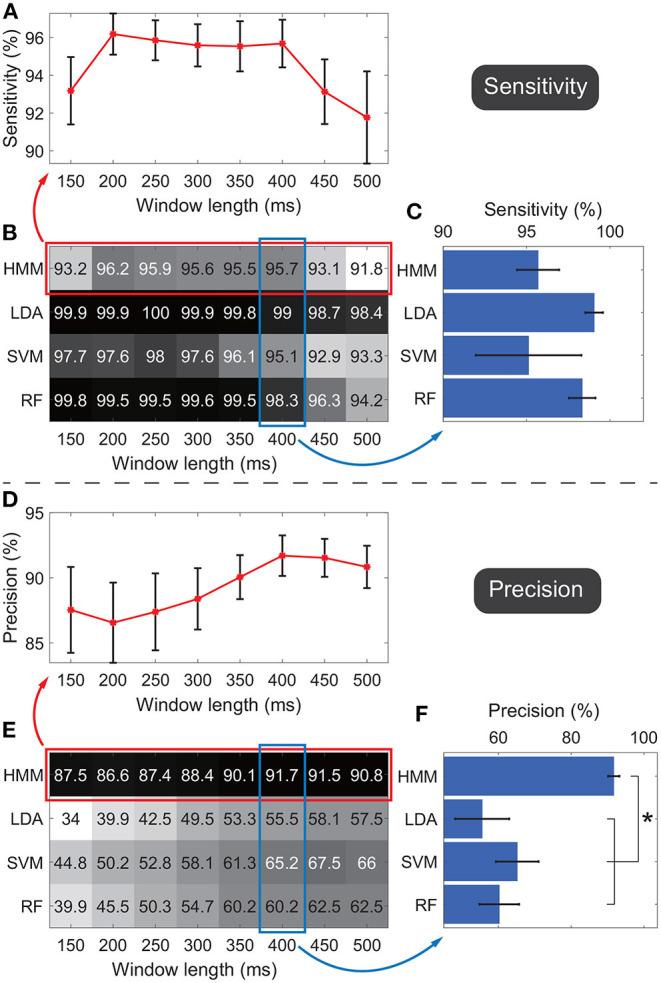
As a minimally invasive recording technique, stereo-electroencephalography (SEEG) measures intracranial signals directly by inserting depth electrodes shafts into the human brain, and thus can capture neural activities in both cortical layers and subcortical structures. Despite gradually increasing SEEG-based brain-computer interface (BCI) studies, the features utilized were usually confined to the amplitude of the event-related potential (ERP) or band power, and the decoding capabilities of other time-frequency and time-domain features have not been demonstrated for SEEG recordings yet. In this study, we aimed to verify the validity of time-domain and time-frequency features of SEEG, where classification performances served as evaluating indicators. To do this, using SEEG signals under intermittent auditory stimuli, we extracted features including the average amplitude, root mean square, slope of linear regression, and line-length from the ERP trace and three traces of band power activities (high-gamma, beta, and alpha). These features were used to detect the active state (including activations to two types of names) against the idle state. Results suggested that valid time-domain and time-frequency features distributed across multiple regions, including the temporal lobe, parietal lobe, and deeper structures such as the insula. Among all feature types, the average amplitude, root mean square, and line-length extracted from high-gamma (60-140 Hz) power and the line-length extracted from ERP were the most informative. Using a hidden Markov model (HMM), we could precisely detect the onset and the end of the active state with a sensitivity of 95.7 ± 1.3% and a precision of 91.7 ± 1.6%. The valid features derived from high-gamma power and ERP in this work provided new insights into the feature selection procedure for further SEEG-based BCI applications.
作为一种微创记录技术,立体脑电图(SEEG)通过将深度电极杆插入人脑直接测量颅内信号,从而能够捕捉皮层和皮层下结构中的神经活动。尽管基于SEEG的脑机接口(BCI)研究逐渐增多,但所利用的特征通常局限于事件相关电位(ERP)的幅度或频段功率,而其他时频和时域特征的解码能力尚未在SEEG记录中得到证实。在本研究中,我们旨在验证SEEG的时域和时频特征的有效性,其中分类性能作为评估指标。为此,我们利用间歇性听觉刺激下的SEEG信号,从ERP轨迹以及三个频段功率活动轨迹(高伽马、贝塔和阿尔法)中提取了包括平均幅度、均方根、线性回归斜率和线长等特征。这些特征用于检测相对于空闲状态的活跃状态(包括对两种类型名称的激活)。结果表明,有效的时域和时频特征分布在多个区域,包括颞叶、顶叶以及诸如脑岛等更深层结构。在所有特征类型中,从高伽马(60 - 140 Hz)功率中提取的平均幅度、均方根和线长以及从ERP中提取的线长信息最为丰富。使用隐马尔可夫模型(HMM),我们能够以95.7 ± 1.3%的灵敏度和91.7 ± 1.6%的精度精确检测活跃状态的开始和结束。本研究中从高伽马功率和ERP中得出的有效特征为基于SEEG的进一步BCI应用的特征选择过程提供了新的见解。




 Zotero 插件