Huang Qiang, Zhang Qiang, Bible Paul W, Liang Qiaoxing, Zheng Fangfang, Wang Ying, Hao Yuantao, Liu Yu
Department of Medical Statistics and Epidemiology, School of Public Health, Sun Yat-sen University, Guangzhou, China.
College of Computer, Chengdu University, Chengdu, China.
Front Microbiol. 2022 Mar 16;13:859241. doi: 10.3389/fmicb.2022.859241. eCollection 2022.
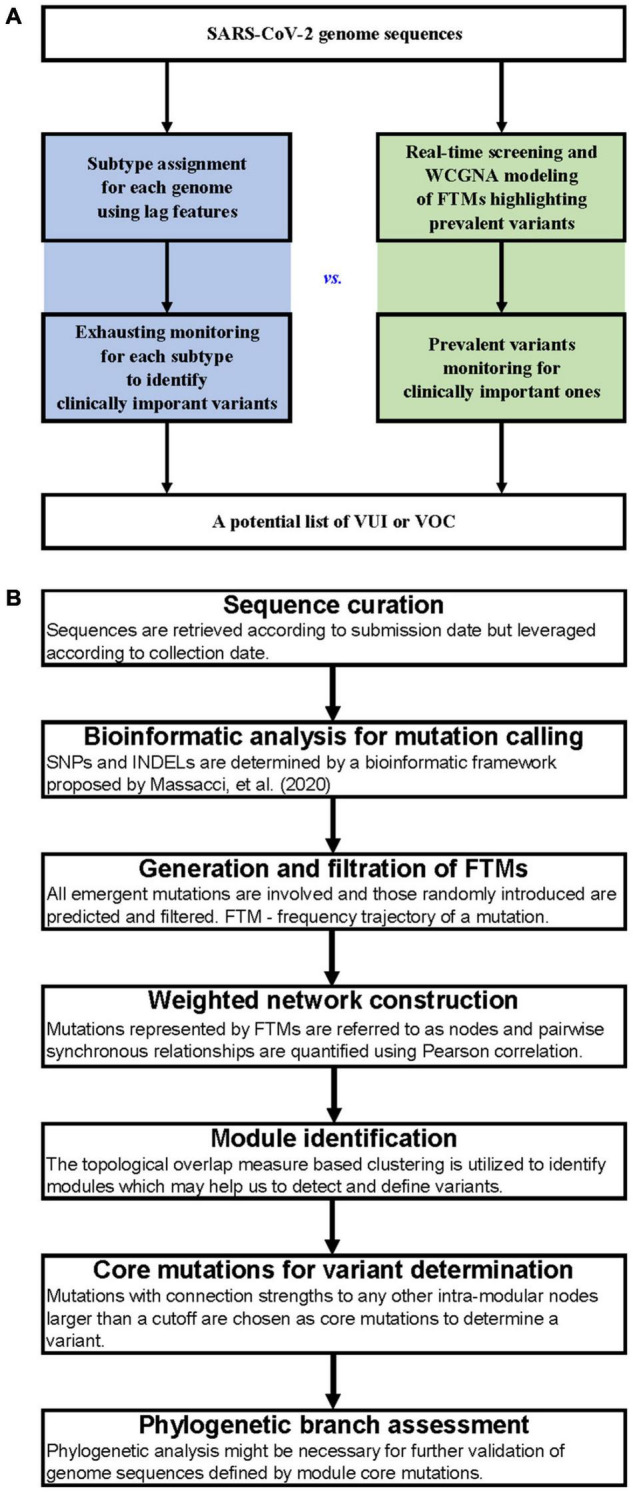
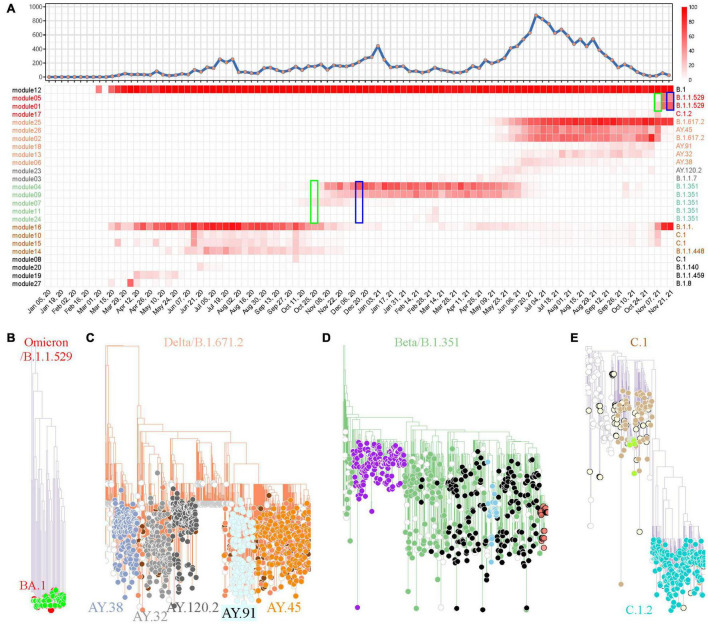
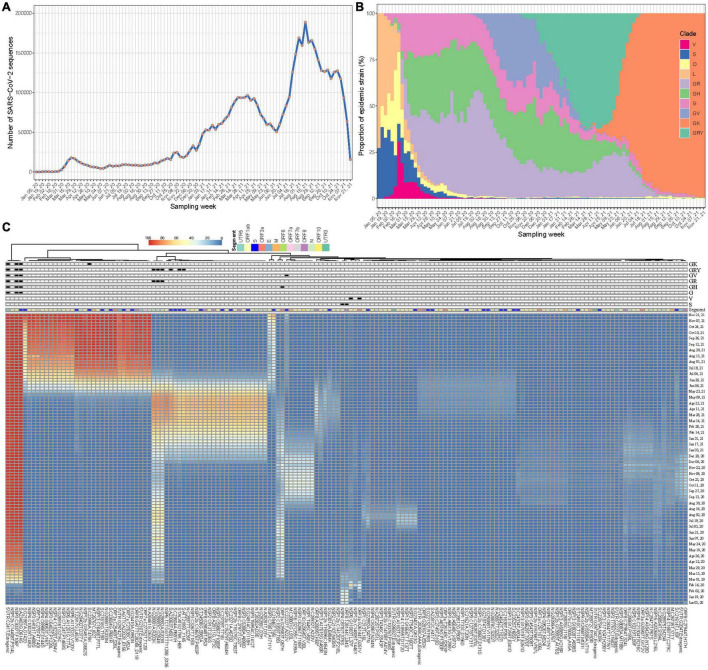
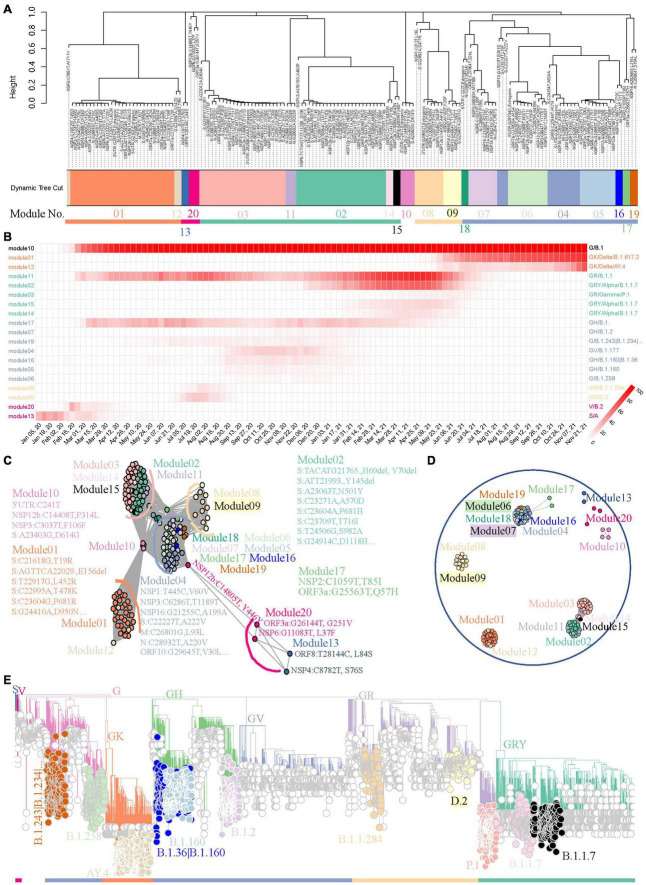
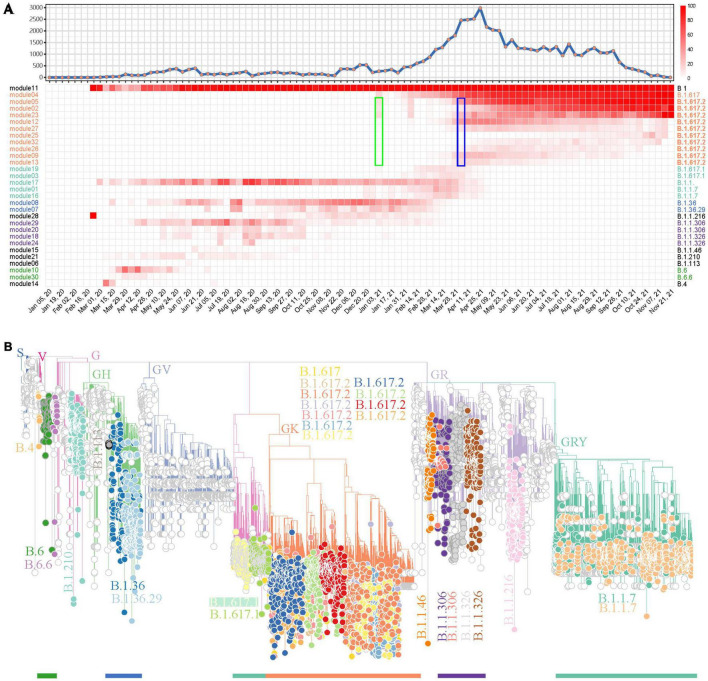
Early detection of SARS-CoV-2 variants enables timely tracking of clinically important strains in order to inform the public health response. Current subtype-based variant surveillance depending on prior subtype assignment according to lag features and their continuous risk assessment may delay this process. We proposed a weighted network framework to model the frequency trajectories of mutations (FTMs) for SARS-CoV-2 variant tracing, without requiring prior subtype assignment. This framework modularizes the FTMs and conglomerates synchronous FTMs together to represent the variants. It also generates module clusters to unveil the epidemic stages and their contemporaneous variants. Eventually, the module-based variants are assessed by phylogenetic tree through sub-sampling to facilitate communication and control of the epidemic. This process was benchmarked using worldwide GISAID data, which not only demonstrated all the methodology features but also showed the module-based variant identification had highly specific and sensitive mapping with the global phylogenetic tree. When applying this process to regional data like India and South Africa for SARS-CoV-2 variant surveillance, the approach clearly elucidated the national dispersal history of the viral variants and their co-circulation pattern, and provided much earlier warning of Beta (B.1.351), Delta (B.1.617.2), and Omicron (B.1.1.529). In summary, our work showed that the weighted network modeling of FTMs enables us to rapidly and easily track down SARS-CoV-2 variants overcoming prior viral subtyping with lag features, accelerating the understanding and surveillance of COVID-19.
早期检测严重急性呼吸综合征冠状病毒2(SARS-CoV-2)变体能够及时追踪具有临床重要性的毒株,以便为公共卫生应对措施提供信息。当前基于亚型的变体监测依赖于根据滞后特征进行的先验亚型分配及其持续风险评估,这可能会延迟这一过程。我们提出了一种加权网络框架,用于对SARS-CoV-2变体追踪的突变频率轨迹(FTM)进行建模,而无需先验亚型分配。该框架将FTM模块化,并将同步的FTM聚集在一起以代表变体。它还生成模块簇以揭示流行阶段及其同期变体。最终,通过子采样利用系统发育树对基于模块的变体进行评估,以促进疫情的沟通和控制。这一过程使用全球流感共享数据库(GISAID)的数据进行了基准测试,该数据不仅展示了所有方法学特征,还表明基于模块的变体识别与全球系统发育树具有高度特异性和敏感性的映射关系。当将这一过程应用于印度和南非等地区的数据进行SARS-CoV-2变体监测时,该方法清楚地阐明了病毒变体的国家传播历史及其共同传播模式,并提供了关于贝塔(B.1.351)、德尔塔(B.1.617.2)和奥密克戎(B.1.1.529)的更早预警。总之,我们的工作表明,FTM的加权网络建模使我们能够快速轻松地追踪SARS-CoV-2变体,克服具有滞后特征的先前病毒亚型分类,加速对2019冠状病毒病的理解和监测。