Shi Qiming, Herbert Carly, Ward Doyle V, Simin Karl, McCormick Beth A, Ellison Iii Richard T, Zai Adrian H
Center for Clinical and Translational Science, UMass Chan Medical School, Worcester, MA, United States.
Department of Population and Quantitative Health Sciences, UMass Chan Medical School, Worcester, MA, United States.
JMIR Form Res. 2022 Jun 13;6(6):e37858. doi: 10.2196/37858.
Public health scientists have used spatial tools such as web-based Geographical Information System (GIS) applications to monitor and forecast the progression of the COVID-19 pandemic and track the impact of their interventions. The ability to track SARS-CoV-2 variants and incorporate the social determinants of health with street-level granularity can facilitate the identification of local outbreaks, highlight variant-specific geospatial epidemiology, and inform effective interventions. We developed a novel dashboard, the University of Massachusetts' Graphical user interface for Geographic Information (MAGGI) variant tracking system that combines GIS, health-associated sociodemographic data, and viral genomic data to visualize the spatiotemporal incidence of SARS-CoV-2 variants with street-level resolution while safeguarding protected health information. The specificity and richness of the dashboard enhance the local understanding of variant introductions and transmissions so that appropriate public health strategies can be devised and evaluated.
We developed a web-based dashboard that simultaneously visualizes the geographic distribution of SARS-CoV-2 variants in Central Massachusetts, the social determinants of health, and vaccination data to support public health efforts to locally mitigate the impact of the COVID-19 pandemic.
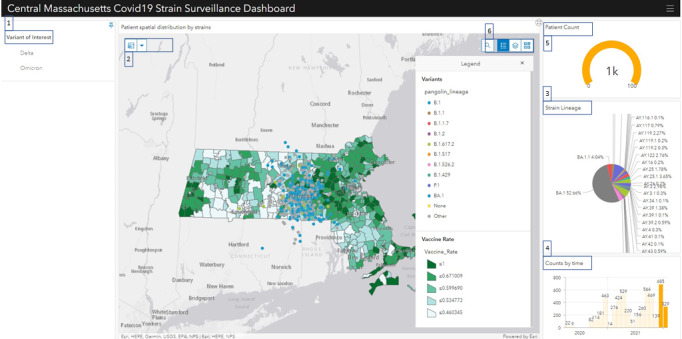
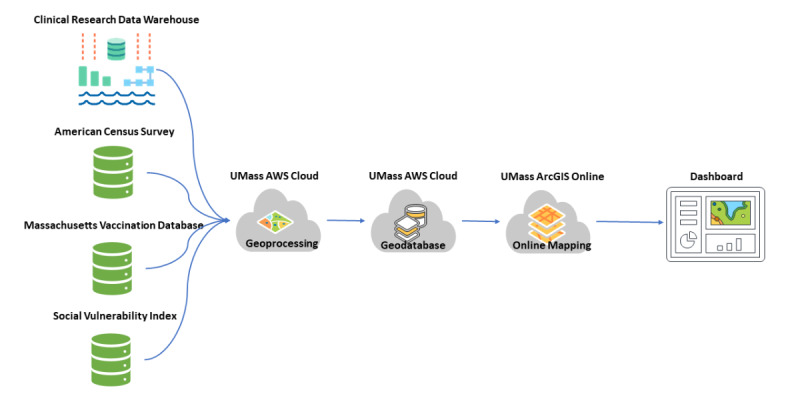
MAGGI uses a server-client model-based system, enabling users to access data and visualizations via an encrypted web browser, thus securing patient health information. We integrated data from electronic medical records, SARS-CoV-2 genomic analysis, and public health resources. We developed the following functionalities into MAGGI: spatial and temporal selection capability by zip codes of interest, the detection of variant clusters, and a tool to display variant distribution by the social determinants of health. MAGGI was built on the Environmental Systems Research Institute ecosystem and is readily adaptable to monitor other infectious diseases and their variants in real-time.
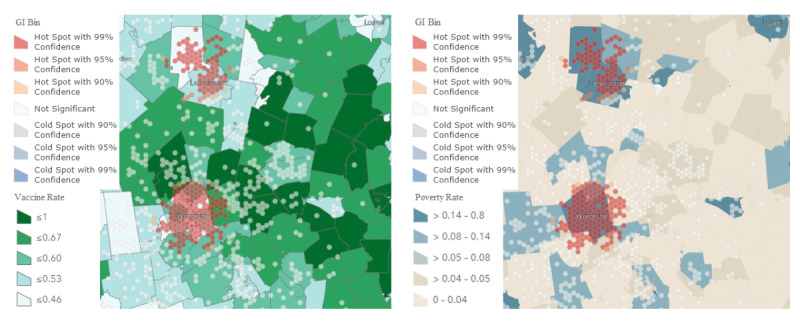
We created a geo-referenced database and added sociodemographic and viral genomic data to the ArcGIS dashboard that interactively displays Central Massachusetts' spatiotemporal variants distribution. Genomic epidemiologists and public health officials use MAGGI to show the occurrence of SARS-CoV-2 genomic variants at high geographic resolution and refine the display by selecting a combination of data features such as variant subtype, subject zip codes, or date of COVID-19-positive sample collection. Furthermore, they use it to scale time and space to visualize association patterns between socioeconomics, social vulnerability based on the Centers for Disease Control and Prevention's social vulnerability index, and vaccination rates. We launched the system at the University of Massachusetts Chan Medical School to support internal research projects starting in March 2021.
We developed a COVID-19 variant surveillance dashboard to advance our geospatial technologies to study SARS-CoV-2 variants transmission dynamics. This real-time, GIS-based tool exemplifies how spatial informatics can support public health officials, genomics epidemiologists, infectious disease specialists, and other researchers to track and study the spread patterns of SARS-CoV-2 variants in our communities.
公共卫生科学家已使用基于网络的地理信息系统(GIS)应用程序等空间工具来监测和预测新冠疫情的发展,并追踪其干预措施的影响。能够追踪严重急性呼吸综合征冠状病毒2(SARS-CoV-2)变体并以街道级别的粒度纳入健康的社会决定因素,有助于识别局部疫情,突出特定变体的地理空间流行病学,并为有效的干预措施提供信息。我们开发了一个新颖的仪表板,即马萨诸塞大学地理信息图形用户界面(MAGGI)变体追踪系统,该系统结合了GIS、与健康相关的社会人口数据和病毒基因组数据,以街道级分辨率可视化SARS-CoV-2变体的时空发病率,同时保护受保护的健康信息。该仪表板的特异性和丰富性增强了对变体引入和传播的局部理解,从而可以制定和评估适当的公共卫生策略。
我们开发了一个基于网络的仪表板,同时可视化马萨诸塞州中部SARS-CoV-2变体的地理分布、健康的社会决定因素和疫苗接种数据,以支持公共卫生工作,在当地减轻新冠疫情的影响。
MAGGI使用基于服务器-客户端模型的系统,使用户能够通过加密的网络浏览器访问数据和可视化内容,从而确保患者健康信息的安全。我们整合了来自电子病历、SARS-CoV-2基因组分析和公共卫生资源的数据。我们在MAGGI中开发了以下功能:按感兴趣的邮政编码进行空间和时间选择功能、变体集群检测功能,以及一个按健康的社会决定因素显示变体分布的工具。MAGGI建立在环境系统研究所的生态系统之上,很容易适应实时监测其他传染病及其变体。
我们创建了一个地理参考数据库,并将社会人口和病毒基因组数据添加到ArcGIS仪表板中,该仪表板交互式显示马萨诸塞州中部的时空变体分布。基因组流行病学家和公共卫生官员使用MAGGI以高地理分辨率展示SARS-CoV-2基因组变体的发生情况,并通过选择数据特征的组合(如变体亚型、受试者邮政编码或新冠病毒检测呈阳性样本的采集日期)来优化显示。此外,他们使用它来缩放时间和空间,以可视化社会经济、基于疾病控制和预防中心社会脆弱性指数的社会脆弱性与疫苗接种率之间的关联模式。我们于2021年3月在马萨诸塞大学医学院启动了该系统,以支持内部研究项目。
我们开发了一个新冠病毒变体监测仪表板,以推进我们的地理空间技术,研究SARS-CoV-2变体的传播动态。这个基于GIS的实时工具例证了空间信息学如何支持公共卫生官员、基因组流行病学家、传染病专家和其他研究人员追踪和研究SARS-CoV-2变体在我们社区中的传播模式。