Department of Medicine, University of Alabama at Birmingham, Birmingham, Alabama.
Department of Biostatistics, University of Alabama at Birmingham, Birmingham, Alabama.
Kidney360. 2020 Jul 29;1(9):950-956. doi: 10.34067/KID.0000942020. eCollection 2020 Sep 24.
Fibroblast growth factor 23 (FGF23) is a hormone that regulates vitamin D activity. Higher circulating FGF23 concentrations have been associated with an increased risk of infection-related hospitalization, but the association of FGF23 with risk of sepsis remains unclear.
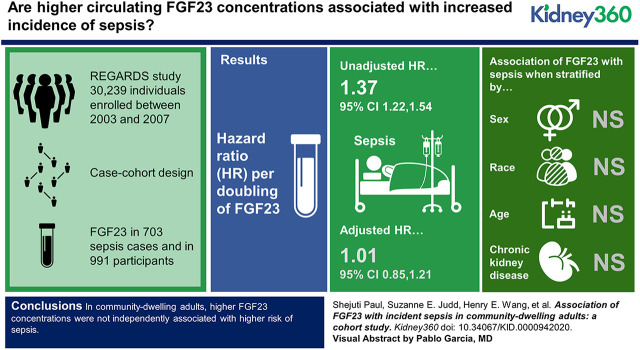
We examined the association of FGF23 with incident sepsis events in the Reasons for Geographic and Racial Differences in Stroke (REGARDS) study, a national longitudinal cohort of black and white adults ≥45 years of age. Using a case-cohort design, we measured baseline FGF23 in 703 sepsis cases and in 991 participants randomly selected from the REGARDS cohort. We defined sepsis as the presence of a serious infection plus two or more Systemic Inflammatory Response Syndrome criteria. We identified first sepsis hospitalizations during 2003-2012 by adjudicated medical record review. Cox proportional hazards models were used to examine associations of FGF23 with incident sepsis, adjusting for age, sex, race, income, education, smoking, body mass index, physical activity, chronic pulmonary disease, eGFR, urine albumin-creatinine ratio, and high-sensitivity C-reactive protein. We also examined whether associations differed by age, race, sex, and CKD by testing interaction terms.
Higher FG23 concentrations were associated with greater risk of sepsis (hazard ratio [HR] per doubling of FGF23, 1.37; 95% CI, 1.22 to 1.54) in models adjusted for sociodemographic and clinical variables. After further adjusting for eGFR, urine albumin-creatinine ratio, and high-sensitivity C-reactive protein, the association was attenuated and no longer statistically significant (HR per doubling, 1.01; 95% CI, 0.85 to 1.21). The results did not statistically differ by strata of age, sex, race, or CKD.
In community-dwelling adults, higher FGF23 concentrations were not independently associated with higher risk of sepsis.
成纤维细胞生长因子 23(FGF23)是一种调节维生素 D 活性的激素。循环中更高的 FGF23 浓度与感染相关住院的风险增加有关,但 FGF23 与脓毒症风险的关系尚不清楚。
我们在 Reasons for Geographic and Racial Differences in Stroke(REGARDS)研究中研究了 FGF23 与感染性休克事件的相关性,这是一项针对≥45 岁的黑人和白人成年人的全国性纵向队列研究。使用病例-队列设计,我们在 703 例脓毒症病例和从 REGARDS 队列中随机选择的 991 名参与者中测量了基线 FGF23。我们将脓毒症定义为存在严重感染和两个或更多全身炎症反应综合征标准。通过有条件的医疗记录审查,我们确定了 2003-2012 年期间的首次脓毒症住院治疗。使用 Cox 比例风险模型检查 FGF23 与感染性休克的关联,调整年龄、性别、种族、收入、教育、吸烟、体重指数、身体活动、慢性肺部疾病、肾小球滤过率、尿白蛋白-肌酐比值和高敏 C 反应蛋白。我们还通过检验交互项,检查了关联是否因年龄、种族、性别和 CKD 而不同。
在调整了社会人口统计学和临床变量的模型中,更高的 FG23 浓度与更高的脓毒症风险相关(每增加一倍 FGF23 的风险比[HR],1.37;95%CI,1.22 至 1.54)。进一步调整肾小球滤过率、尿白蛋白-肌酐比值和高敏 C 反应蛋白后,相关性减弱且不再具有统计学意义(每增加一倍的 HR,1.01;95%CI,0.85 至 1.21)。结果在年龄、性别、种族或 CKD 的分层中没有统计学差异。
在社区居住的成年人中,更高的 FGF23 浓度与更高的脓毒症风险无关。