State Key Laboratory of Infectious Disease Prevention and Control, National Center for AIDS/STD Control and Prevention, Collaborative Innovation Center for Diagnosis and Treatment of Infectious Diseases, Chinese Center for Disease Control and Prevention, Beijing, China.
Guangxi Key Laboratory of AIDS Prevention and Control and Achievement Transformation, Guangxi Center for Disease Prevention and Control, Nanning, China.
Front Cell Infect Microbiol. 2022 Mar 17;12:862754. doi: 10.3389/fcimb.2022.862754. eCollection 2022.
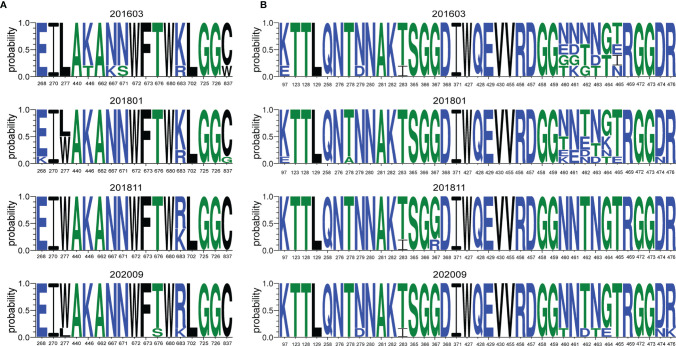
The diversity of HIV-1 envelope (Env) glycoproteins affects the potency and breadth of broadly neutralizing antibodies (bNAbs), a promising alternative to antiretroviral drugs for the prevention and treatment of HIV-1 infection. To facilitate immunogen design and development of therapeutic neutralizing antibodies, we characterized viral evolution and monitored the changes in neutralizing activity/sensitivity of a long-term non-progressor patient with HIV-1 CRF07_BC infection. Fifty-nine full-length Env gene fragments were derived from four plasma samples sequentially harvested from the patient between 2016 and 2020. Sequencing of patient-derived Env genes revealed that potential N-linked glycosylation sites (PNGS) in V1 and V5 significantly increased over time. Further, 24 functional Env-pseudotyped viruses were generated based on Env gene sequences. While all 24 Env-pseudotyped viruses remained sensitive to concurrent and subsequent autologous plasma, as well as bNAbs, including 10E8, VRC01, and 12A21, Env-pseudotyped viruses corresponding to later sampling time were increasingly more resistant to autologous plasma and bNAbs. All 24 Env-pseudotyped viruses were resistant to bNAbs 2G12, PGT121, and PGT135. The neutralization breadth of plasma from all four sequential samples was 100% against the global HIV-1 reference panel. Immune escape mutants resulted in increased resistance to bNAb targeting of different epitopes. Our study identified known mutations F277W in gp41 and previously uncharacterized mutation S465T in V5 which may be associated with increased viral resistance to bNAbs.
HIV-1 包膜 (Env) 糖蛋白的多样性影响着广谱中和抗体 (bNAbs) 的效力和广度,bNAbs 是预防和治疗 HIV-1 感染的一种有前途的抗逆转录病毒药物替代物。为了促进免疫原设计和治疗性中和抗体的开发,我们对 HIV-1 CRF07_BC 感染的长期非进展者患者的病毒进化进行了特征分析,并监测了中和活性/敏感性的变化。从患者的四个血浆样本中连续采集了 59 个全长 Env 基因片段,这些样本分别采集于 2016 年至 2020 年期间。对患者来源的 Env 基因测序显示,V1 和 V5 中的潜在 N 连接糖基化位点 (PNGS) 随着时间的推移显著增加。此外,根据 Env 基因序列生成了 24 种功能性 Env 假型病毒。虽然所有 24 种 Env 假型病毒仍然对同时和随后的自体血浆以及 bNAbs 敏感,包括 10E8、VRC01 和 12A21,但对应较晚采样时间的 Env 假型病毒对自体血浆和 bNAbs 的抵抗力逐渐增强。所有 24 种 Env 假型病毒均对 bNAb 2G12、PGT121 和 PGT135 具有抗性。来自所有四个连续样本的血浆的中和广度对全球 HIV-1 参考面板为 100%。免疫逃逸突变导致对不同表位的 bNAb 靶向的抗性增加。我们的研究鉴定出了 gp41 中的已知突变 F277W 和 V5 中的先前未表征的突变 S465T,这可能与病毒对 bNAb 的抗性增加有关。