Department of Health Policy and Management, Graduate School of Public Health, Yonsei University, Seoul, South Korea.
Institute of Health Services Research, Yonsei University, Seoul, South Korea.
Front Public Health. 2022 Mar 8;10:828318. doi: 10.3389/fpubh.2022.828318. eCollection 2022.
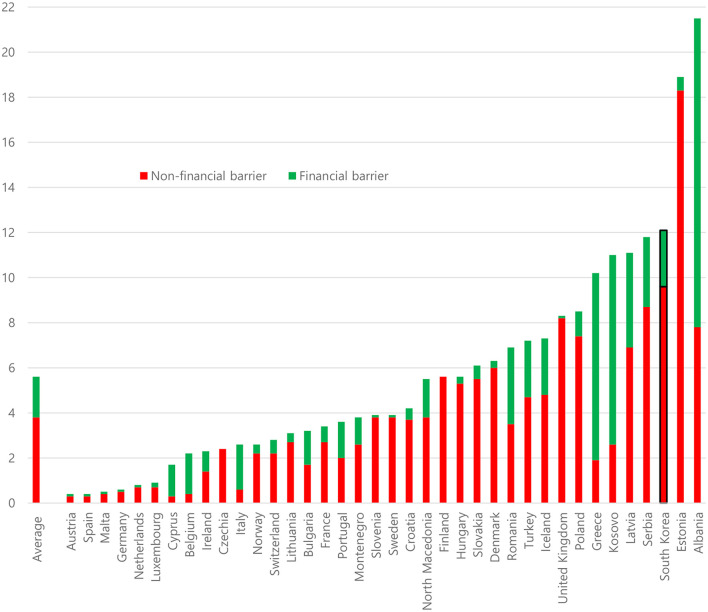
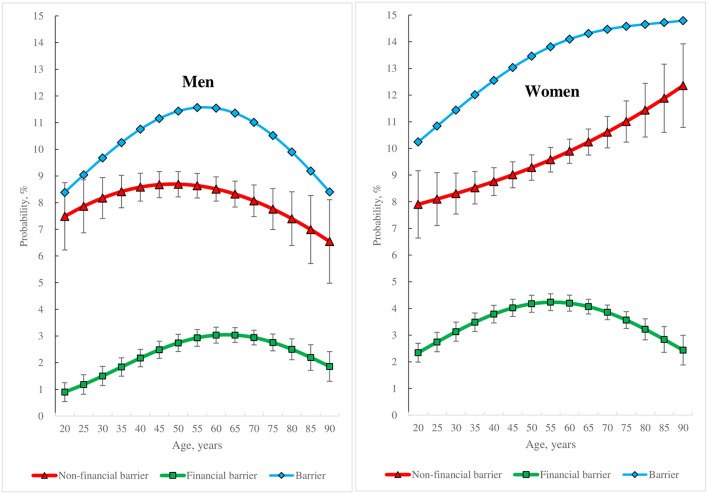
While many studies have explored the financial barriers to healthcare, there is little evidence regarding the non-financial barriers to healthcare. This study identified characteristics associated with financial and non-financial barriers to healthcare and quantified the effects of these characteristics in South Korea, using a nationally representative longitudinal survey dataset. Overall, 68,930 observations of 16,535 individuals aged 19 years and above were sampled from Korea Health Panel survey data (2014-2018). From self-reported information about respondents' experiences of unmet healthcare needs, a trichotomous dependent variable-no barrier, non-financial barrier, and financial barrier-was derived. Sociodemographics, physical and health conditions were included as explanatory variables. The average adjusted probability (AAP) of experiencing each barrier was predicted using multivariable and panel multinomial logistic regression analyses. According to the results, the percentage of people experiencing non-financial barriers was much higher than that of people experiencing financial barriers in 2018 (9.6 vs. 2.5%). Women showed higher AAPs of experiencing both non-financial (9.9 vs. 8.3%) and financial barriers (3.6 vs. 2.5%) than men. Men living in the Seoul metropolitan area showed higher AAPs of experiencing non-financial (8.7 vs. 8.0%) and financial barriers (3.4 vs. 2.1%) than those living outside it. Household income showed no significant associations in the AAP of experiencing a non-financial barrier. People with a functional limitation exhibited a higher AAP of experiencing a non-financial barrier, for both men (17.8 vs. 7.8%) and women (17.4 vs. 9.0%), than those without it. In conclusion, people in South Korea, like those in most European countries, fail to meet their healthcare needs more often due to non-financial barriers than financial barriers. In addition, the characteristics associated with non-financial barriers to healthcare differed from those associated with financial barriers. This finding suggests that although financial barriers may be minimised through various policies, a considerable degree of unmet healthcare needs and disparity among individuals is very likely to persist due to non-financial barriers. Therefore, current universal health insurance systems need targeted policy instruments to minimise non-financial barriers to healthcare to ensure effective universal health coverage.
虽然许多研究都探讨了医疗保健的财务障碍,但关于医疗保健的非财务障碍的证据很少。本研究使用全国代表性的纵向调查数据集,确定了与医疗保健的财务和非财务障碍相关的特征,并量化了这些特征在韩国的影响。总体而言,从韩国健康面板调查数据(2014-2018 年)中抽取了 16535 名 19 岁及以上个体的 68930 个观察值。从受访者未满足医疗需求的经历的自我报告信息中,得出了无障碍、非财务障碍和财务障碍的三分叉因变量。将社会人口统计学、身体和健康状况纳入解释变量。使用多变量和面板多项逻辑回归分析预测经历每种障碍的平均调整概率 (AAP)。根据结果,2018 年经历非财务障碍的人数百分比远高于经历财务障碍的人数百分比(9.6%比 2.5%)。与男性相比,女性经历非财务(9.9%比 8.3%)和财务障碍(3.6%比 2.5%)的 AAP 更高。居住在首尔大都市区的男性经历非财务(8.7%比 8.0%)和财务障碍(3.4%比 2.1%)的 AAP 高于居住在大都市区以外的男性。家庭收入与经历非财务障碍的 AAP 无关。有功能障碍的人比没有功能障碍的人经历非财务障碍的 AAP 更高,无论是男性(17.8%比 7.8%)还是女性(17.4%比 9.0%)。总之,韩国人(与大多数欧洲国家的人一样)因非财务障碍而非财务障碍而未能满足医疗保健需求的情况更为常见。此外,与医疗保健的财务障碍相关的特征与与非财务障碍相关的特征不同。这一发现表明,尽管通过各种政策可以最小化财务障碍,但由于非财务障碍,很大程度上未满足的医疗保健需求和个人之间的差距很可能持续存在。因此,当前的全民健康保险系统需要有针对性的政策手段来最小化医疗保健的非财务障碍,以确保有效的全民健康覆盖。