Liu Kunxiang, Zhao Qi, Li Bei, Zhao Xia
State Key Laboratory of Oncology in South China, Collaborative Innovation Center for Cancer Medicine, Department of Oncology, Sun Yat-sen University Cancer Center, Guangzhou, China.
State Key Laboratory of Applied Optics, Changchun Institute of Optics, Fine Mechanics and Physics, Chinese Academy of Sciences, Changchun, China.
Front Bioeng Biotechnol. 2022 Mar 15;10:856591. doi: 10.3389/fbioe.2022.856591. eCollection 2022.
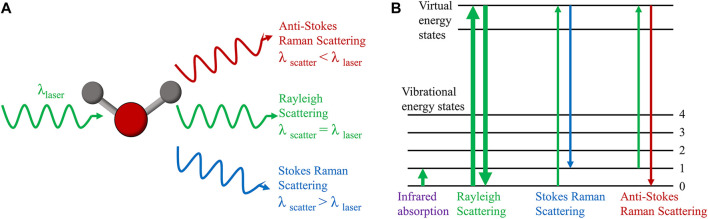
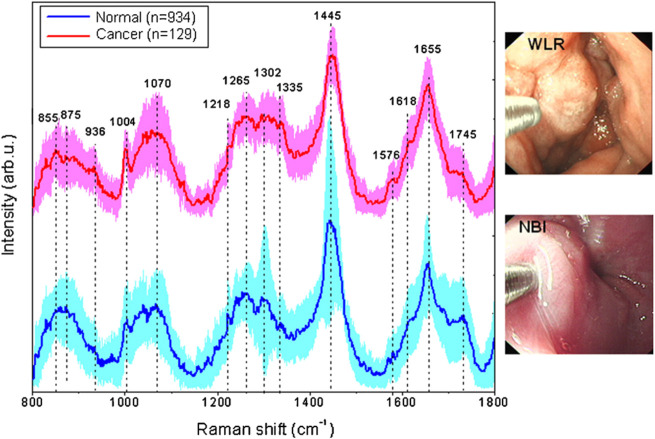
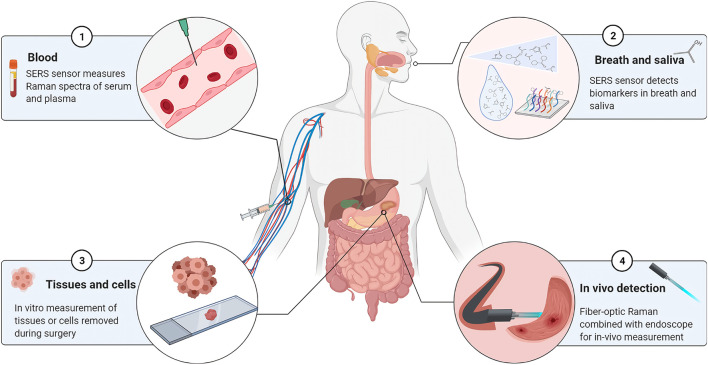
Gastric cancer is usually diagnosed at late stage and has a high mortality rate, whereas early detection of gastric cancer could bring a better prognosis. Conventional gastric cancer diagnostic methods suffer from long diagnostic times, severe trauma, and a high rate of misdiagnosis and rely heavily on doctors' subjective experience. Raman spectroscopy is a label-free molecular vibrational spectroscopy technique that identifies the molecular fingerprint of various samples based on the inelastic scattering of monochromatic light. Because of its advantages of non-destructive, rapid, and accurate detection, Raman spectroscopy has been widely studied for benign and malignant tumor differentiation, tumor subtype classification, and section pathology diagnosis. This paper reviews the applications of Raman spectroscopy for the and diagnosis of gastric cancer, methodology related to the spectroscopy data analysis, and presents the limitations of the technique.
胃癌通常在晚期被诊断出来,死亡率很高,而早期发现胃癌可以带来更好的预后。传统的胃癌诊断方法存在诊断时间长、创伤大、误诊率高的问题,并且严重依赖医生的主观经验。拉曼光谱是一种无标记的分子振动光谱技术,它基于单色光的非弹性散射来识别各种样品的分子指纹。由于其具有无损、快速、准确检测的优点,拉曼光谱已被广泛用于良性和恶性肿瘤的鉴别、肿瘤亚型分类以及切片病理诊断。本文综述了拉曼光谱在胃癌诊断中的应用、与光谱数据分析相关的方法,并介绍了该技术的局限性。