
一种7基因炎症特征的开发与验证可预测肺腺癌的预后及多样的免疫格局
Development and Validation of a 7-Gene Inflammatory Signature Forecasts Prognosis and Diverse Immune Landscape in Lung Adenocarcinoma.
作者信息
Nai Aitao, Ma Feng, He Zirui, Zeng Shuwen, Bashir Shoaib, Song Jian, Xu Meng
机构信息
Department of Oncology, The First Affiliated Hospital of Jinan University, Guangzhou, China.
Department of Oncology, ZhongShan Torch Development Zone Hospital, Zhongshan, China.
出版信息
Front Mol Biosci. 2022 Mar 15;9:822739. doi: 10.3389/fmolb.2022.822739. eCollection 2022.
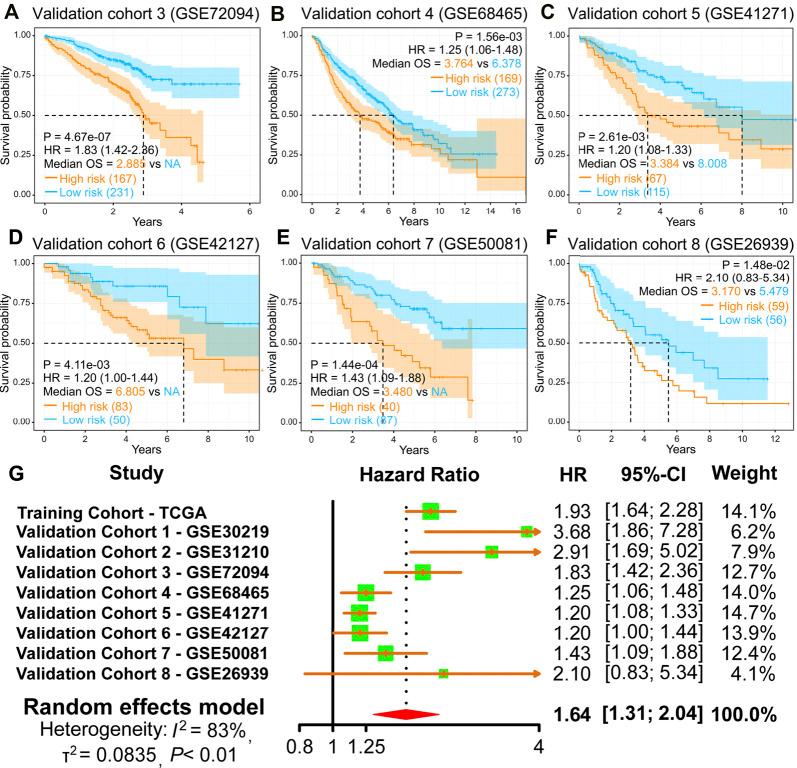
Inflammatory responses are strongly linked with tumorigenesis and cancer development. This research aimed to construct and validate a novel inflammation response-related risk predictive signature for forecasting the prognosis of patients with LUAD. Differential expression analysis, univariate Cox, LASSO, and multivariate Cox regression analyses of 200 inflammatory response-related genes (IRRG) were performed to establish a risk predictive model in the TCGA training cohort. The performance of the IRRG model was verified in eight GEO datasets. GSEA analysis, ESTIMATE algorithms, and ssGSEA analysis were applied to elucidate the possible mechanisms. Furthermore, the relationship analysis between risk score, model genes, and chemosensitivity was performed. Last, we verified the protein expression of seven model genes by immunohistochemical staining or Western blotting. We constructed a novel inflammatory response-related 7-gene signature (MMP14, BTG2, LAMP3, CCL20, TLR2, IL7R, and PCDH7). Patients in the high-risk group presented markedly decreased survival time in the TCGA cohort and eight GEO cohorts than the low-risk group. Interestingly, multiple pathways related to immune response were suppressed in high-risk groups. The low infiltration levels of B cell, dendritic cell, natural killer cell, and eosinophil can significantly affect the unsatisfactory prognosis of the high-risk group in LUAD. Moreover, the tumor cells' sensitivity to anticancer drugs was markedly related to risk scores and model genes. The protein expression of seven model genes was consistent with the mRNA expression. Our IRRG prognostic model can effectively forecast LUAD prognosis and is tightly related to immune infiltration.
炎症反应与肿瘤发生和癌症发展密切相关。本研究旨在构建并验证一种新的炎症反应相关风险预测特征,以预测肺腺癌患者的预后。对200个炎症反应相关基因(IRRG)进行差异表达分析、单变量Cox分析、LASSO分析和多变量Cox回归分析,以在TCGA训练队列中建立风险预测模型。在8个GEO数据集中验证了IRRG模型的性能。应用GSEA分析、ESTIMATE算法和ssGSEA分析来阐明可能的机制。此外,还进行了风险评分、模型基因与化疗敏感性之间的关系分析。最后,我们通过免疫组织化学染色或蛋白质印迹法验证了7个模型基因的蛋白表达。我们构建了一种新的炎症反应相关的7基因特征(MMP14、BTG2、LAMP3、CCL20、TLR2、IL7R和PCDH7)。在TCGA队列和8个GEO队列中,高危组患者的生存时间明显低于低危组。有趣的是,高危组中与免疫反应相关的多种途径受到抑制。B细胞、树突状细胞、自然杀伤细胞和嗜酸性粒细胞的低浸润水平可显著影响肺腺癌高危组的不良预后。此外,肿瘤细胞对抗癌药物的敏感性与风险评分和模型基因显著相关。7个模型基因的蛋白表达与mRNA表达一致。我们的IRRG预后模型可以有效地预测肺腺癌的预后,并且与免疫浸润密切相关。




 Zotero 插件