Department of Thoracic Surgery, National Cancer Center/National Clinical Research Center for Cancer/Cancer Hospital, Chinese Academy of Medical Sciences and Peking Union Medical College, Chaoyang District, Beijing, China.
Cancer Med. 2020 Aug;9(16):5960-5975. doi: 10.1002/cam4.3240. Epub 2020 Jun 26.
Lung adenocarcinomas (LUAD) is the most common histological subtype of lung cancers. Tumor immune microenvironment (TIME) is involved in tumorigeneses, progressions, and metastases. This study is aimed to develop a robust immune-related signature of LUAD.
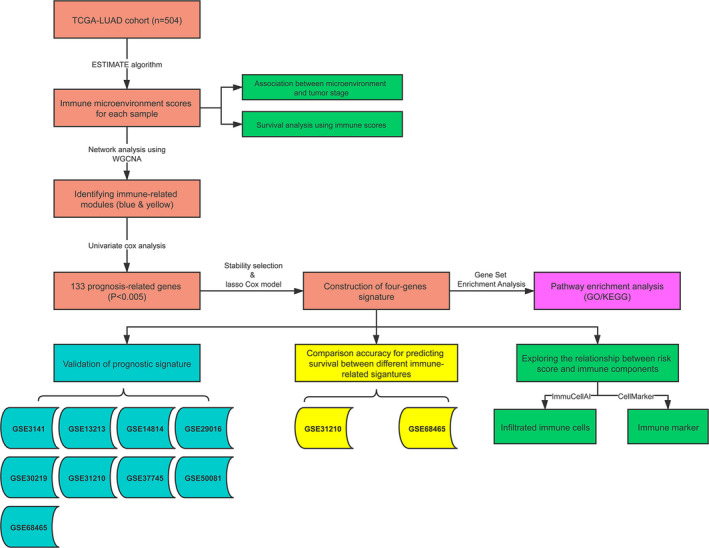
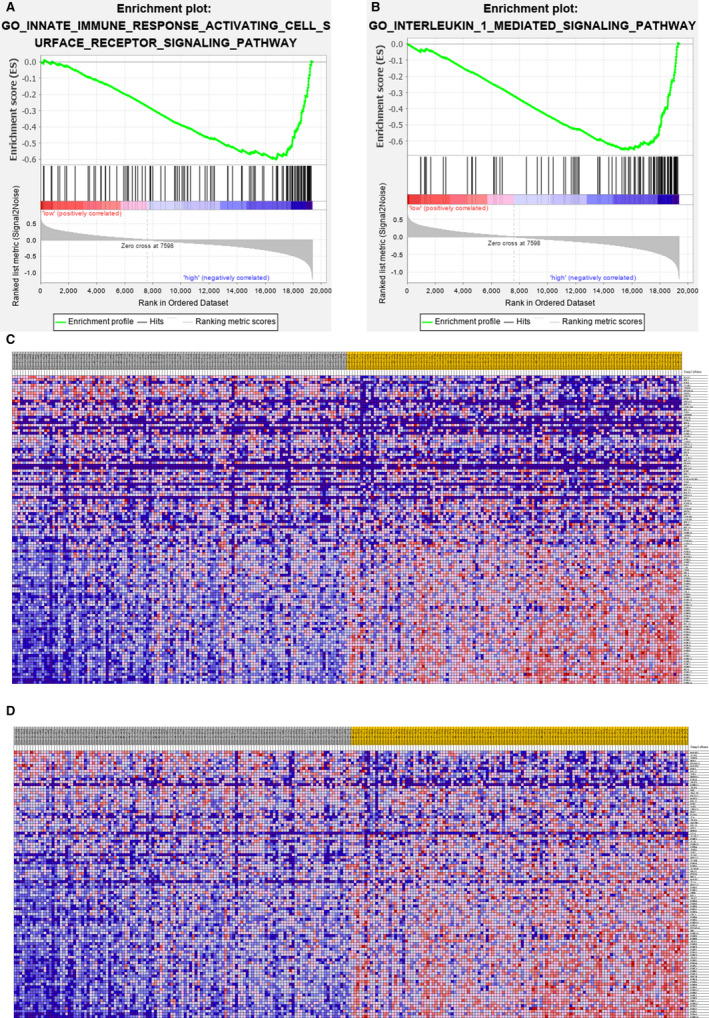
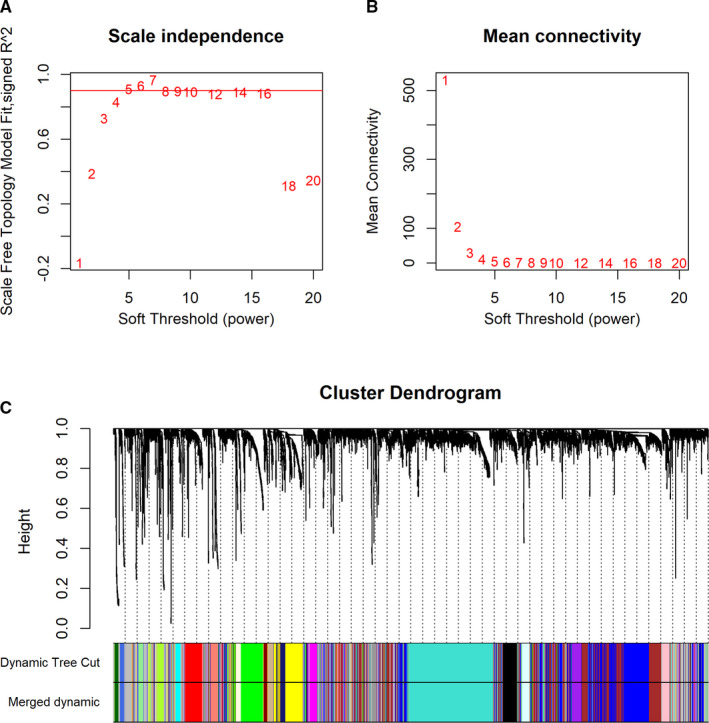
A total of 1774 LUAD cases sourced from public databases were included in this study. Immune scores were calculated through ESTIMATE algorithm and weighted gene co-expression network analysis (WGCNA) was applied to identify immune-related genes. Stability selections and Lasso COX regressions were implemented to construct prognostic signatures. Validations and comparisons with other immune-related signatures were conducted in independent Gene Expression Omnibus (GEO) cohorts. Abundant infiltrated immune cells and pathway enrichment analyses were carried out, respectively, through ImmuCellAI and gene set enrichment analysis (GSEA).
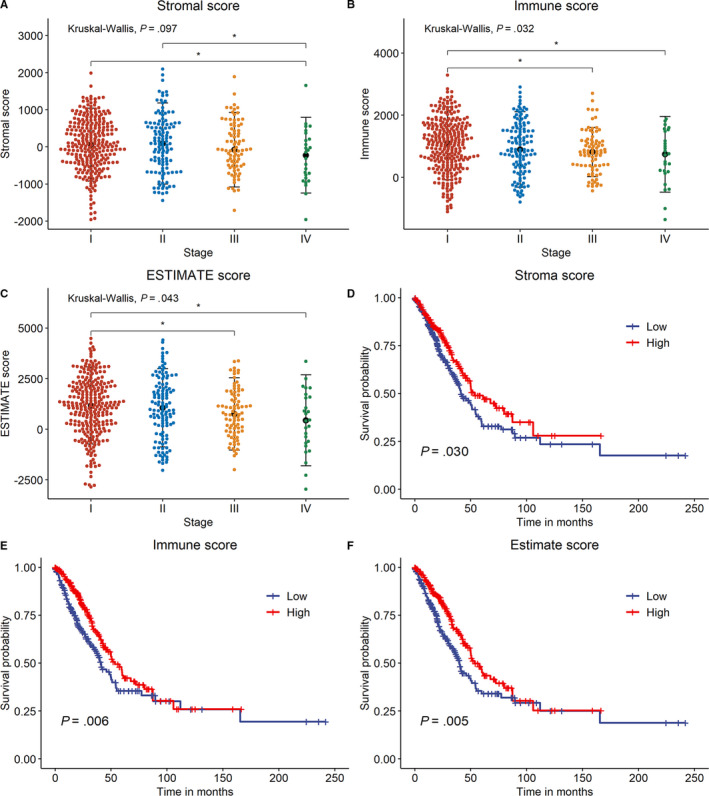
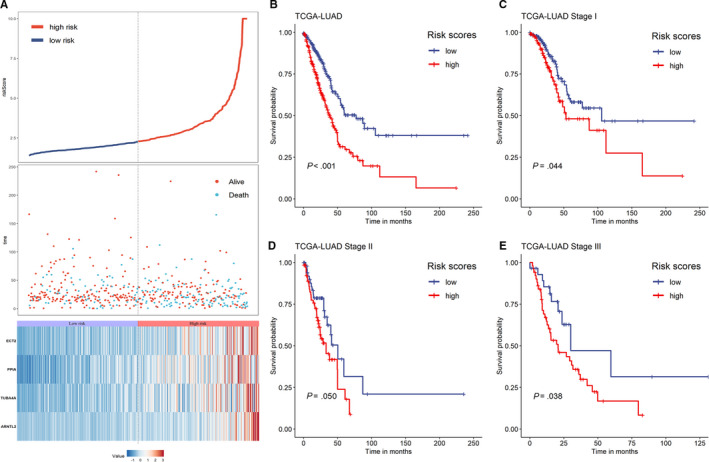
In Cancer Genome Atlas (TCGA) LUAD cohorts, immune scores of higher levels were significantly associated with better prognoses (P < .05). Yellow (n = 270) and Blue (n = 764) colored genes were selected as immune-related genes, and after univariate Cox regression analysis (P < .005), a total of 133 genes were screened out for subsequent model constructions. A four-gene signature (ARNTL2, ECT2, PPIA, and TUBA4A) named IPSLUAD was developed through stability selection and Lasso COX regression. It was suggested by multivariate and subgroup analyses that IPSLUAD was an independent prognostic factor. It was suggested by Kaplan-Meier survival analysis that eight out of nine patients in high-risk groups had significantly worse prognoses in validation data sets (P < .05). IPSLUAD outperformed other signatures in two independent cohorts.
A robust immune-related prognostic signature with great performances in multiple LUAD cohorts was developed in this study.
肺腺癌(LUAD)是肺癌最常见的组织学亚型。肿瘤免疫微环境(TIME)参与肿瘤发生、进展和转移。本研究旨在建立 LUAD 的稳健免疫相关特征。
本研究共纳入了来自公共数据库的 1774 例 LUAD 病例。通过 ESTIMATE 算法计算免疫评分,并应用加权基因共表达网络分析(WGCNA)鉴定免疫相关基因。通过稳定性选择和 Lasso COX 回归构建预后特征。在独立的基因表达综合数据库(GEO)队列中进行验证和与其他免疫相关特征的比较。通过 ImmuCellAI 和基因集富集分析(GSEA)分别进行丰富浸润免疫细胞和途径富集分析。
在癌症基因组图谱(TCGA)LUAD 队列中,较高水平的免疫评分与更好的预后显著相关(P<0.05)。黄色(n=270)和蓝色(n=764)颜色的基因被选为免疫相关基因,经过单变量 Cox 回归分析(P<0.005),共筛选出 133 个基因用于后续模型构建。通过稳定性选择和 Lasso COX 回归构建了一个由 4 个基因(ARNTL2、ECT2、PPIA 和 TUBA4A)组成的命名为 IPSLUAD 的四基因特征。多变量和亚组分析表明 IPSLUAD 是一个独立的预后因素。Kaplan-Meier 生存分析表明,在验证数据集的高风险组的 9 名患者中,有 8 名患者的预后明显更差(P<0.05)。IPSLUAD 在两个独立的队列中表现优于其他特征。
本研究建立了一个在多个 LUAD 队列中表现良好的稳健免疫相关预后特征。