Division of Nephrology, Department of Medicine, Veterans Affairs Puget Sound Health Care System, Seattle, Washington.
Department of Internal Medicine, Scripps Clinic, Scripps Health, San Diego, California.
Kidney360. 2020 Sep 11;1(11):1217-1225. doi: 10.34067/KID.0003962020. eCollection 2020 Nov 25.
The discovery of nondiabetic kidney disease (NDKD) in an individual patient with diabetes may have significant treatment implications. Extensive histopathologic data in this population are lacking, but they may provide insights into the complex pathogenesis of diabetic nephropathy (DN) and reveal specific phenotypes for the development of targeted therapies. This study seeks to elucidate the clinical and laboratory parameters associated with the spectrum of kidney histopathologic features in patients with diabetes.
This study is a retrospective analysis of 399 kidney biopsies assessed from 2014 to 2016 at the University of Washington among patients with diabetes. More comprehensive clinical data were evaluated in a subset of 79 participants.
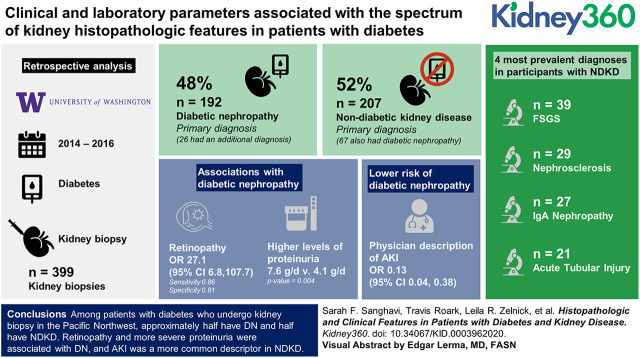
Of the 399 biopsies reviewed, 192 (48%) had a primary diagnosis of DN (including 26 with an additional diagnosis), and 207 (52%) had a primary diagnosis of NDKD (including 67 who also had DN). Retinopathy (sensitivity: 0.86; specificity: 0.81; OR, 27.1; 95% CI, 6.8 to 107.7) and higher levels of proteinuria (7.6 versus 4.1 g/d; =0.004) were associated with DN, whereas a physician description of AKI was associated with a lower risk of DN (OR, 0.13; 95% CI, 0.04 to 0.38). The four most prevalent diagnoses in participants with NDKD were FSGS in 39, nephrosclerosis in 29, IgA nephropathy in 27, and acute tubular injury in 21.
Among patients with diabetes who undergo kidney biopsy in the Pacific Northwest, approximately half have DN, and half have NDKD. Retinopathy and more severe proteinuria were associated with DN, and AKI was a more common descriptor in NDKD. This article contains a podcast at https://www.asnonline.org/media/podcast/K360/2020_11_25_KID0003962020.mp3.
在患有糖尿病的个体中发现非糖尿病性肾脏疾病(NDKD)可能具有重要的治疗意义。该人群缺乏广泛的组织病理学数据,但它们可能提供有关糖尿病肾病(DN)复杂发病机制的见解,并揭示针对特定表型的靶向治疗方法。本研究旨在阐明与糖尿病患者肾脏组织病理学特征谱相关的临床和实验室参数。
这是 2014 年至 2016 年在华盛顿大学对 399 例糖尿病患者进行的肾脏活检的回顾性分析。在 79 名参与者中评估了更全面的临床数据。
在回顾的 399 例活检中,192 例(48%)有 DN 的主要诊断(包括 26 例伴有其他诊断),207 例(52%)有 NDKD 的主要诊断(包括 67 例也有 DN)。视网膜病变(敏感性:0.86;特异性:0.81;比值比,27.1;95%可信区间,6.8 至 107.7)和更高水平的蛋白尿(7.6 与 4.1 g/d;=0.004)与 DN 相关,而医生描述的 AKI 与 DN 的风险较低相关(比值比,0.13;95%可信区间,0.04 至 0.38)。在 NDKD 患者中最常见的四个诊断是 FSGS(39 例)、肾硬化症(29 例)、IgA 肾病(27 例)和急性肾小管损伤(21 例)。
在西北太平洋地区接受肾脏活检的糖尿病患者中,约有一半患有 DN,一半患有 NDKD。视网膜病变和更严重的蛋白尿与 DN 相关,而 AKI 在 NDKD 中更为常见。本文包含一个播客,可在 https://www.asnonline.org/media/podcast/K360/2020_11_25_KID0003962020.mp3 上找到。