Department of Radiology, Faculty of Clinical Sciences and.
Department of Radiology, Obafemi Awolowo University Teaching Hospital, Ile-Ife, Osun State, Nigeria; and.
Kidney360. 2020 Jan 31;1(2):79-85. doi: 10.34067/KID.0000142019. eCollection 2020 Feb 27.
Endothelial dysfunction (ED), as ascertained by brachial artery flow-mediated dilation (FMD), is a known feature of sickle cell disease (SCD), which is present both in crisis and in steady state. The assessment of FMD was introduced to examine the vasodilator function. Our objective was to establish the relationship between ED determined by FMD, biomarkers of renal dysfunction, and biomarkers of disease severity in SCD subjects asymptomatic of renal disease.
We enrolled 44 patients with homozygous SCD in steady state and 33 age- and sex-matched controls between 2013 and 2014 in a tropical tertiary hospital. Ultrasonographic FMD of the right brachial artery, renal arterial Doppler, complete blood count, creatinine, fetal hemoglobin, soluble P-selectin, and cystatin C (Cys-C) levels were determined. Using the median FMD value of the control group, the SCD subjects were further classified into two groups for comparison.
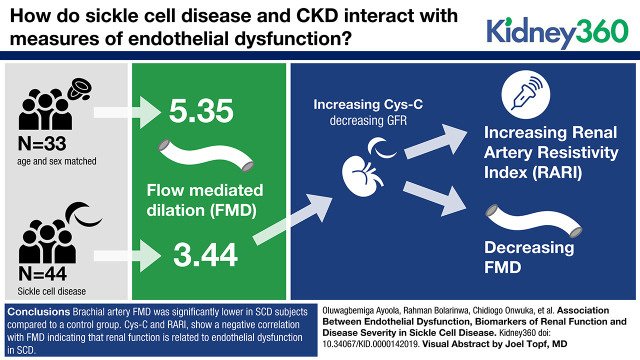
The median FMD in SCD subjects of 3.44 (IQR, 0.00-7.08) was significantly lower than that of controls, which was 5.35 (IQR, 3.60-6.78; =0.04). There was negative correlation between FMD and Cys-C levels (=-0.372; =0.01) along with renal artery resistivity index (RARI; =-0.307; =0.04) in SCD subjects. Additionally, Cys-C level was significantly higher in SCD subjects with FMD<5.35.
Brachial artery FMD was significantly lower in SCD subjects compared with a control group. Cys-C and RARI show a negative correlation with FMD, indicating that renal function is related to ED in SCD.
通过肱动脉血流介导的扩张(FMD)确定的血管内皮功能障碍(ED)是镰状细胞病(SCD)的一个已知特征,无论是在危机期间还是在稳定状态下均存在。FMD 的评估用于检查血管舒张功能。我们的目的是确定 FMD 确定的 ED 与 SCD 患者无症状性肾病的肾功能生物标志物和疾病严重程度生物标志物之间的关系。
我们在 2013 年至 2014 年期间在一家热带三级医院招募了 44 名处于稳定状态的纯合 SCD 患者和 33 名年龄和性别匹配的对照者。确定了右侧肱动脉超声 FMD、肾动脉多普勒、全血细胞计数、肌酐、胎儿血红蛋白、可溶性 P 选择素和胱抑素 C(Cys-C)水平。使用对照组的中位 FMD 值,将 SCD 患者进一步分为两组进行比较。
SCD 患者的中位 FMD 为 3.44(IQR,0.00-7.08),明显低于对照组的 5.35(IQR,3.60-6.78;=0.04)。在 SCD 患者中,FMD 与 Cys-C 水平呈负相关(=-0.372;=0.01),与肾动脉阻力指数(RARI;=-0.307;=0.04)也呈负相关。此外,FMD<5.35 的 SCD 患者的 Cys-C 水平显著升高。
与对照组相比,SCD 患者的肱动脉 FMD 明显降低。Cys-C 和 RARI 与 FMD 呈负相关,表明 SCD 患者的肾功能与 ED 有关。