Department of Internal Medicine, State University of New York at Buffalo, Buffalo, New York.
Department of Internal Medicine, University of Kansas Medical Center, Kansas City, Kansas.
Kidney360. 2021 Sep 16;2(11):1728-1733. doi: 10.34067/KID.0000852021. eCollection 2021 Nov 25.
A computable phenotype is an algorithm used to identify a group of patients within an electronic medical record system. Developing a computable phenotype that can accurately identify patients with autosomal dominant polycystic kidney disease (ADPKD) will assist researchers in defining patients eligible to participate in clinical trials and other studies. Our objective was to assess the accuracy of a computable phenotype using International Classification of Diseases 9th and 10th revision (ICD-9/10) codes to identify patients with ADPKD.
We reviewed four random samples of approximately 250 patients on the basis of ICD-9/10 codes from the EHR from the Kansas University Medical Center database: patients followed in nephrology clinics who had ICD-9/10 codes for ADPKD (Neph+), patients seen in nephrology clinics without ICD codes for ADPKD (Neph-), patients who were not followed in nephrology clinics with ICD codes for ADPKD (No Neph+), and patients not seen in nephrology clinics without ICD codes for ADPKD (No Neph-). We reviewed the charts and determined ADPKD status on the basis of internationally accepted diagnostic criteria for ADPKD.
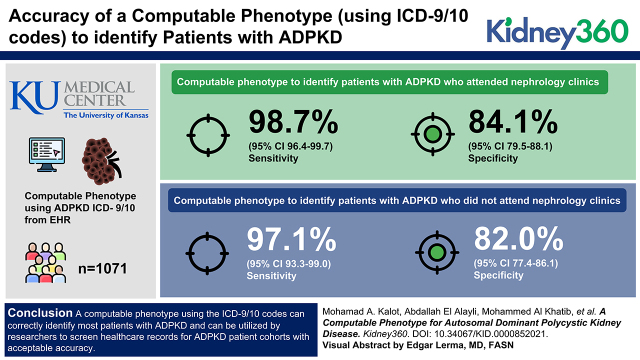
The computable phenotype to identify patients with ADPKD who attended nephrology clinics has a sensitivity of 99% (95% confidence interval [95% CI], 96.4 to 99.7) and a specificity of 84% (95% CI, 79.5 to 88.1). For those who did not attend nephrology clinics, the sensitivity was 97% (95% CI, 93.3 to 99.0), and a specificity was 82% (95% CI, 77.4 to 86.1).
A computable phenotype using the ICD-9/10 codes can correctly identify most patients with ADPKD, and can be utilized by researchers to screen health care records for cohorts of patients with ADPKD with acceptable accuracy.
可计算表型是一种用于在电子病历系统中识别患者群体的算法。开发一种能够准确识别常染色体显性多囊肾病(ADPKD)患者的可计算表型,将有助于研究人员确定有资格参加临床试验和其他研究的患者。我们的目标是评估使用国际疾病分类第 9 版和第 10 版(ICD-9/10)代码的可计算表型来识别 ADPKD 患者的准确性。
我们根据堪萨斯大学医学中心数据库中电子病历的 ICD-9/10 代码,对四个大约 250 名患者的随机样本进行了回顾性研究:在肾病诊所就诊且有 ADPKD ICD-9/10 代码的患者(Neph+)、在肾病诊所就诊但没有 ADPKD ICD 代码的患者(Neph-)、未在肾病诊所就诊但有 ADPKD ICD 代码的患者(无 Neph+)和未在肾病诊所就诊且无 ADPKD ICD 代码的患者(无 Neph-)。我们查阅了病历,并根据国际公认的 ADPKD 诊断标准确定了 ADPKD 状态。
用于识别在肾病诊所就诊的 ADPKD 患者的可计算表型的敏感性为 99%(95%置信区间[95%CI],96.4 至 99.7),特异性为 84%(95%CI,79.5 至 88.1)。对于未到肾病诊所就诊的患者,敏感性为 97%(95%CI,93.3 至 99.0),特异性为 82%(95%CI,77.4 至 86.1)。
使用 ICD-9/10 代码的可计算表型可以正确识别大多数 ADPKD 患者,并且可以被研究人员用于以可接受的准确性筛选 ADPKD 患者的医疗记录队列。