Department of Internal Medicine, Division of Endocrinology and Metabolism, Seoul St. Mary's Hospital, College of Medicine, The Catholic University of Korea, Seoul, Republic of Korea.
Department of Internal Medicine, Division of Endocrinology and Metabolism, Yeouido St. Mary's Hospital, College of Medicine, The Catholic University of Korea, Seoul, Republic of Korea.
Osteoporos Int. 2022 Jul;33(7):1591-1599. doi: 10.1007/s00198-022-06388-w. Epub 2022 Apr 4.
Follow-up raloxifene therapy after denosumab discontinuation resulted in a decrease in bone mass to the pre-denosumab levels and a rebound increase of bone turnover markers. The decrease in lumbar bone mineral density was particularly evident when the body mass index was low, there were previous vertebral fractures, or lumbar bone mineral density before denosumab administration was low.
Selective estrogen receptor modulators may be an alternative to bisphosphonates for treating rebound resorption after discontinuing denosumab. This study aimed to investigate the effects of follow-up raloxifene therapy after denosumab discontinuation in postmenopausal women.
This retrospective observational study included 61 patients who received 12-month follow-up raloxifene therapy after denosumab discontinuation. The primary endpoint was the bone mineral density change. The secondary endpoints were the changes in bone turnover markers and the incidence of new vertebral fractures.
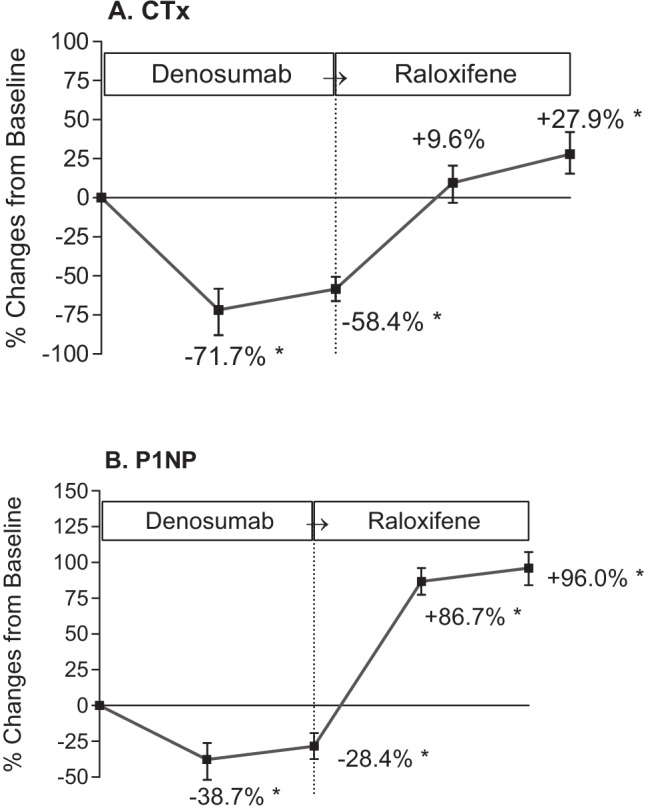
Raloxifene administration for 12 months after denosumab discontinuation resulted in a significantly lower bone mineral density at all sites compared to the level at 6 months after the last denosumab treatment (lumbar spine, - 5.48%; femoral neck, - 2.95%; total hip, - 3.52%; all, p < 0.001). The decrease in lumbar bone mineral density was particularly evident when the body mass index was low, there were previous vertebral fractures, or lumbar bone mineral density before denosumab administration was low. Marked increases in the bone turnover markers from baseline were noted after switching to raloxifene. However, no new vertebral fractures occurred during raloxifene treatment.
Follow-up raloxifene therapy after denosumab discontinuation resulted in a decrease in bone mass to the pre-denosumab levels and a rebound increase of bone turnover markers. Therefore, raloxifene administered sequentially after denosumab discontinuation was not effective in preventing rebound phenomenon.
在停用地舒单抗后进行雷洛昔芬随访治疗会导致骨量降至地舒单抗治疗前水平,并出现骨转换标志物的反弹性增加。当体重指数较低、有既往椎体骨折或地舒单抗治疗前腰椎骨密度较低时,腰椎骨密度的下降尤其明显。
选择性雌激素受体调节剂可能是治疗停用地舒单抗后反弹吸收的一种替代双膦酸盐的方法。本研究旨在探讨在绝经后妇女中停用地舒单抗后进行雷洛昔芬随访治疗的效果。
本回顾性观察性研究纳入了 61 例接受地舒单抗停药后 12 个月雷洛昔芬随访治疗的患者。主要终点为骨密度变化。次要终点为骨转换标志物的变化和新发椎体骨折的发生率。
地舒单抗停药后 12 个月给予雷洛昔芬治疗,与最后一次地舒单抗治疗后 6 个月相比,所有部位的骨密度均显著降低(腰椎,-5.48%;股骨颈,-2.95%;全髋,-3.52%;所有部位,p<0.001)。当体重指数较低、有既往椎体骨折或地舒单抗治疗前腰椎骨密度较低时,腰椎骨密度的下降尤为明显。从基线开始,骨转换标志物明显增加,然后转换为雷洛昔芬。然而,在雷洛昔芬治疗期间没有发生新的椎体骨折。
在停用地舒单抗后进行雷洛昔芬随访治疗会导致骨量降至地舒单抗治疗前水平,并出现骨转换标志物的反弹性增加。因此,在停用地舒单抗后序贯给予雷洛昔芬并不能有效预防反弹现象。