• 文献检索
  • 文档翻译
  • 深度研究
  • 学术资讯
  • Suppr Zotero 插件Zotero 插件
  • 邀请有礼
  • 套餐&价格
  • 历史记录
应用&插件
Suppr Zotero 插件Zotero 插件浏览器插件Mac 客户端Windows 客户端微信小程序
定价
高级版会员购买积分包购买API积分包
服务
文献检索文档翻译深度研究API 文档MCP 服务
关于我们
关于 Suppr公司介绍联系我们用户协议隐私条款
关注我们

Suppr 超能文献

核心技术专利:CN118964589B侵权必究
粤ICP备2023148730 号-1Suppr @ 2026

文献检索

告别复杂PubMed语法,用中文像聊天一样搜索,搜遍4000万医学文献。AI智能推荐,让科研检索更轻松。

立即免费搜索

文件翻译

保留排版,准确专业,支持PDF/Word/PPT等文件格式,支持 12+语言互译。

免费翻译文档

深度研究

AI帮你快速写综述,25分钟生成高质量综述,智能提取关键信息,辅助科研写作。

立即免费体验

新冠疫情期间学生远程学习与眼表疾病的关系

The relationship of distance learning with ocular surface disorders in students in the COVID-19 pandemic.

作者信息

Uzun Seda Liman, Topcu Husna

机构信息

Department of Ophthalmology, Fethi Sekin City Hospital, Elazıg, Turkey.

Department of Ophthalmology, UHS Beyoglu Eye Training and Research Hospital, Istanbul, Turkey.

出版信息

Int Ophthalmol. 2022 Oct;42(10):3045-3051. doi: 10.1007/s10792-022-02290-w. Epub 2022 Apr 4.

DOI:10.1007/s10792-022-02290-w
PMID:35377033
原文链接:https://pmc.ncbi.nlm.nih.gov/articles/PMC8978497/
Abstract

PURPOSE

To evaluate ocular surface disorders in students whose daily screen time increased due to distance learning during the COVID-19 pandemic.

METHODS

Eighty-eight eyes of 44 cases were included in this cross-sectional study. The distance learning students with complaints of redness, stinging, and increased blinking were evaluated. Biomicroscopic examination findings, spherical equivalent, keratometry values, and average daily average screen time were recorded. Ocular Surface Disease Index (OSDI) survey and non-contact tear film breakup time (BUT) assessment (Topcon CA-800) were performed.

RESULTS

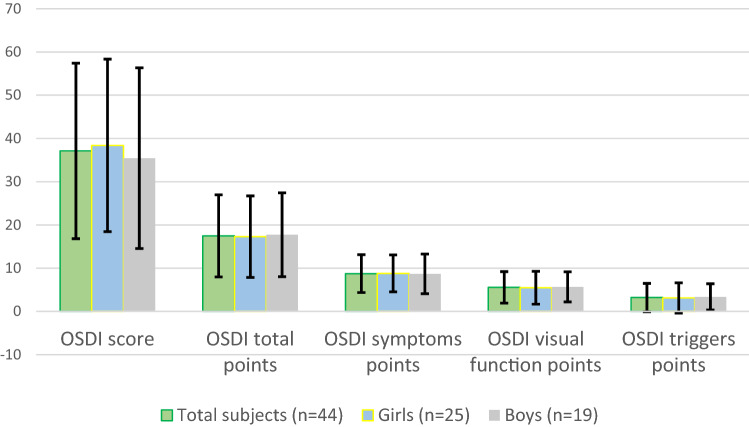
Forty-four cases between 15 and 25 years old were evaluated; 25 were girls (56.8%), 19 were boys (43.2%), and the mean age was 19.2 ± 3.9 years (15-25). The mean daily screen time was 4.9 ± 0.9 h. The mean non-contact BUT was 3.18 ± 2.0 s (1.24-8.80 s), and the spherical equivalent was -1.39 ± 1.79. Punctate epitheliopathy was present in 33 eyes (37.5%) on biomicroscopic examination. The mean OSDI score was 37.12 ± 20.30 (10-75) points. A significant positive correlation was present between daily average screen time, punctate epitheliopathy (r = 0,341; p = 0,001), and OSDI score (r = 0,510; p < 0,001). There was also a significant positive correlation between the OSDI score and punctate epitheliopathy (r = 0.754; p < 0.001). There was no significant correlation between the non-contact BUT and punctate epitheliopathy, OSDI score, or daily screen time (p > 0.05).

CONCLUSION

Ocular surface disorders in students can be associated with increasing daily screen time due to distance learning.

摘要

目的

评估在2019年冠状病毒病大流行期间因远程学习而导致每日屏幕使用时间增加的学生的眼表疾病。

方法

本横断面研究纳入了44例患者的88只眼。对有眼红、刺痛和眨眼增多主诉的远程学习学生进行评估。记录生物显微镜检查结果、等效球镜度、角膜曲率计值和每日平均屏幕使用时间。进行眼表疾病指数(OSDI)调查和非接触泪膜破裂时间(BUT)评估(Topcon CA-800)。

结果

评估了44例年龄在15至25岁之间的患者;其中25例为女性(56.8%),19例为男性(43.2%),平均年龄为19.2±3.9岁(15 - 25岁)。平均每日屏幕使用时间为4.9±0.9小时。平均非接触BUT为3.18±2.0秒(1.24 - 8.80秒),等效球镜度为-1.39±1.79。生物显微镜检查发现33只眼(37.5%)存在点状上皮病变。平均OSDI评分为37.12±20.30(10 - 75)分。每日平均屏幕使用时间与点状上皮病变(r = 0.341;p = 0.001)以及OSDI评分(r = 0.510;p < 0.001)之间存在显著正相关。OSDI评分与点状上皮病变之间也存在显著正相关(r = 0.754;p < 0.001)。非接触BUT与点状上皮病变、OSDI评分或每日屏幕使用时间之间无显著相关性(p > 0.05)。

结论

学生的眼表疾病可能与因远程学习导致的每日屏幕使用时间增加有关。

https://cdn.ncbi.nlm.nih.gov/pmc/blobs/b15d/8978497/c2d51e8a8c87/10792_2022_2290_Fig1_HTML.jpg

相似文献

1
The relationship of distance learning with ocular surface disorders in students in the COVID-19 pandemic.新冠疫情期间学生远程学习与眼表疾病的关系
Int Ophthalmol. 2022 Oct;42(10):3045-3051. doi: 10.1007/s10792-022-02290-w. Epub 2022 Apr 4.
2
The Effects of Daily Digital Device Use on the Ocular Surface in Healthy Children.日常使用数字设备对健康儿童眼表的影响。
Optom Vis Sci. 2022 Feb 1;99(2):167-171. doi: 10.1097/OPX.0000000000001840.
3
Assessment of dry eye symptoms among university students during the COVID-19 pandemic.评估 COVID-19 大流行期间大学生的干眼症状。
Clin Exp Optom. 2022 Jul;105(5):507-513. doi: 10.1080/08164622.2021.1945411. Epub 2021 Jul 19.
4
Reduced ocular surface disease index (OSDI) scores in patients with isotretinoin treatment.异维A酸治疗患者的眼表疾病指数(OSDI)得分降低。
Int Ophthalmol. 2017 Feb;37(1):197-202. doi: 10.1007/s10792-016-0263-y. Epub 2016 May 18.
5
Relationship between OSDI score and biomicroscopic ocular surface damages in glaucomatous patients treated with preserved antiglaucomatous eye drops.青光眼患者经保存的抗青光眼滴眼液治疗后,OSDI 评分与眼表生物显微镜损害的关系。
J Fr Ophtalmol. 2021 Nov;44(9):1326-1331. doi: 10.1016/j.jfo.2021.03.008. Epub 2021 Jul 26.
6
Assessment of prevalence of dry eye among medical students using ocular surface disease index questionnaire - Is COVID-19 to be really blamed?使用眼表面疾病指数问卷评估医学生干眼的患病率——真的要怪 COVID-19 吗?
Indian J Ophthalmol. 2023 Apr;71(4):1450-1453. doi: 10.4103/IJO.IJO_2824_22.
7
Ocular Surface Disease Index and the five-item dry eye questionnaire: A comparison in Indian patients with dry eye disease.眼表疾病指数和五问干眼问卷:在印度干眼疾病患者中的比较。
Indian J Ophthalmol. 2021 Sep;69(9):2396-2400. doi: 10.4103/ijo.IJO_3345_20.
8
Online Vs In-person Education: Evaluating the Potential Influence of Teaching Modality on Dry Eye Symptoms and Risk Factors During the COVID-19 Pandemic.线上教育与线下教育:评估教学模式对 COVID-19 大流行期间干眼症状和相关风险因素的潜在影响。
Eye Contact Lens. 2021 Oct 1;47(10):565-572. doi: 10.1097/ICL.0000000000000816.
9
Assessment of the prevalence and risk factors for dry eye symptoms among Romanian medical students using the ocular surface disease index - a cross-sectional study.采用眼表疾病指数评估罗马尼亚医学生干眼症状的患病率和危险因素 - 一项横断面研究。
BMC Ophthalmol. 2024 Jan 5;24(1):12. doi: 10.1186/s12886-023-03260-1.
10
Evaluation of incomplete blinking as a measurement of dry eye disease.评估不完全眨眼作为干眼症的测量指标。
Ocul Surf. 2019 Jul;17(3):440-446. doi: 10.1016/j.jtos.2019.05.007. Epub 2019 May 29.

引用本文的文献

1
Automated eyeball volume measurement based on CT images using neural network-based segmentation and simple estimation.基于神经网络分割和简单估计的 CT 图像自动眼球容积测量。
Sci Rep. 2024 Jul 2;14(1):15094. doi: 10.1038/s41598-024-64913-9.
2
Investigating the Impact of COVID-19 Infection on Dry Eye Parameters.研究新冠病毒感染对干眼参数的影响。
Diagnostics (Basel). 2023 Apr 24;13(9):1524. doi: 10.3390/diagnostics13091524.
3
Prevalence and associated factors for self-reported symptoms of dry eye among Thai school children during the COVID-19 outbreak.

本文引用的文献

1
Progression of Myopia in School-Aged Children After COVID-19 Home Confinement.新冠居家隔离后学龄儿童近视进展。
JAMA Ophthalmol. 2021 Mar 1;139(3):293-300. doi: 10.1001/jamaophthalmol.2020.6239.
2
Prevalence and risk factor assessment of digital eye strain among children using online e-learning during the COVID-19 pandemic: Digital eye strain among kids (DESK study-1).新冠疫情期间使用在线电子学习的儿童数字眼疲劳的患病率和风险因素评估:儿童数字眼疲劳(DESK 研究-1)。
Indian J Ophthalmol. 2021 Jan;69(1):140-144. doi: 10.4103/ijo.IJO_2535_20.
3
High Prevalence of Abnormal Ocular Surface Tests in a Healthy Pediatric Population.
新冠疫情期间泰国在校儿童自述干眼症状的流行情况及其相关因素。
PLoS One. 2023 Apr 24;18(4):e0284928. doi: 10.1371/journal.pone.0284928. eCollection 2023.
4
The ocular symptoms and signs during the COVID-19 pandemic.新冠疫情期间的眼部症状和体征。
PLoS One. 2022 Oct 20;17(10):e0276435. doi: 10.1371/journal.pone.0276435. eCollection 2022.
健康儿童群体中眼表检查异常的高患病率。
Clin Ophthalmol. 2020 Oct 22;14:3427-3438. doi: 10.2147/OPTH.S266261. eCollection 2020.
4
Investigation of Dry Eye Symptoms in Lecturers by Ocular Surface Disease Index.使用眼表疾病指数对讲师干眼症状的调查。
Turk J Ophthalmol. 2019 Jun 27;49(3):142-148. doi: 10.4274/tjo.galenos.2018.67915.
5
Update on the association between dry eye disease and meibomian gland dysfunction.干眼疾病与睑板腺功能障碍之间关联的最新进展。
Hong Kong Med J. 2019 Feb;25(1):38-47. doi: 10.12809/hkmj187331. Epub 2019 Jan 31.
6
Association between dry eye symptoms and signs.干眼症状与体征之间的关联。
J Curr Ophthalmol. 2018 Jun 28;30(4):321-325. doi: 10.1016/j.joco.2018.05.002. eCollection 2018 Dec.
7
The influences of smartphone use on the status of the tear film and ocular surface.智能手机使用对泪膜和眼表状态的影响。
PLoS One. 2018 Oct 31;13(10):e0206541. doi: 10.1371/journal.pone.0206541. eCollection 2018.
8
TFOS DEWS II Definition and Classification Report.TFOS DEWS II 定义与分类报告。
Ocul Surf. 2017 Jul;15(3):276-283. doi: 10.1016/j.jtos.2017.05.008. Epub 2017 Jul 20.
9
Smartphone use is a risk factor for pediatric dry eye disease according to region and age: a case control study.根据地区和年龄,智能手机使用是儿童干眼症的一个风险因素:一项病例对照研究。
BMC Ophthalmol. 2016 Oct 28;16(1):188. doi: 10.1186/s12886-016-0364-4.
10
Associations between signs and symptoms of dry eye disease: a systematic review.干眼疾病体征与症状之间的关联:一项系统综述
Clin Ophthalmol. 2015 Sep 16;9:1719-30. doi: 10.2147/OPTH.S89700. eCollection 2015.