Division of Radiation Oncology, Kobe Minimally Invasive Cancer Center, Chuo-ku Kobe, Hyogo, Japan.
Division of Radiation Oncology, Kobe University Graduate School of Medicine, Chuo-ku Kobe, Hyogo, Japan.
J Appl Clin Med Phys. 2022 Jun;23(6):e13596. doi: 10.1002/acm2.13596. Epub 2022 Apr 4.
Real-time tracking systems of moving respiratory targets such as CyberKnife, Radixact, or Vero4DRT are an advanced robotic radiotherapy device used to deliver stereotactic body radiotherapy (SBRT). The internal target volume (ITV) of lung tumors is assessed through a fiducial marker fusion using four-dimensional computed tomography (CT). It is important to minimize the ITV to protect normal lung tissue from exposure to radiation and the associated side effects post SBRT. However, the ITV may alter if there is a change in the position of the fiducial marker with respect to the tumor. This study investigated the relationship between fiducial marker position and the ITV in order to prevent radiation exposure of normal lung tissue, and correct target coverage.
This study retrospectively reviewed 230 lung cancer patients who received a fiducial marker for SBRT between April 2015 and September 2021. The distance of the fiducial marker to the gross tumor volume (GTV) in the expiratory (d ) and inspiratory (d ) CT, and the ratio of the ITV/V(GTV ), were investigated.
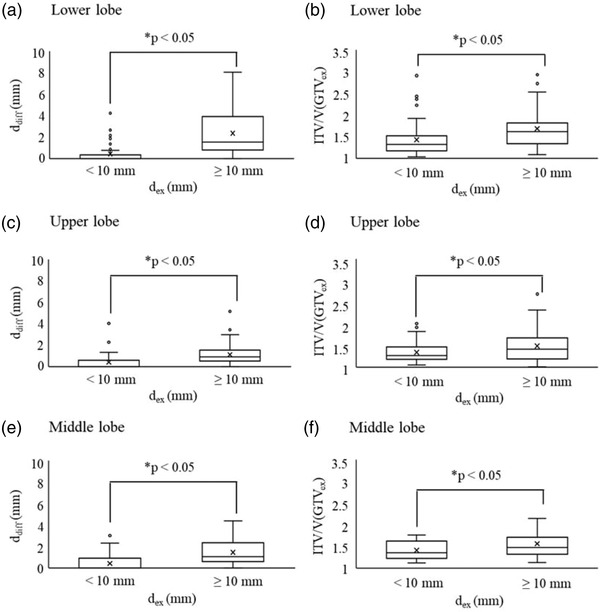
Upon comparing each lobe, although there was no significant difference in the d and the ITV/V(GTV ) between all lobes for d < 10 mm, there was significant difference in the d and the ITV/V(GTV ) between the lower and upper lobes for d ≥ 10 mm (p < 0.05). Moreover, there was significant difference in the d and the ITV/V(GTV ) between d ≥10 mm and d < 10 mm in all lung regions (p < 0.05).
The ITV that had no margin from GTVs increased when d was ≥10 mm for all lung regions (p < 0.05). Furthermore, the increase in ITV tended to be greater in the lower lung lobe. These findings can help decrease the possibility of adverse events post SBRT, and correct target coverage.
CyberKnife、Radixact 或 Vero4DRT 等移动呼吸目标的实时跟踪系统是一种用于提供立体定向体放射治疗 (SBRT) 的先进机器人放射治疗设备。通过使用四维计算机断层扫描 (CT) 进行基准标记融合来评估肺部肿瘤的内部靶区 (ITV)。为了保护正常肺组织免受 SBRT 后辐射和相关副作用的影响,尽量减小 ITV 非常重要。然而,如果基准标记相对于肿瘤的位置发生变化,ITV 可能会发生变化。本研究旨在调查基准标记位置与 ITV 之间的关系,以防止正常肺组织受到辐射照射,并纠正目标覆盖范围。
本研究回顾性分析了 2015 年 4 月至 2021 年 9 月期间接受 SBRT 基准标记的 230 例肺癌患者。研究了基准标记到吸气 (d) 和呼气 (d) CT 中的大体肿瘤体积 (GTV) 的距离,以及 ITV/V(GTV) 的比值。
在比较每个肺叶时,尽管对于 d < 10mm,所有肺叶的 d 和 ITV/V(GTV) 之间没有显著差异,但对于 d ≥ 10mm,下叶和上叶之间的 d 和 ITV/V(GTV) 有显著差异 (p < 0.05)。此外,在所有肺区,d ≥ 10mm 与 d < 10mm 之间的 d 和 ITV/V(GTV) 有显著差异 (p < 0.05)。
对于所有肺区,当 d ≥ 10mm 时,无 GTV 边界的 ITV 会增加 (p < 0.05)。此外,下肺叶的 ITV 增加趋势更大。这些发现有助于降低 SBRT 后不良事件的发生可能性,并纠正目标覆盖范围。