Department of Psychiatry and Psychotherapy, Otto-von-Guericke-University Magdeburg, Leipziger Str. 44, 39120, Magdeburg, Germany.
Laboratory of Translational Psychiatry, Otto-von-Guericke-University Magdeburg, Magdeburg, Germany.
J Neuroinflammation. 2022 Apr 4;19(1):74. doi: 10.1186/s12974-022-02429-7.
We recently reported increased levels of neutrophils, monocytes and C-reactive protein (CRP) correlated with symptom severity in acute schizophrenia. Here, we investigated if a similar pattern of innate immune system activation occurs in major depression (MD).
We assessed differential blood counts, CRP, depression symptoms (HAMD-21) and psychosocial functioning (GAF) in controls (n = 129) and patients with first (FEMD: n = 82) or recurrent (RMD: n = 47) disease episodes of MD at baseline (T0; hospital admission) and after 6-weeks treatment (T6).
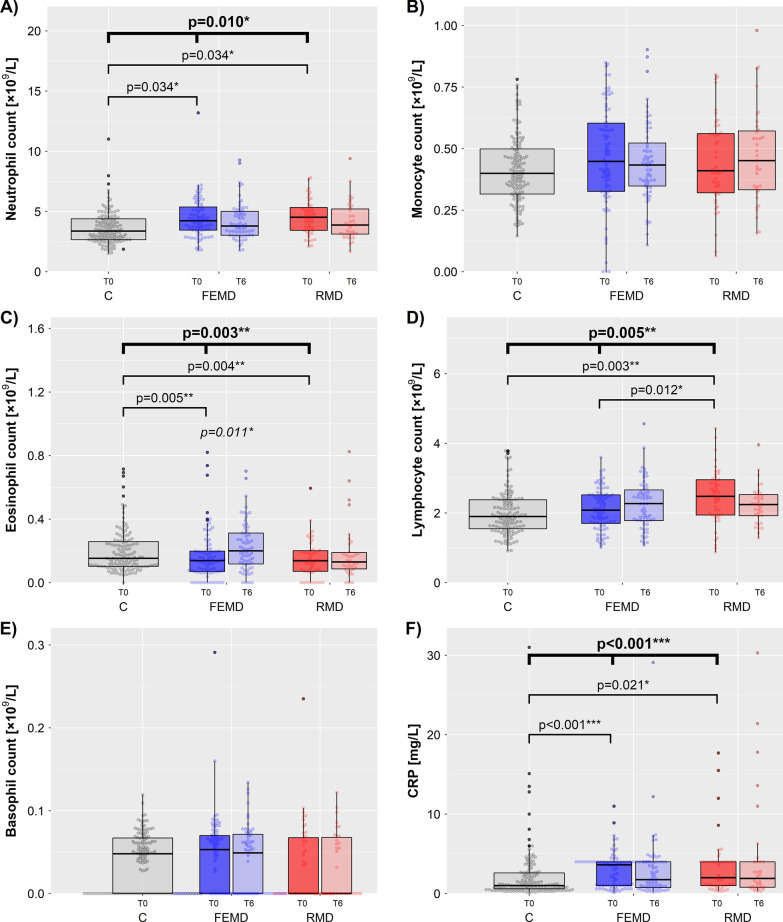
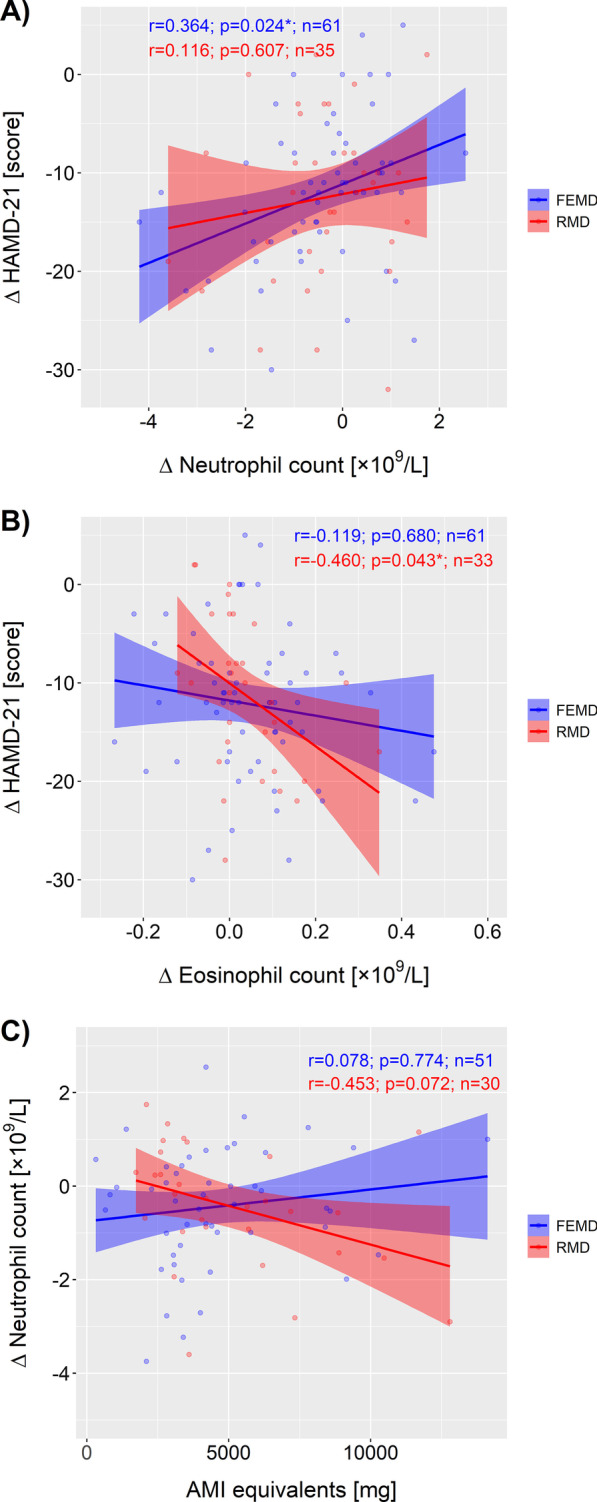
Considering smoking, BMI and gender as covariates, neutrophils (FEMD: p = 0.034, RMD: p = 0.034) and CRP (FEMD: p < 0.001, RMD: p = 0.021) were higher, and eosinophils (FEMD: p = 0.005, RMD: p = 0.004) lower in patients versus controls at T0. Baseline lymphocyte counts were elevated in RMD (p = 0.003) but not FEMD. Results were confirmed by analyses of nonsmokers. At follow-up, eosinophils rose significantly in FEMD (p = 0.011) but no significant changes were observed in RMD. Improvement in HAMD-21 correlated with T0-T6 changes of neutrophil counts in FEMD (r = 0.364, p = 0.024). Compared with our previous schizophrenia study, raised baseline neutrophil and reduced eosinophil counts in MD had smaller effect sizes and treatment had a weaker association with T0-T6 changes in neutrophils. In addition, lymphocytes were elevated at T0 in recurrent MD but not in schizophrenia patients.
These findings suggest that innate immunity may be involved in early stages of MD, and adaptive immunity may be involved in chronic disease. Thus, further studies may lead to new disease stage-dependent MD treatment strategies targeting different aspects of immune system activation.
我们最近报道称,中性粒细胞、单核细胞和 C 反应蛋白(CRP)水平升高与急性精神分裂症的症状严重程度相关。在此,我们研究了这种先天免疫系统激活的类似模式是否也存在于重度抑郁症(MD)中。
我们评估了对照组(n=129)和首发(FEMD:n=82)或复发性(RMD:n=47)MD 患者的差异血细胞计数、CRP、抑郁症状(HAMD-21)和心理社会功能(GAF),在基线(T0;住院时)和 6 周治疗后(T6)。
考虑到吸烟、BMI 和性别作为协变量,中性粒细胞(FEMD:p=0.034,RMD:p=0.034)和 CRP(FEMD:p<0.001,RMD:p=0.021)在患者中高于对照组,而在 FEMD(p=0.005,RMD:p=0.004)和 RMD(p=0.003)中则低于对照组。在 FEMD 中,基线淋巴细胞计数升高(p=0.003),但在 RMD 中则没有。非吸烟者的分析结果得到了证实。在随访时,FEMD 中的嗜酸性粒细胞显著升高(p=0.011),但 RMD 中没有观察到显著变化。HAMD-21 的改善与 FEMD 中 T0-T6 中性粒细胞计数的变化相关(r=0.364,p=0.024)。与我们之前的精神分裂症研究相比,MD 患者中基线中性粒细胞升高和嗜酸性粒细胞减少的效应较小,且治疗与中性粒细胞的 T0-T6 变化相关性较弱。此外,在复发性 MD 患者中,T0 时淋巴细胞升高,但在精神分裂症患者中则没有。
这些发现表明,先天免疫可能参与 MD 的早期阶段,而适应性免疫可能参与慢性疾病。因此,进一步的研究可能会导致针对不同的免疫系统激活方面的新的基于疾病阶段的 MD 治疗策略。