Jiao Xinyan, Wang Bo, Yang Lu, Zhao Qingbin, Zhang Miao, Liu Xiaoxu, Zhou Can, Wang Ruiqi, Chen He, Wang Jichang, Ren Yu, Liu Peijun
Center for Translational Medicine, the First Affiliated Hospital of Xi'an Jiaotong University, Xi'an, 710061, Shaanxi, P.R. China.
Key Laboratory for Tumor Precision Medicine of Shaanxi Province, the First Affiliated Hospital of Xi'an Jiaotong University, Xi'an, 710061, Shaanxi, P.R. China.
Cell Death Discov. 2022 Apr 4;8(1):155. doi: 10.1038/s41420-022-00964-z.
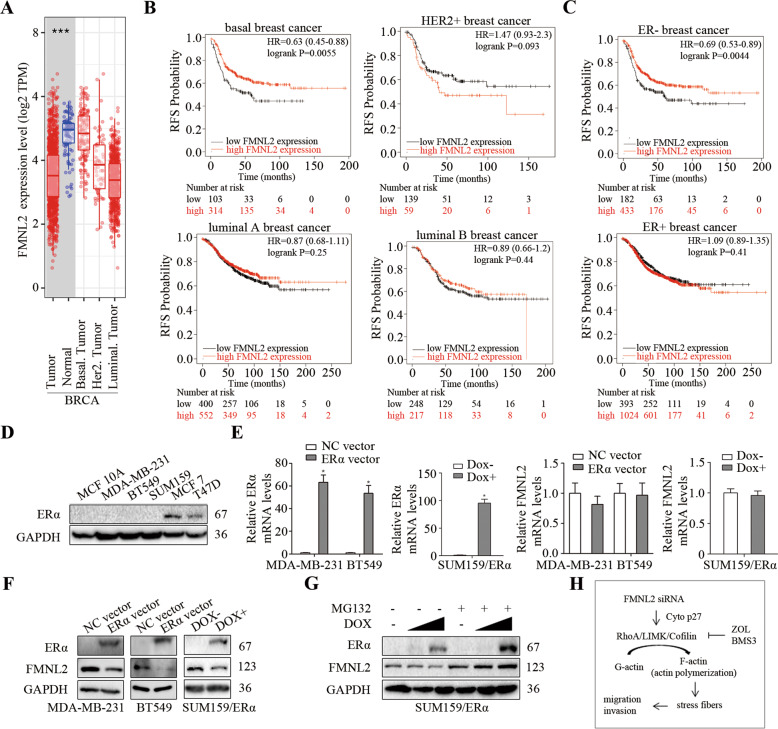
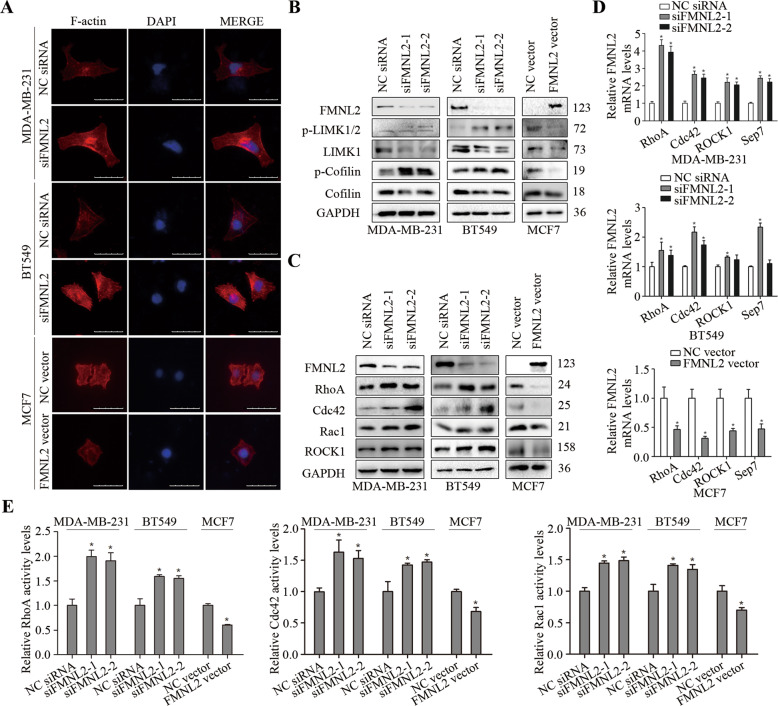
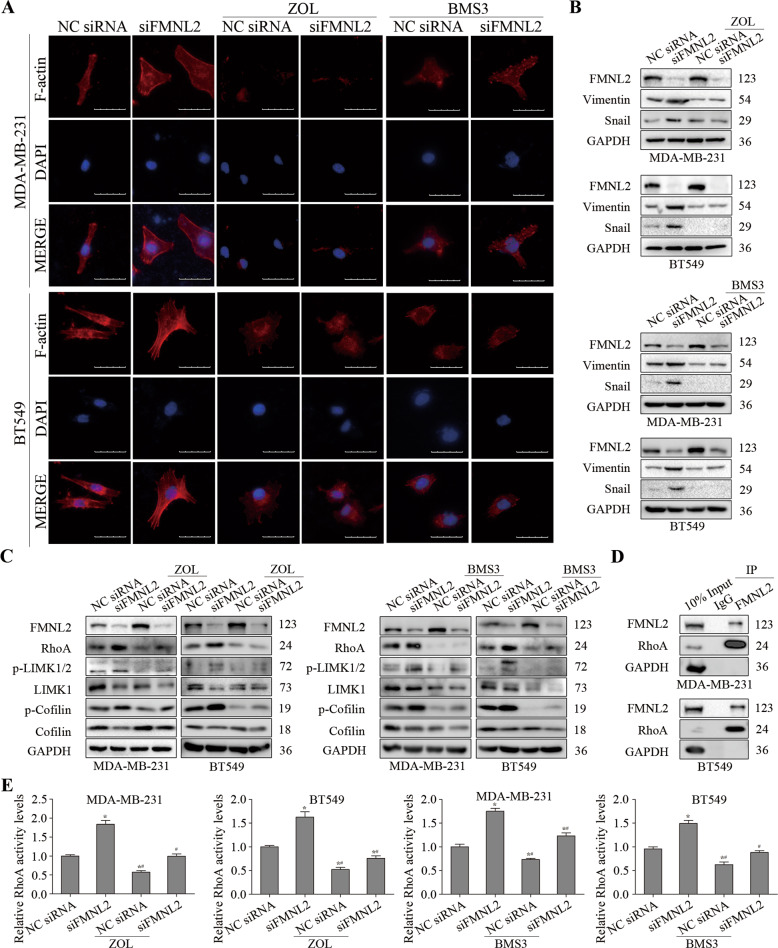
Formin-like protein 2 (FMNL2) belongs to a highly conserved family of cytoskeletal remodeling proteins that have been reported to be implicated in various actin-dependent physiological and cancer-associated processes. In this study, we mainly investigated the effects of FMNL2 on breast cancer cell migration and invasion, and the underlying mechanisms involved. We found that FMNL2 reduced cell migration and invasion of breast cancer in vitro and in vivo. Further, FMNL2 disrupted actin cytoskeleton rearrangement and hampered the RhoA/LIMK/Cofilin pathway in breast cancer cells. Critically, both Rho inhibitor ZOL and LIMK inhibitor BMS3 significantly abrogated these migration-promoting effects in FMNL2-silencing MDA-MB-231 and BT549 cells. RhoA/LIMK/Cofilin pathway was involved in FMNL2 silencing-induced actin cytoskeleton rearrangement in MDA-MB-231 and BT549 cells. More importantly, cytoplasmic p27 promoted FMNL2-mediated cell migration and invasion through RhoA/LIMK/Cofilin pathway in MCF7 and MDA-MB-231 cells. In addition, the expression and prognosis of FMNL2 were associated with ER in breast cancer. Furthermore, ERα overexpression reduced the protein levels of FMNL2 in breast cancer cells, which were reversed by MG132. In conclusion, FMNL2 suppressed cell migration and invasion of breast cancer by inhibiting RhoA/LIMK/Cofilin pathway through a reduction of cytoplasmic p27. This finding implies that the interference of FMNL2-mediated RhoA/LIMK/Cofilin pathway involving the cytoplasmic p27 may be a promising strategy for ameliorating breast cancer metastasis and prognosis.
formin样蛋白2(FMNL2)属于细胞骨架重塑蛋白的一个高度保守家族,据报道该家族参与各种肌动蛋白依赖性生理过程和癌症相关过程。在本研究中,我们主要研究了FMNL2对乳腺癌细胞迁移和侵袭的影响及其潜在机制。我们发现FMNL2在体外和体内均降低了乳腺癌细胞的迁移和侵袭能力。此外,FMNL2破坏了乳腺癌细胞中的肌动蛋白细胞骨架重排,并阻碍了RhoA/LIMK/丝切蛋白途径。至关重要的是,Rho抑制剂ZOL和LIMK抑制剂BMS3均显著消除了FMNL2沉默的MDA-MB-231和BT549细胞中的这些迁移促进作用。RhoA/LIMK/丝切蛋白途径参与了FMNL2沉默诱导的MDA-MB-231和BT549细胞中的肌动蛋白细胞骨架重排。更重要的是,细胞质p27通过RhoA/LIMK/丝切蛋白途径促进了MCF7和MDA-MB-231细胞中FMNL2介导的细胞迁移和侵袭。此外,FMNL2的表达和预后与乳腺癌中的雌激素受体(ER)相关。此外,ERα过表达降低了乳腺癌细胞中FMNL2的蛋白水平,而MG132可逆转这种降低。总之,FMNL2通过降低细胞质p27抑制RhoA/LIMK/丝切蛋白途径,从而抑制乳腺癌细胞的迁移和侵袭。这一发现表明,干扰涉及细胞质p27的FMNL2介导的RhoA/LIMK/丝切蛋白途径可能是改善乳腺癌转移和预后的一种有前景的策略。