Radboud University Medical Centre, Department of Psychiatry, 6525 GA, Nijmegen, The Netherlands.
Radboud University, Donders Institute for Brain Behaviour and Cognition, Centre for Cognitive Neuroimaging, Nijmegen, The Netherlands.
Commun Biol. 2022 Apr 4;5(1):302. doi: 10.1038/s42003-022-03234-x.
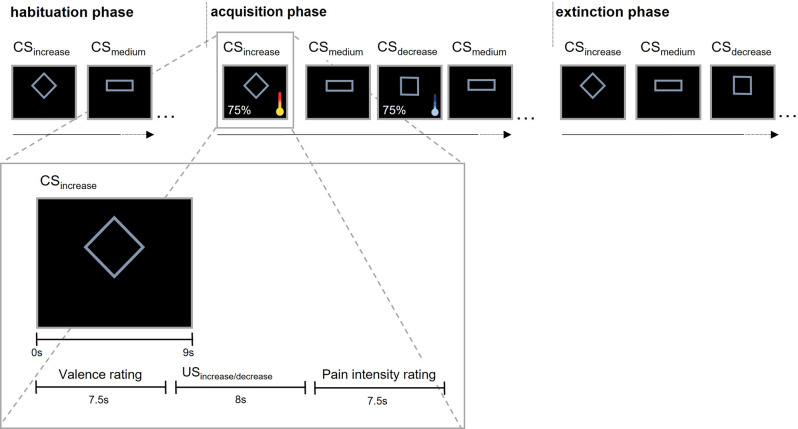
Appetitive and aversive learning are both key building blocks of adaptive behavior, yet knowledge regarding their differences is sparse. Using a capsaicin heat pain model in 36 healthy participants, this study directly compared the acquisition and extinction of conditioned stimuli (CS) predicting pain exacerbation and relief. Valence ratings show stronger acquisition during aversive compared to appetitive learning, but no differences in extinction. Skin conductance responses and contingency ratings confirmed these results. Findings were unrelated to individual differences in pain sensitivity or psychological factors. Our results support the notion of an evolutionarily hardwired preponderance to acquire aversive rather than appetitive cues as is protective for acute aversive states such as pain but may contribute to the development and maintenance of clinical conditions such as chronic pain, depression or anxiety disorders.
** appetitive 和 aversive 学习都是适应性行为的关键组成部分,但关于它们差异的知识却很匮乏。** 通过在 36 名健康参与者中使用辣椒素热痛模型,本研究直接比较了预测疼痛加重和缓解的条件刺激 (CS) 的获得和消退。效价评分显示,在厌恶学习中比在食欲学习中更容易获得,但在消退中没有差异。皮肤电导反应和条件评分证实了这些结果。研究结果与疼痛敏感性或心理因素的个体差异无关。我们的研究结果支持这样一种观点,即获得厌恶刺激而不是食欲刺激的倾向性是进化过程中固有的,这对急性厌恶状态(如疼痛)具有保护作用,但可能导致慢性疼痛、抑郁或焦虑障碍等临床状况的发展和维持。