He Z X, Zhang R L, Zhai W H, Ma Q L, Pang A M, Yang D L, He Y, Wei J L, Chen X, Jiang E L, Feng S Z, Han M Z
State Key Laboratory of Experimental Hematology, National Clinical Research Center for Blood Diseases, Institute of Hematology & Blood Diseases Hospital, Chinese Academy of Medical Sciences & PekingUnion Medical College, Tianjin 300020, China He Zhenxin now works at the Department of Hematology of The First Affiliated Hospital of Kunming Medical University, Kunming 650032, China.
State Key Laboratory of Experimental Hematology, National Clinical Research Center for Blood Diseases, Institute of Hematology & Blood Diseases Hospital, Chinese Academy of Medical Sciences & PekingUnion Medical College, Tianjin 300020, China.
Zhonghua Xue Ye Xue Za Zhi. 2022 Feb 14;43(2):120-127. doi: 10.3760/cma.j.issn.0253-2727.2022.02.006.
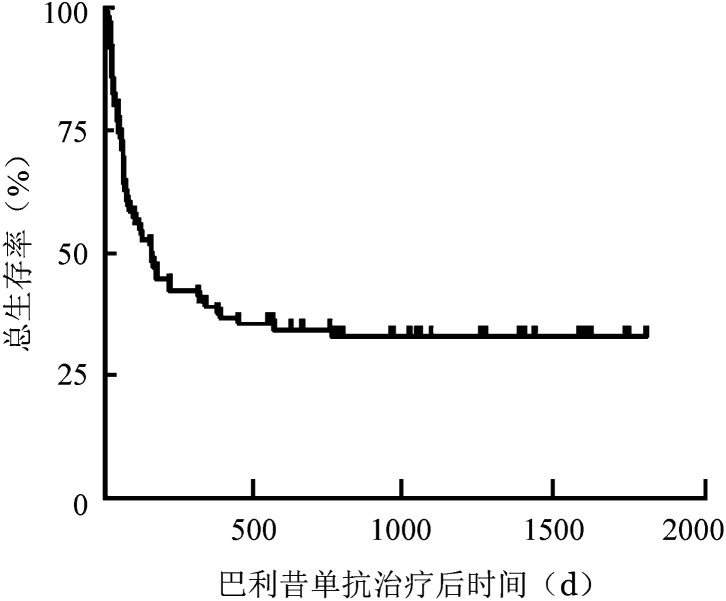
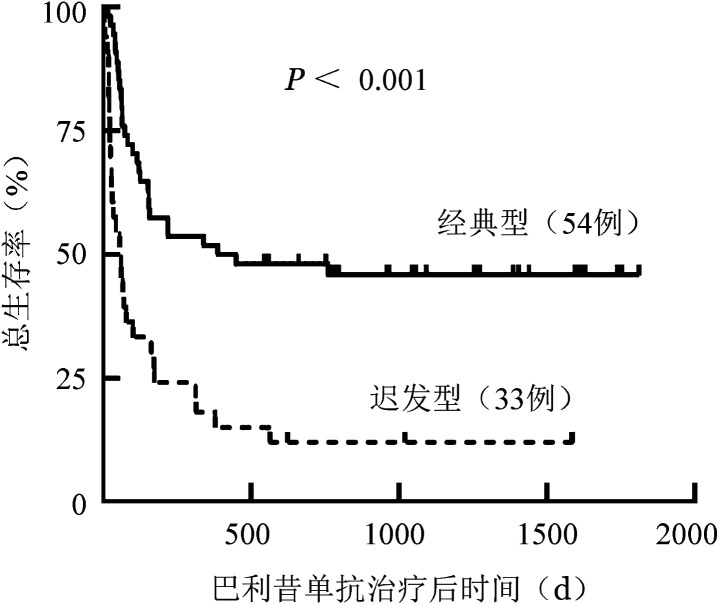
To evaluate the efficacy and prognosis of basiliximab in the treatment of steroid-refractory or steroid-dependent acute graft-versus-host disease (SR/SD-aGVHD) after allogeneic hematopoietic stem cell transplantation (allo-HSCT) . Clinical data of 87 patients with SR/SD-aGVHD in the skin, intestine, and liver after allo-HSCT at the Institute of Hematology & Blood Diseases Hospital Transplantation Center from January 2015 to December 2018 were retrospectively analyzed. The administration plan of basiliximab was as follows: 20 mg for adults and children weighing ≥35 kg and 10 mg for children weighing<35 kg. The drug was administered once on the 1st, 4th, and 8th days, respectively, and then once weekly. The efficacy was evaluated on the 7th, 14th, 21st, and 28th days after basiliximab treatment. ①There were 51 males (58.6%) and 36 females (41.4%) , with a median (range) age of 34 (4-63) years. There were 54 cases of classic aGVHD, 33 of late aGVHD, 49 of steroid-refractory aGVHD, and 38 of steroid-dependent aGVHD. ②Thirty-five patients (40.2%) achieved complete remission (CR) , 23 (26.4%) achieved partial remission (PR) , and 29 had no remission (NR) . The total effective rate[overall response rate (ORR) ] was 66.7% (58/87) . ③The ORR of the classic and late aGVHD groups was 77.8% (42/54) and 48.5% (16/33) , respectively. ④The median (range) follow-up time was 154 (4-1813) days, the 6-month overall survival (OS) rate of the 87 patients was 44.8% (95% 39.5%-50.1%) and the 1-year OS was 39.4% (95% 34.2%-44.3%) . ⑤After treatment with basiliximab, the 6-month OS in the CR (35 cases) , PR (23 cases) , and NR (29 cases) groups was 80.0% (95% 73.2%-86.8%) , 39.1% (95% 28.9%-49.3%) , and 6.9% (95% 2.2%-11.6%) , respectively ((2)=34.679, <0.001) , and the 1-year OS was 74.3% (95% 66.9%-81.7%) , 30.4% (95% 20.8%-40.0%) , and 3.4% (95% 0%-6.8%) , respectively ((2)=43.339, <0.001) . The OS of the classic and late aGVHD groups was 57.4% (95% 50.7%-64.1%) and 24.2% (95% 16.7%-31.7%) , respectively ((2)=9.109, =0.004) , and the 1-year OS was 51.9% (95% 45.1%-58.7%) and 18.2% (95% 11.5%-24.9%) , respectively ((2)=9.753, =0.003) . ⑥Univariate and multivariate analyses showed that late aGVHD (=3.121, 95% 1.770-5.503, <0.001) , Minnesota score high-risk group before medication (=3.591, 95% 1.931-6.679, <0.001) , active infection before medication (=1.881, 95% 1.029-3.438, =0.040) , and impairment of important organ function caused by non-GVHD (=3.100, 95% 1.570-6.121, =0.001) were independent risk factors affecting the efficacy of basiliximab. Basiliximab has good efficacy and safety for SR/SD-aGVHD, but not in patients with late aGVHD, high-risk group of Minnesota score, and infection or impaired function of important organs.
评估巴利昔单抗治疗异基因造血干细胞移植(allo-HSCT)后类固醇难治性或类固醇依赖性急性移植物抗宿主病(SR/SD-aGVHD)的疗效及预后。回顾性分析2015年1月至2018年12月在血液学研究所血液病医院移植中心接受allo-HSCT后发生皮肤、肠道和肝脏SR/SD-aGVHD的87例患者的临床资料。巴利昔单抗的给药方案如下:成人及体重≥35 kg的儿童为20 mg,体重<35 kg的儿童为10 mg。分别于第1、4和8天各给药1次,之后每周给药1次。在巴利昔单抗治疗后的第7、14、21和28天评估疗效。①男性51例(58.6%),女性36例(41.4%),中位(范围)年龄为34(4-63)岁。经典型急性移植物抗宿主病54例,迟发型急性移植物抗宿主病33例,类固醇难治性急性移植物抗宿主病49例,类固醇依赖性急性移植物抗宿主病38例。②35例患者(40.2%)达到完全缓解(CR),23例(26.4%)达到部分缓解(PR),29例未缓解(NR)。总有效率[总缓解率(ORR)]为66.7%(58/87)。③经典型和迟发型急性移植物抗宿主病组的ORR分别为77.8%(42/54)和48.5%(16/33)。④中位(范围)随访时间为154(4-1813)天,87例患者的6个月总生存率(OS)为44.8%(95% 39.5%-50.1%),1年OS为39.4%(95% 34.2%-44.3%)。⑤巴利昔单抗治疗后,CR组(35例)、PR组(23例)和NR组(29例)的6个月OS分别为80.0%(95% 73.2%-86.8%)、39.1%(95% 28.9%-49.3%)和6.9%(95% 2.2%-11.6%)(χ²=34.679,P<0.001),1年OS分别为74.3%(95% 66.9%-81.7%)、30.4%(95% 20.8%-40.0%)和3.4%(95% 0%-6.8%)(χ²=43.339,P<0.001)。经典型和迟发型急性移植物抗宿主病组的OS分别为57.4%(95% 50.7%-64.1%)和24.2%(95% 16.7%-31.7%)(χ²=9.109,P=0.004),1年OS分别为51.9%(95% 45.1%-58.7%)和18.2%(95% 11.5%-24.9%)(χ²=9.753,P=0.003)。⑥单因素和多因素分析显示,迟发型急性移植物抗宿主病(χ²=3.121,95% 1.770-5.503,P<0.001)、用药前明尼苏达评分高危组(χ²=3.591,95% 1.931-6.679,P<0.001)、用药前有活动性感染(χ²=1.881,95% 1.029-3.438,P=0.040)以及非移植物抗宿主病导致的重要器官功能损害(χ²=3.100,95% 1.570-6.121,P=0.001)是影响巴利昔单抗疗效的独立危险因素。巴利昔单抗对SR/SD-aGVHD有良好的疗效和安全性,但对迟发型急性移植物抗宿主病、明尼苏达评分高危组以及有感染或重要器官功能损害的患者疗效不佳。